

Trump says US military to stay around Iran; threatens action if Teheran fails to comply with deal
Peace talks with US would be ‘unreasonable’, says Teheran, following Israeli strikes on Lebanon
US President Trump said on Wednesday (Apr 8) that American military ships and aircraft will remain around Iran and threatened that the US will start “shooting” again unless Teheran fully complies with the deal reached with Washington.
“All US Ships, Aircraft, and Military Personnel, with additional Ammunition, Weaponry ... will remain in place in, and around, Iran, until such time as the REAL AGREEMENT reached is fully complied with,” he said on his Truth Social platform.
“If for any reason it is not, which is highly unlikely, then the “Shootin’ Starts,” bigger, and better, and stronger than anyone has ever seen before,” the president added.
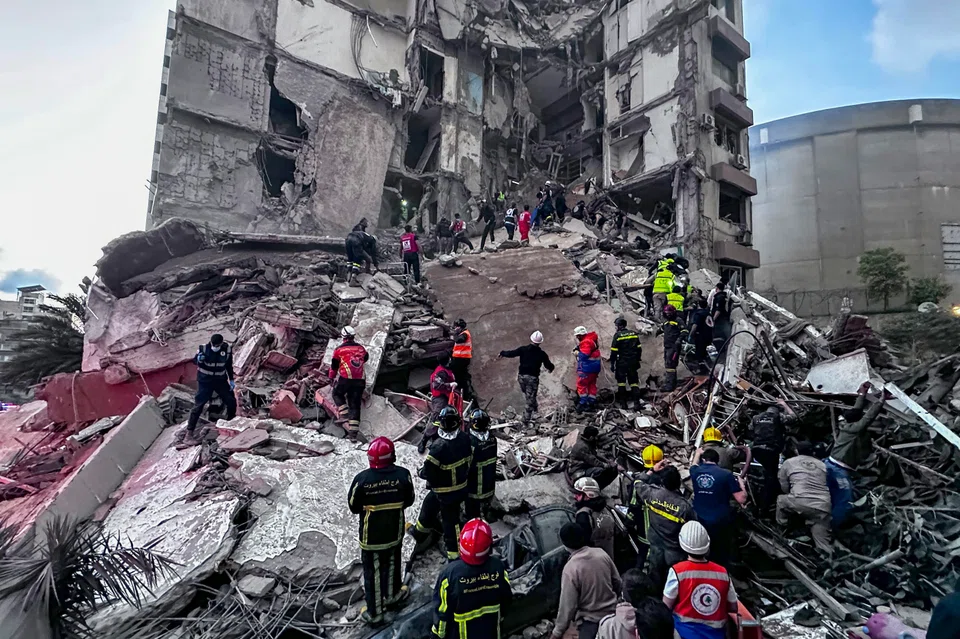
This comes as Israel pounded Lebanon with its heaviest strikes yet on Wednesday, killing hundreds of people and drawing a threat of retaliation from Iran, which suggested it would be “unreasonable” to proceed with talks to forge a permanent peace deal with the US.
The warning from Iran’s lead negotiator, parliament speaker Mohammed Bager Qalibaf, laid bare the continued volatility in the region following Tuesday’s ceasefire announcement by Trump.
Differences in interpretation of truce
Washington and Teheran have laid out sharply contrasting agendas for peace talks set to start on Saturday, but it was unclear whether the two-week ceasefire would hold until then.
Qalibaf said Israel had already violated several conditions of that ceasefire by ramping up its parallel war against the Iran-aligned militia Hezbollah, while the US had violated the agreement by insisting that Iran abandon its nuclear ambitions.
“In such a situation, a bilateral ceasefire or negotiations were unreasonable,” he said in a statement.
Israel and the US both said the two-week ceasefire did not cover Lebanon, and Israeli Prime Minister Benjamin Netanyahu said the strikes would continue.
SEE ALSO

“I think the Iranians thought that the ceasefire included Lebanon, and it just didn’t,” US Vice-President JD Vance, who will lead the US delegation, told reporters in Budapest.
The two sides appeared to be far apart on Iran’s nuclear programme as well - one of the factors that Trump cited as the basis for war.
Trump said Iran had agreed to stop enriching uranium, which can be turned into nuclear weapons, and the White House said Iran has indicated it would turn over its existing stocks.
“The United States will, working with Iran, dig up and remove all of the deeply buried ... Nuclear ‘Dust’,” Trump said on social media.
Qalibaf, however, said it was allowed to continue enriching uranium under the terms of the ceasefire.
Though both the US and Iran declared victory in a five-week-old war that has killed thousands, their core disputes remained unresolved.
Each side is sticking to competing demands for a deal that could shape the Middle East for generations.
Despite the uncertainty, world stock indexes surged while oil prices plunged 14 per cent to settle near US$95 per barrel, after falling as low as US$90.40.
Benchmark Brent crude remains roughly US$25 higher than before the joint US-Israel attacks began.
Teheran’s newly demonstrated ability to cut off Gulf energy supplies through its grip on the strait, despite decades of massive US military investment in the region, shows how the conflict has already altered power dynamics in the Gulf.
‘Finger on the trigger’
Meanwhile, Netanyahu said Israel had its “finger on the trigger” and was prepared to return to fighting at “any moment.”
Lebanon’s civil defence service said 254 people had been killed in Israel’s strikes across Lebanon on Wednesday.
The highest toll was in the capital Beirut, where Israeli strikes killed 91 people, it said.
Residents said some of the Israeli strikes had come without the usual warnings for civilians to evacuate.
Hezbollah, the Iran-backed militant group in Lebanon, said early Thursday that it fired rockets at northern Israel in response to “ceasefire violations.”
French President Emmanuel Macron condemned “in the strongest possible terms” what he called indiscriminate Israeli attacks on Lebanon, saying in a statement on X that Lebanon “must be fully covered” by the ceasefire.
Leaders of 13 European countries, Japan and Canada also issued a joint statement welcoming the ceasefire and calling for a swift end to hostilities in order to “avert a severe global energy crisis.”
Iran also struck oil facilities in nearby Gulf countries, including a pipeline in Saudi Arabia that has been used to bypass the blockaded Strait of Hormuz, according to an oil industry source.
Kuwait, Bahrain and the UAE also reported missile and drone strikes.
The Strait of Hormuz remained shut to vessels sailing without a permit and shippers said they needed more clarity before resuming transit.
Iran’s Revolutionary Guards navy posted a map showing alternative shipping routes in the Strait of Hormuz to help ships avoid naval mines, the semi-official Iranian news agency ISNA said.
In a flurry of online posts, Trump announced new tariffs of 50 per cent on all goods from any country that supplies arms to Iran, though he lacks the authority to do so.
Iran’s ruling establishment survives
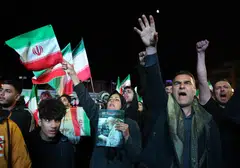
Crowds took to the streets of Iran overnight to celebrate, waving Iranian flags and burning those of the US and Israel.
But there was also wariness that a deal would not hold.
“Israel will not allow diplomacy to work and Trump might change his view tomorrow. But at least we can sleep tonight without strikes,” Alireza, 29, a government employee in Teheran, told Reuters by phone.
The war was launched on Feb 28 by Trump and Netanyahu, who said they aimed to prevent Iran from projecting force beyond its borders, end its nuclear programme and create conditions for Iranians to topple their rulers.
US Defence Secretary Pete Hegseth on Wednesday said Washington had won a decisive military victory.
But so far, Iran retains both its stockpile of near-weapons-grade highly enriched uranium and its ability to hit its neighbours with missiles and drones.
The clerical leadership, which faced mass protests months ago, has withstood the superpower onslaught with no sign of internal collapse. REUTERS
Decoding Asia newsletter: your guide to navigating Asia in a new global order. Sign up here to get Decoding Asia newsletter. Delivered to your inbox. Free.
Share with us your feedback on BT's products and services
TRENDING NOW

LTA proposes combining car COE categories, adding rebate-surcharge system

StarHub to acquire MyRepublic’s mobile business amid ongoing telco consolidation

DBS, OCBC, UOB rout lops billions off STI as inflation, rate concerns spook investors

Grab CEO’s wife Chloe Tong on life with Anthony Tan and finding her purpose

