A shortage of used cooking oil threatens green aviation. Could these Singapore projects help?

Two Aster-related ventures look at alternative feedstocks, but could face various challenges

Summarise
Sharanya Pillai
Published Wed, Mar 4, 2026 · 09:17 AM
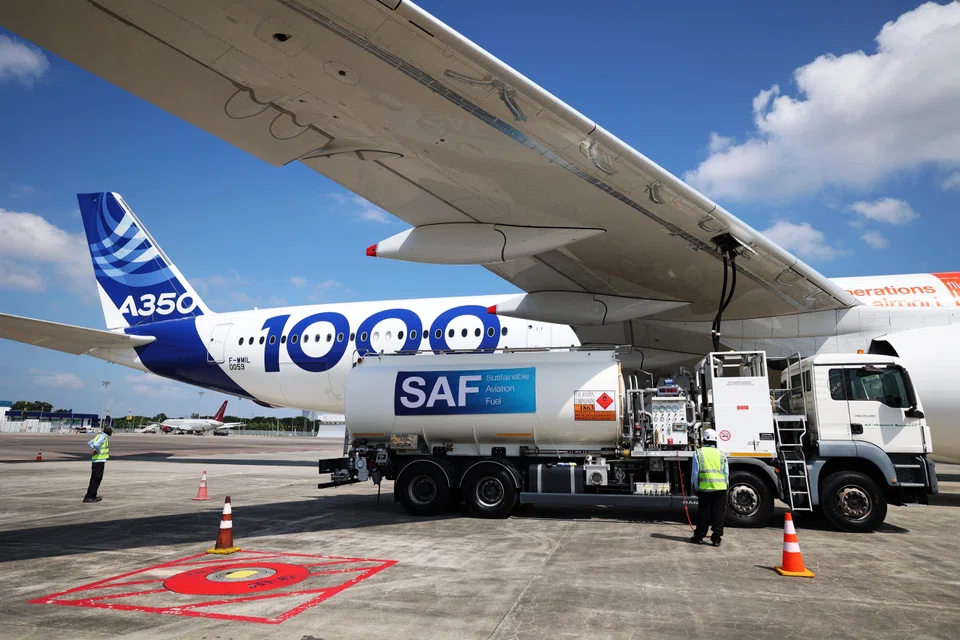
    • Despite industry scepticism over sustainable aviation fuel, trends in Asia are promising, with more governments introducing mandates for green aviation.
    • Despite industry scepticism over sustainable aviation fuel, trends in Asia are promising, with more governments introducing mandates for green aviation. PHOTO: BT FILE

    [SINGAPORE] Green fuel for airplanes has a take-off problem: The raw material commonly used for its production, used cooking oil (UCO), faces supply bottlenecks, while fraud risks abound in the market.

    This is spurring a race for alternative means of making sustainable aviation fuel, with two new efforts in Singapore.

    In January, refiner Aster and asset manager Keppel announced that they are exploring the development of a plant on Jurong Island to produce up to 100,000 tonnes of sustainable aviation fuel a year.

    Separately, Aster and startup Aether Fuels are building another facility to produce green jet fuel on Pulau Bukom, where Aster took over Shell’s refinery last year. The plant is expected to produce 1,600 tonnes of the fuel a year and 400 tonnes of sustainable naphtha.

    Notably, neither project taps UCO or other fat sources – a production method known as hydroprocessed esters and fatty acids (Hefa). Instead, they seek to produce sustainable aviation fuel with alternative methods.

    The Jurong Island project – if it proceeds – would tap low-carbon ethanol as a feedstock, making it one of the first commercial plants in Asia for so-called “ethanol-to-jet” (EtJ) fuel.

    Meanwhile, the Pulau Bukom plant would convert industrial waste gases and biomethane – a gas fuel derived from waste – into sustainable aviation fuel. It would use an enhanced form of the Fischer-Tropsch (FT) process, which involves a series of chemical reactions.

    With these projects, Aster “aims to strengthen supply chain resilience, diversify feedstock options, and support Singapore’s ambition to be a regional leader in sustainable aviation fuels”, said Rachel Kwan, its general manager for low-carbon solutions and the circular economy.

    The ambition is massive. Both the EtJ and FT methods of production are still nascent; they also require high costs and risk appetite. The world’s first commercial EtJ plant only began operations in November 2025 in the US, after several delays.

    Hefa-based green jet fuel is already pricey, costing between two and five times regular jet fuel. Non-Hefa variants are likely to be even more expensive.

    The unfolding Iran conflict also adds more uncertainty to prices. On Friday (Mar 6), Aster declared force majeure regarding supplies, citing the disruption in raw materials amid the crisis.

    Chua Wei Jun, principal analyst for biofuels at S&P Global Energy, said that the “major hurdle would be to bring production costs down to a level consumers can stomach at volume”.

    UCO problems

    That said, the impetus to develop UCO alternatives is strong.

    While Asia-Pacific is projected to have an oversupply of sustainable aviation fuel this year, there is a limited supply of UCO to scale up production in the long term, said Jade Patterson, renewable fuels specialist at BloombergNEF.

    “UCO is a waste product and not purpose-made to produce biofuels,” he explained. “Therefore, UCO supply is inelastic with biofuel demand – supply doesn’t increase with price.”

    Chua of S&P Global Energy noted that there are also concerns about the quality of UCO and fraudulent acts, such as the dumping of cooking oil.

    Patterson sees potential in the EtJ method. Ethanol is used as a road fuel in markets such as Brazil and the United States, but BloombergNEF projects that global road fuel demand is set to decline 48 per cent from 2024 to 2050.

    This could bring down demand for ethanol as a road fuel and free up a large amount to be converted to sustainable aviation fuel, Patterson pointed out. He expects that the Americas will lead on the EtJ pathway as most ethanol is already concentrated in that region.

    The ethanol would also ideally have to be made from renewable feedstock, rather than food crops such as corn and sugarcane. Chua noted that the latter could stir debates over food sustainability.

    Asia could instead become a hub for green jet fuel made with the FT process, as this requires large amounts of clean hydrogen. BloombergNEF found that Asia has the lowest costs of green hydrogen production due to its “robust” market for electrolysers – systems that can extract hydrogen from water.

    Lars Klesse, a biofuels research analyst at Rystad Energy, said that projects that use industrial waste gases, such as the Pulau Bukom one, also have an upside: They can be integrated into an existing industrial hub with steady streams and good infrastructure.

    “The challenge is that eligibility and life-cycle emissions treatment can be complicated, especially if the gases are fossil-derived, and the process is more complex than Hefa,” he added.

    Building investor confidence is another sizeable challenge, but Lim Wen Bin, partner for infrastructure advisory at KPMG, reckons that such issues are “surmountable”.

    “As with any emerging technology, continued optimisation and commercial scaling will be important… and early projects in this area are paving the way for wider adoption across the region,” he said. “The long-term potential for this pathway is highly encouraging.”

    Pie in the sky?

    These bets come amid plenty of industry scepticism over sustainable aviation fuel.

    Aengus Kelly, the head of aviation leasing giant AerCap, recently dismissed the 2050 target to decarbonise flying as “pie in the sky”, claiming that no one would pay the extra costs for green jet fuel.

    However, trends in Asia are promising, as more governments introduce mandates for green aviation. For instance, Singapore aims for 1 per cent of all jet fuel used at Changi and Seletar airports in 2026 to be green, with the target rising to 3 to 5 per cent by 2030.

    Chua noted that Thailand also has a 1 per cent blending target, while Malaysia plans to roll out pilot programmes for flights out of Kuala Lumpur International Airport.

    With mandates and pilots, Asia is expected to demand 270,000 tonnes of sustainable aviation fuel in 2026, he added.

    Sanjeev Gupta, Asean and Singapore energy leader at EY-Parthenon, said that East Asia is scaling up, but has not yet reached its “long-term demand potential” with sustainable aviation fuel. “In addition, airlines in the Middle East and South Asia continue to rely heavily on imports due to limited domestic production capabilities.”

    Oversupply could narrow

    The current oversupply of sustainable aviation fuel in Asia comes as China released a 2026 export quota of 1.4 million tonnes. Neste’s plant in Singapore, meanwhile, has a nameplate capacity of one million tonnes.

    But supply could be more constrained in the future. “The wider Asian picture is tighter,” said Rystad’s Klesse. “More countries are progressing toward sustainable aviation fuel uptake, policy ambition can rise, and demand outside the headline mandated markets starts to increase.”

    Rising European demand will also add to competition for sustainable aviation fuel and its feedstock in the Asian market, he noted.

    Gupta of EY-Parthenon said that ultimately, the success of new sustainable aviation production facilities in South-east Asia “largely depends on offtake agreements and the clarity of government policies”. He pointed out that Europe’s ReFuelEU mandates for green jet fuel, which provide guaranteed offtake and premium pricing, can make Asian EtJ and FT projects more financeable.

    Certification frameworks, such as that of the International Civil Aviation Organisation, are also helping to reduce regulatory and technical challenges for non-Hefa production, allowing broader adoption, he added.

    With multiple pathways, fuel producers can tap multiple feedstock sources – biomass, waste, renewable electricity and industrial by-products – which Lim of KPMG said “strengthens supply security and supports long-term scalability”. He added: “As technology costs continue to decline, and policy frameworks evolve, these pathways are poised to play an increasingly important role in shaping the region’s sustainable aviation fuel future.”