

Singapore’s hunt for AI stars risks alienating small players
The government is going well beyond the US$700 million it has committed to artificial intelligence research

[SINGAPORE] As the AI race heats up, Singapore is trying to recreate the magic of Block71, the startup hub that gave rise to home-grown tech darlings such as Carousell, 99.co and Carro.
In March, JTC – the government-linked real estate developer behind Block71 – unveiled plans to build an AI-focused startup community dubbed “Kampong AI”. The name is an ode to the community spirit of early village settlements of the 1950s.
Slated for 2028, the area will have a living and working block that will house up to 70 companies and 200 residential units. Singapore’s Minister of State for Trade and Industry and National Development Alvin Tan called it “Singapore’s hub and home for AI” and said the project will let “AI founders and tech professionals live and work together, creating spontaneity”.
However, this premise rests on a leap: that today’s AI startups need the same kind of proximity and chance encounters that fuelled consumer tech firms in the 2010s.
And even if that holds, affordable rental costs and well-designed workspaces alone won’t be enough to draw the AI talent Singapore is chasing.
Singapore has committed over US$700 million to AI research, and leading frontier labs such as Yann LeCun’s Advanced Machine Intelligence Labs are already here on the island. But the government isn’t stopping there.
Starting in 2027, the Singapore government will also offer a new AI visa track under the existing One Pass that is designed to draw AI and tech talent.
The visa has more flexible terms than other pass options and doesn’t have to be tied to a job offer. It also takes into account a candidate’s cash as well as share components when assessing if they meet the minimum salary requirements.
Yet, Tech in Asia’s interviews with more than half a dozen founders, corporate leaders, investors and AI researchers point to a deeper tension: There is a gulf between what AI operators need and the kind of talent such passes cater to.
While many welcomed the latest push, several questioned whether it targets the industry’s real bottlenecks.
Chasing big tech talent
A local AI research lead, who asked to remain anonymous, said that the AI pass is likely to attract those “interested in building organisations similar to OpenAI or Anthropic”. These individuals may have several years of experience at Big Tech firms in the US and are looking to apply their skills elsewhere.
With limited GPU resources compared to countries like the US and China in developing frontier AI models, attracting individuals with the relevant expertise could benefit local AI researchers through knowledge transfer, the research lead added.
Because the new AI visa is not tied to a job offer like regular employment passes are, this could, in theory, give talent the flexibility to explore Singapore as a potential base.
That flexibility aligns with how some global AI leaders already view the city. LeCun, the former chief AI scientist at Meta, described Singapore as an “important” base.
“We have quite a lot of links in Singapore, and partners here and in Asia generally. The talent pool is great, too,” LeCun told The Straits Times in March.
His venture, AMI Labs, which counts Temasek and Sea Group among its seed round backers, currently has four employees in Singapore and aims to increase its headcount to 20 in the coming year.
A similar logic may underlie moves like Manus’. The AI company, which was acquired by Meta in a deal valuing it at over US$2 billion, also likely had other top-of-mind considerations when it chose to relocate its headquarters from China to Singapore in mid-2025, when US-China tensions were escalating.
Rather than senior talent, some think it’s C-suite executives from Big Tech firms in the US – and in China – who might use the pass to come to Singapore.
“It’s a good move to try to attract talent… if somebody is looking for an alternative, a stable place to live and to build a career and bring their families along… Singapore is a great place,” noted Wi Lex Tan, associate director at local VC firm Lion X Ventures.
To Tan, attracting such workers will play an important role in building Singapore’s second and third generations of entrepreneurs, though he questions how significant knowledge transfer could be from “just a few people coming over”, he said.
For smaller players, talent isn’t cheap
If frontier labs in Singapore can already recruit top hires, it’s not obvious whether One Pass’ new track will benefit smaller startups.
Some 8,000 individuals currently hold the One Pass, which was first introduced in 2023, according to Manpower Minister Tan See Leng. The Ministry of Manpower has said it does not expect a large number of applicants for the AI and tech track, given the high qualifying threshold.
Among other criteria – such as five years of cumulative experience for founders, C-level executives, or technical professionals – applicants must have earned at least S$30,000 a month in the past year to qualify.
While that’s modest compared to the staggering amounts big tech firms such as Meta offer to recruit AI workers, it’s an eye-watering amount for early-stage companies.
For AI startup Axium Industries, it doesn’t expect to benefit from the One Pass in the short term, even though it’s actively hiring and expanding its team. With around 20 in the team currently, Axium Industries expects to roughly double the headcount across its Singapore, Malaysia, and Thailand offices by the end of the year.
“Definitely, there is AI talent here in Singapore. It’s whether companies can afford that,” said co-founder and CEO Jeremy Ang.
This year, Ang and his other co-founder, Tobias Leong, are setting out to build an AI research and development lab in Singapore. The project, however, is taking longer than expected, as finding the right government stakeholders to speak to on obtaining grants and other support has been a challenge.
The company currently runs its research in-house but is hoping to accelerate this by collaborating with universities and academic institutions to publish proprietary research on agentic AI use cases.
In the meantime, with clients waiting and projects on the line, Axium is prioritising revenue. “We just didn’t want to waste our time,” Ang said.
The firm has crossed seven figures in annual recurring revenue, a forward-looking metric based on annualising January’s performance, and is now net profitable.
Meanwhile, even larger multicorporations that can afford to hire staff on these salaries don’t necessarily need another pass either.
“Because we are a fairly sizeable MNC, we ourselves don’t need to utilise this sort of programme,” Tianyi Jiang, CEO and co-founder of SGX-listed AvePoint, told Tech in Asia.
The US-based company made close to US$420 million in revenue last year and considers Singapore one of its major innovation hubs.
“We have no problem sponsoring expertise… when we get senior resources, which this visa is tailored towards, we’re able to get EPs (employment passes),” Jiang explained.
AvePoint plans to increase its headcount to 500 employees in Singapore in the next three years, from under 300 currently.
AI builders or just researchers?
Without access to cheap computing power, abundant electricity, and land, some believe Singapore may struggle to build a frontier AI company. “But there’s a chance we can build a highly profitable AI application company,” said Tan of Lion X Ventures.
That view is shaping where capital is going. The firm this month co-raised US$90 million – of a US$200 million target – for a new global tech fund with Empyrean Sky Partners seeking opportunities in areas like robotics and smart devices. The fund counts Dreame Technology, a China-based smart-home appliances manufacturer, as a partner.
The focus on applications also underscores a shift in hiring priorities.
While policymakers have emphasised attracting top AI researchers, startups say that alone isn’t enough. They need operators, people with deep domain expertise and a clear understanding of local market dynamics.
One example is forward-deployed engineers – a role currently in high demand, which involves working closely with customers to embed, customise, and deploy solutions.
“You don’t need the entire team to be PhD-level AI researchers, but you need a healthy mix of engineers who know enough about what is out there, read research papers, and be able to apply that to a company’s problems,” Leong of Axium Industries said.
Likewise, Chopra of Addlly AI said the firm’s priority in the next 12 months is building execution-heavy teams in markets such as Singapore, Australia, New Zealand and India, with people who have a strong understanding of local systems.
“In a team with leading tech, you need only one or two people to strategise,” she said. “But you need many more who can execute and deliver.”
The local AI researcher quoted above is cautious against such a limiting view, however.
“The broader AI ecosystem appears to be signalling a preference to focus on applying and using AI, rather than competing at the frontier level. In my view, it remains important to maintain the capability to develop AI, even if the primary role is as a practitioner,” the person added.
Maintaining the spirit of Block71
It’s too early to judge whether a startup community such as Kampong AI or a new pass for AI talent will pay off. But dismissing them outright would be premature.
Even today, Block71 continues to deliver pockets of success.
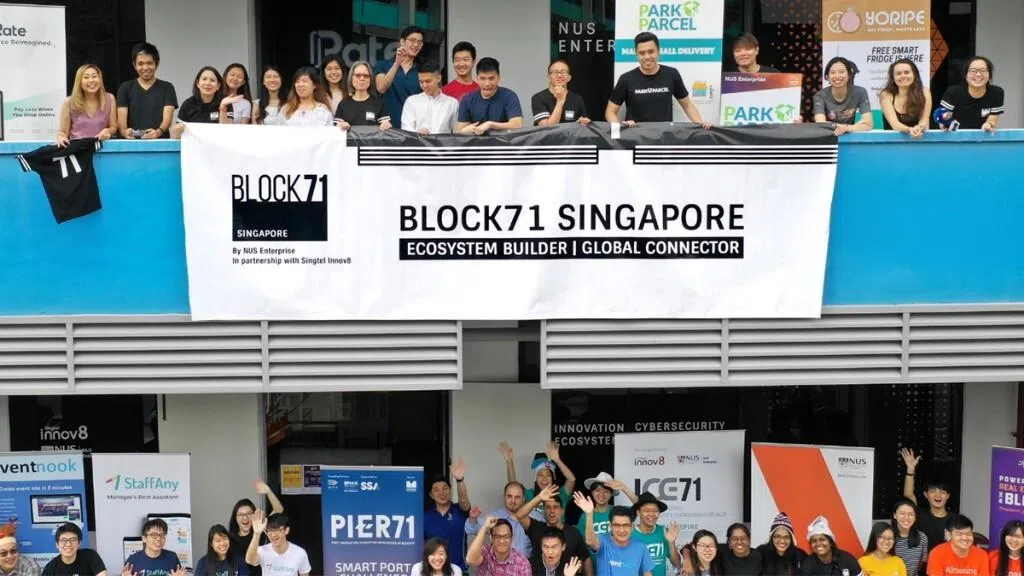
Several portfolio companies and partners of JRE Ventures, the corporate venture capital arm of Japanese railway company JR East, are located a stone’s throw away from its office at Block 81, and that’s by no means a coincidence. One of them is H3 Zoom, which develops AI-powered inspection software for building exteriors.
The concentration of tech companies and investors in the area makes LaunchPad – the seven blocks in one-north, including Block71 – “a great place to be,” Junichi Eto, JRE Venture’s managing partner, told Tech in Asia. Kampong AI will eventually be situated within the cluster.
“I think casual conversation and frequent conversation (are) a very essential part for business expansion,” he added, particularly as a firm with a Japan-based stakeholder that values face time.
Chopra from Addlly AI also remains optimistic.
“When top talent comes to Singapore, startups like us get an opportunity to be mentored… they evangelise the cause and can open doors for the whole industry,” she noted. “If the tide is rising, we can benefit as well.” TECH IN ASIA
TRENDING NOW

Philippine power giant First Gen rebuffs foreign offers, plans up to US$2.6 billion in expansion
Cliff Tan has 7 million followers and a 4-month waitlist. Why won’t he expand his business?

Could stablecoins be the future of money?
From finance aspirant to Asean CEO: TUV SUD’s Jonas Strahberger on finding people who believe in you

