Singapore’s national accountancy body builds lower-cost regional route for smaller firms
Isca is using partner firms and shared infrastructure to lower the barriers to overseas expansion

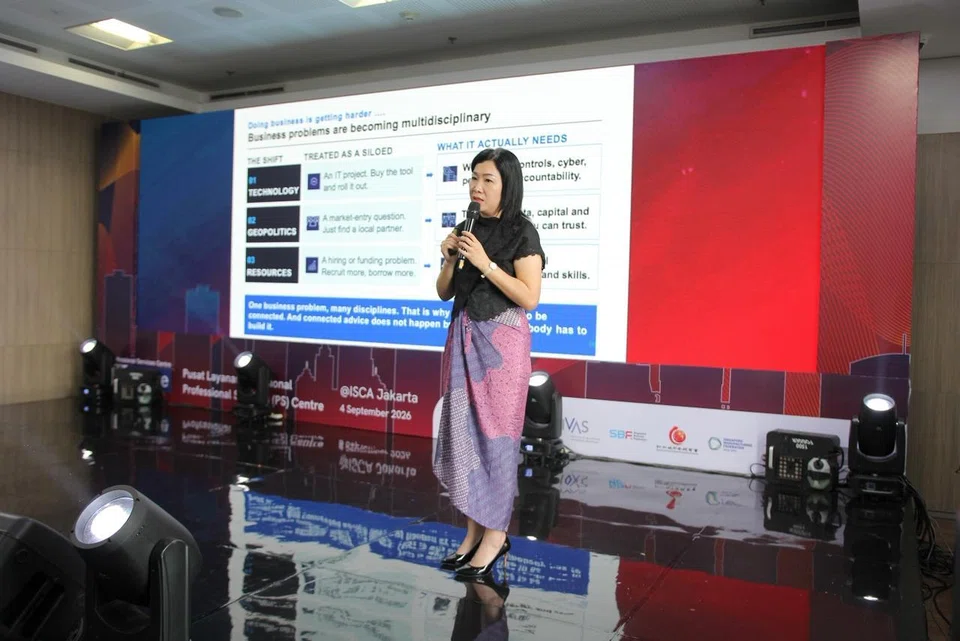
[JAKARTA] Singapore’s smaller accounting firms could expand across Asia without bearing the cost of building and maintaining their own overseas offices, under a partnership model led by the Institute of Singapore Chartered Accountants (Isca).
Instead of replicating local teams, regulatory expertise and business networks country by country, firms can tap partners through a growing Professional Services Centre (PSC) network.
The Singapore firm brings capabilities it already has at home, while its overseas partner handles work requiring local expertise, relationships or regulated services.
“In the past, bigger firms like the Big Four had the infrastructure and the network, but this has never really been an opportunity for smaller firms,” Isca CEO Fann Kor told The Business Times in Jakarta, on the sidelines of the launch of the centre on Friday (Sep 4).
“What we are trying to do is set up the infrastructure so smaller firms can also tap the network that Isca and our alliance partners have put together, and consider internationalisation as well.”
For a small and medium-sized practice, that means avoiding the fixed costs of establishing its own physical presence and building a local network from scratch each time it follows a client abroad.
Kor cited an emerging arrangement between Singapore and Chinese accounting firms as an example: when a Chinese client enters Singapore, the Singapore partner can handle regulated services such as audit; when a Singapore client enters China, the Chinese partner takes on the regulated work there.
The payoff could include access to “a bigger market, a more dynamic market” and a wider pool of talent, she added.
The push reflects a broader question facing Singapore’s accountancy profession as more clients venture abroad.
“When Singapore businesses internationalise, can professional services stay in Singapore? The answer is, usually, you can’t,” Kor said.
Rather than measure Isca’s internationalisation by the number of overseas offices it opens or revenue generated abroad, she noted that the body is looking at the professional services corridors it helps create, the capabilities Singapore can export and how widely the CA (Singapore) qualification and Singapore-developed programmes are recognised.
No numerical targets have been set yet.
“We’re not internationalising Isca for the sake of collecting overseas offices,” Kor said. “We are internationalising the usefulness of Singapore’s accountancy profession.”
Building the network
The PSC network is one of the main pieces of infrastructure behind that ambition.
Its new Jakarta centre, launched before about 150 attendees at Cyber 2 Tower, joins centres in Singapore, Ho Chi Minh City, Nanjing and Hongqiao in Shanghai. Johor, Shenzhen and Bangkok are among the next locations being developed.
Across its existing locations, the network has facilitated more than 90 business connections, supported 100 companies and engaged over 700 businesses and professionals.
The PSC Alliance comprises eight Singapore organisations – including Isca – spanning accountancy, law, tax, valuation, manufacturing and business, and works with local professional groups in each market.
Kor noted that the willingness of local firms to join the network itself helps identify counterparts with an appetite and capacity for cross-border work, cutting some of the legwork Singapore firms would otherwise have to do when looking for partners overseas.
Indonesia is an “obvious choice” given its large population, economic growth and deep investment links with Singapore, she added.
Kor sees stronger opportunities there in advisory and consulting, rather than audit. The Jakarta network has already generated three to four leads, even before it formally got under way.
Exporting Singapore know-how
Isca’s regional push also involves taking professional capabilities developed in Singapore and adapting them for other markets.
Its artificial intelligence training content has been translated into Chinese, Thai and Vietnamese, with Bahasa Indonesia the latest addition. Isca is now speaking with Indonesian counterparts about using the material to train students and professionals there.
Kor said that its model is to develop and test content in Singapore, then translate it and run local workshops adapted to local conditions and pricing.
Audit methodology is another example. Isca has shared its regularly updated audit manual with counterparts in Vietnam, Indonesia and Cambodia. In Vietnam, it has been translated into Vietnamese and is being used by smaller firms. The material is provided at no charge, on the condition that overseas counterparts also make it freely available to their members.
Kor acknowledged that exporting such programmes could eventually generate revenue, but said commercial returns were not the main objective. “That is an opportunity, but it is not our main priority,” she stressed.