

Spain’s Sanchez calls snap election after housing plan fails
The housing crunch, the government’s fragile parliamentary position and corruption scandals have pushed him to the brink
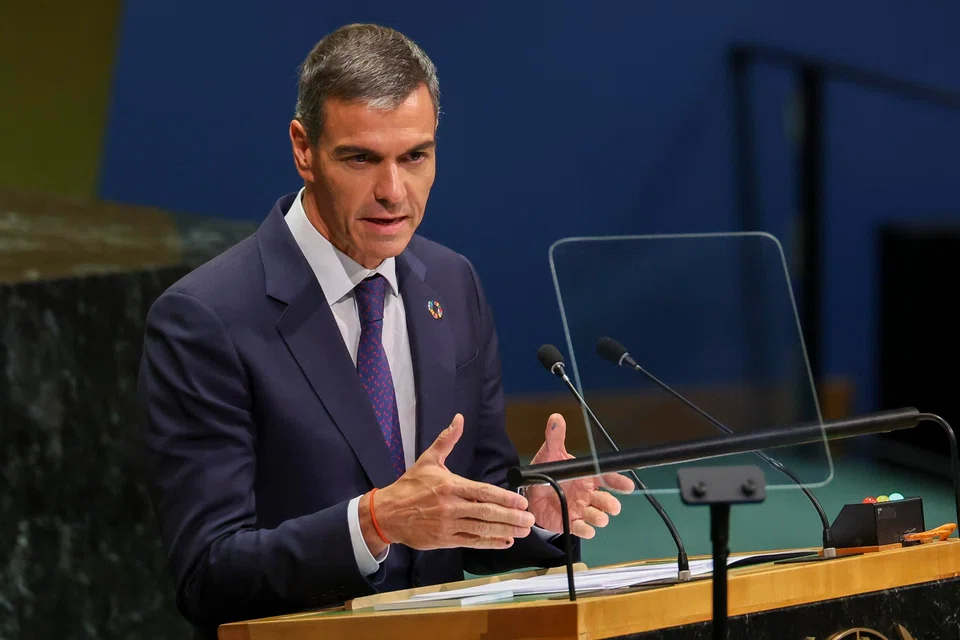
[MADRID] Spanish Prime Minister Pedro Sanchez called an early election for Nov 29 after parliament rejected a housing plan last week that his government had hoped would quell mounting social protests.
“It’s time you, the Spanish people, decide which future you want for yourselves and for the country,” Sanchez, 54, said in an address on Monday (Oct 5) in Madrid. “You must decide what role you wish to play in this era, and what role you want Spain to play.”
Sanchez’s minority government, already struggling after a series of mishaps including deadly floods and a migration crisis, was recently confronted with nationwide protests over housing costs. The situation boiled over after an 87-year-old woman with a disability was evicted from her apartment, galvanising the movement.
The government responded with an emergency package of housing measures that ultimately failed to generate sufficient votes in parliament.
The centre-right People’s Party (PP) has led recent polls, garnering 33.9 per cent support in a SocioMétrica poll conducted over Sept 24-26 with 1,200 respondents.
The PP’s leader, Alberto Núñez Feijóo, has indicated his party could govern with the radical-right Vox, which had 18 per cent in the survey. Sanchez’s Socialists polled at 25.7 per cent.
“We are ready,” Feijóo said on Friday after the housing plan was defeated. “We can’t continue down the path we’re on.”
The yield on benchmark 10-year Spanish government bonds was little changed at 4.08 per cent, while their spread over safer German debt widened three basis points to 65 basis points as some investors looked to German bonds as a safer alternative.
The euro fell 0.5 per cent to 1.1197. General concerns about fiscal and political risks in the eurozone have pressured the region’s currency and bonds, and the latest announcement from Madrid underscored those concerns.

Sanchez came to power in 2018 and, without a stable parliamentary majority, has spent much of his tenure navigating a succession of crises. They included the Covid-19 pandemic, the fallout from Russia’s invasion of Ukraine, deadly floods in the Valencia region and an unprecedented European blackout last year.
His latest term, which began in 2023 and had been due to run until July 2027, has been particularly difficult. Sanchez has failed to pass a single Budget, while corruption cases involving his party as well as his family have multiplied.
The arrival of about 80,000 undocumented migrants this summer in Ceuta, a Spanish exclave in North Africa, fuelled a fresh wave of social discontent.
Sanchez’s housing proposal sought to freeze rents, make rental contracts indefinite, prohibit the eviction of vulnerable people and regulate short-term tourist apartments. Opposition parties, including the Catalan group Junts, which backed Sanchez’s return to office in 2023, argued that greater intervention in the housing market would only worsen the problem.
The PP already governs most of Spain’s biggest cities and regions, often relying on Vox. The two parties govern together in four regions, including Andalusia, the country’s most populous.
Both have made removing Sanchez from office a central priority. While they differ on migration, Spain’s territorial model and Europe, they have signalled a willingness to work together if they secure enough seats to replace the last social democratic government in a major European Union country.
Sanchez’s lack of parliamentary support contrasts with Spain’s strong economic performance. The country has posted the fastest growth among Europe’s major economies, unemployment is at its lowest since the financial crisis and tourism is booming.
Still, the housing crunch, the government’s fragile parliamentary position and corruption scandals have pushed Sanchez to the brink. Voters will now decide what comes next.
During his speech, Sanchez criticised the far right, warning against handing “over the reins of the country to a far-right coalition that has proposed nothing – whose sole objective is to repeal and curtail the rights and freedoms we have built over the last eight years”. BLOOMBERG
Decoding Asia newsletter: your guide to navigating Asia in a new global order. Sign up here to get Decoding Asia newsletter. Delivered to your inbox. Free.
Share with us your feedback on BT's products and services
TRENDING NOW

Government to bring forward raising of retirement age, give employers more financial support to create flexi-load jobs

Former minister Maliki Osman, Revolut chairman join Asia Gulf Holdings advisory board

Is Manila Asia’s new dining hot spot?

Simba at risk of losing operating licence over spectrum misuse

