Sunak, Truss begin 6-week duel to become UK’s next leader
 Add BT as a preferred source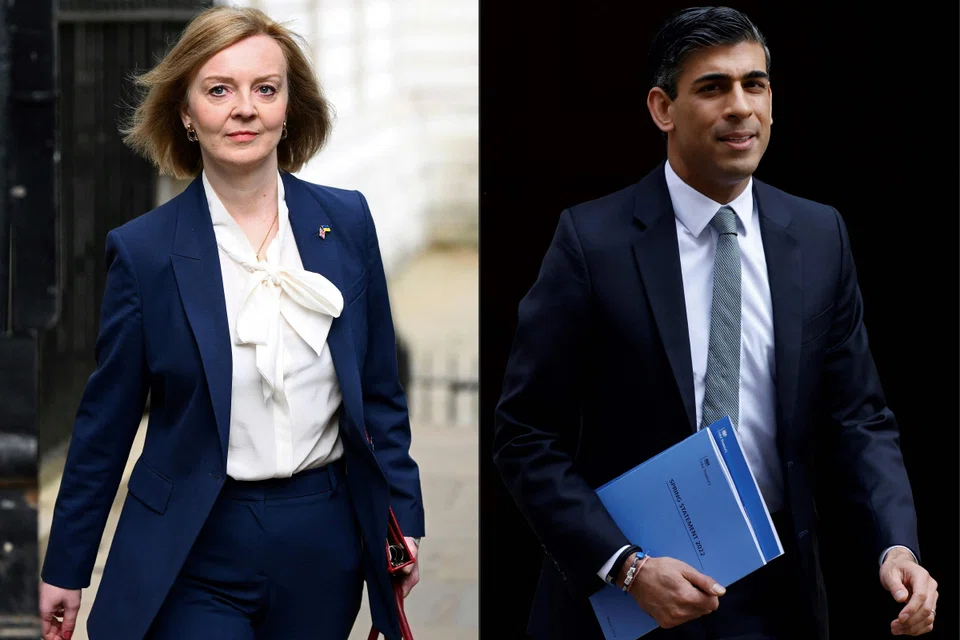
LIZ Truss and Rishi Sunak - the final 2 candidates in the running to become Britain’s next prime minister - are embarking on a gruelling journey around the UK, with just 6 weeks to go until the winner is revealed on Sep 5.
The pair will take part in a TV debate on Monday (Jul 25), followed by the first in a series of 12 hustings in front of members of the Conservative Party on Thursday and a second TV debate on Aug 4. The party’s members will begin voting via post or online at the start of August.
Rishi, the former Chancellor of the Exchequer, and current Foreign Secretary Truss are far apart on how they view Britain’s economic and political crisis, which some observers regard as a poisoned chalice. Their main difference is the level of tax and other economic policies to counter Britain’s high inflation of 9.4 per cent, rising interest rates, low productivity, declining economic growth, massive state and private sector debt, and a sliding pound.
Other key problems they have to address include the National Health Service (NHS), which is way behind in delivering procedures and treatment because of the pandemic; soaring energy costs, the heatwave and storms due to climate change, the housing shortage and climbing mortgage rates. Beyond domestic issues, the UK has spent billions of pounds on military equipment to help Ukraine defend itself against Russia.
There will also be a diplomatic struggle to persuade Russian President Vladimir Putin to end the war, increase the flow of gas and oil to counter the energy crisis for Europe, and ease the shortage of wheat and corn that has contributed to the global inflation surge. Then there are the consequences of Brexit, including labour shortages. A bill that reneges on the Northern Ireland border treaty with the European Union (EU) could bring about punitive EU tariffs on UK exports.
“The problem of the last few years is not that we made the wrong promises, but rather we haven’t delivered on them,” said Rachel Wolf, a former 10 Downing Street adviser and co-author of the Conservative Party’s general election manifesto in 2019.
Truss claims that she will deliver, and do it quickly. She is portraying herself as a “low tax” prime minister with policies similar to those of the late Margaret Thatcher. The early indication is that she is ahead of Sunak at the moment in various polls, and in the odds seen at betting outlets across the UK.
Should Truss become the next prime minister, she plans to hold an emergency budget by the final week of September that would reverse Sunak’s policies when he was Chancellor. These include a 1.25 percentage point rise in national insurance and a planned increase in corporate tax from 19 per cent to 25 per cent next year. She also intends to cut energy bills by freezing green levies.
But even as she promises to simplify Britain’s complicated tax system and announce a three-year spending review, she has expressed her desire to raise defence spending from the current 2 per cent of gross domestic product to 3 per cent.

She campaigned to remain in the EU during the 2016 referendum, but has become a born-again Brexiteer, according to MPs on the right of the party. A key policy would be to ditch EU regulations and import controls. Truss also pledges to follow the 2019 Tory manifesto and build 40 hospitals and expand doctor services.
Sunak, on the other hand, contends that Truss’ tax cuts would cost £30 billion (S$50 billion). Since the government would have to borrow heavily, he said this will boost already high inflation, causing higher interest rates and worsening the economic slowdown.
He is only prepared to cut tax if inflation is falling and the economy is growing at a reasonable pace. He says that he has already introduced “free ports” that have boosted investment and jobs. Businesses that invest will effectively reduce tax.
Sunak insists that Britain is facing a “national emergency” and he would put the nation on a “crisis footing”. He will, for example, institute a taskforce dedicated to tackling NHS backlogs. . The aim of the 2 candidates is to get the majority of votes from around 200,000 Tory members, accounting for 0.4 per cent of the electorate. More than 50 per cent of the members are over the age of 50 and almost two thirds are men, according to a London University study. Moreover, over 80 per cent of members are in higher income groups.
Since their votes cannot be regarded as the overall opinion of the electorate, whoever takes over from the disgraced Boris Johnson on Sep 5 will have a heavy responsibility to win over the masses in the lead-up to the next general election in 2024.
Decoding Asia newsletter: your guide to navigating Asia in a new global order. Sign up here to get Decoding Asia newsletter. Delivered to your inbox. Free.
Share with us your feedback on BT's products and services