Trump launches ‘Economic D-Day’ against Iran, threatens its trade partners
His warning of consequences for countries that give the Islamic Republic ‘any type of lifeline’ puts focus on China, which buys Iranian oil
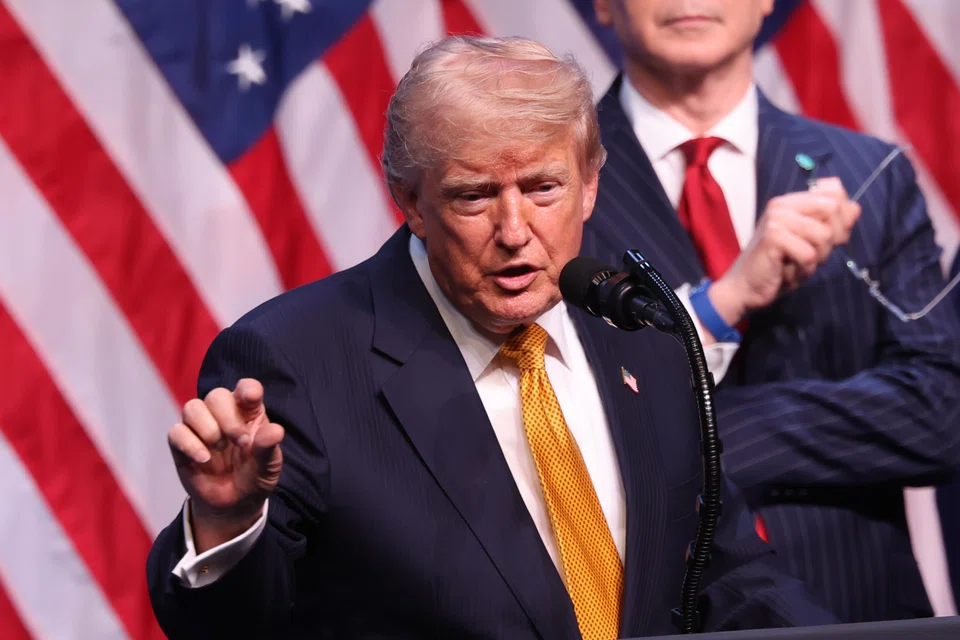
[SAN FRANCISCO] US President Donald Trump announced plans to inflict what he called “an Economic D-Day” against Iran, underscoring his rising frustration with the country’s refusal to capitulate despite weeks of military strikes and a US blockade that has crimped its oil exports.
Trump did not specify what measures he would take but his threat to target Iran’s trading partners, none of which he cited by name, put an immediate focus on China, which buys the bulk of Iran’s oil.
In a social media post, Trump warned that “ANY country that allows its financial institutions, businesses, airports, or government entities to provide any type of lifeline to Iran will itself face TREMENDOUS Economic Consequences”.
He also sought to rally other countries that have so far declined to support his military campaign against Iran, saying the US needs “all of our Allies” to help “isolate, and defeat, the Iran threat”.
Trump’s sentiment followed on the heels of Treasury Secretary Scott Bessent’s warning that the US was prepared to unleash fresh economic measures.
It signalled how the US, beset by munitions shortages, rising costs and an over-extended military, wants to shift away from a military campaign that has so far failed to bring about Iran’s surrender despite eliminating most of the country’s top leaders and devastating its armed forces.
It is not clear what new economic punishment the US could impose, if any, that Iran has not already endured.
Targeting Iranian oil sales would also risk fresh confrontation with China, the buyer of almost all Iranian oil exports.
That would complicate Trump’s bid to extend a tariff truce with Chinese President Xi Jinping, whom he is planning to welcome to the US in September.
“That’s the big red line that Trump is drawing in this post,” Brett Erickson, managing principal at Obsidian Risk Advisors, wrote on X.
“It’s addressed to one country, and one country alone: China. China, far and away is Iran’s economic lifeline.”
Trump got a boost in his campaign a day ago, when the United Arab Emirates severed economic ties with Iran, citing “escalations that undermine regional and international peace and security”.
The UAE has been Iran’s top trade partner in recent years, with Teheran relying on the relationship for access to foreign goods and hard currency.
At the same time, Iran has weathered economic sanctions for decades, and survived the “Maximum Pressure” campaign that Trump brought to bear in his first term after he abandoned an Obama-era deal that put limits on Iran’s nuclear programme.
Trump’s goal is to force Iran into fresh negotiations meant to end the war for good, force Teheran to give up its nuclear programme and release its chokehold on the Strait of Hormuz, along the lines of a memorandum of understanding that the two sides signed in June but that later collapsed amid a flurry of tit-for-tat strikes.
Iran’s response so far to threats has been to make its own economic demands, such as funds for damage inflicted during the war and potential fees for access to the strait.
Oil held four days of gains, with West Texas Intermediate for October trading above US$84 a barrel, while Brent closed near US$92.
Resolving the conflict is increasingly urgent for Trump as he contends with high gas prices, the war’s growing unpopularity and Republican concerns about losing one or both houses of Congress in November’s midterm elections.
Earlier this week, he even threatened to bomb Oman, a US ally that has sometimes played the role of mediator, if it gets in the US’ way.
Iran’s threats against commercial shipping have stifled traffic through the Strait of Hormuz, and a counter-blockade ordered by Trump has severely limited Iran’s own ability to export oil.
The US blockade, damage from the US-Israeli bombing campaign and internal corruption in Iran have spurred nearly 80 per cent inflation and a currency that has lost almost 30 per cent of its value so far in 2026.
Economists have warned that the conflict may drag it into one of the worst economic crises in the history of the nation of 90 million people.
Trump listed examples of aid to Iran that its economic partners should cease, including exchange houses, cash transfers and swap lines, ship registries, front companies and oil smuggling.
The president had earlier shown his impatience with his decision to curtail military drills with South Korea, which he said had been insufficiently supportive of his campaign against Iran. BLOOMBERG
Decoding Asia newsletter: your guide to navigating Asia in a new global order. Sign up here to get Decoding Asia newsletter. Delivered to your inbox. Free.
Share with us your feedback on BT's products and services