Trump wants more tariffs. How are they affecting the US economy?
The levies have been shown to raise the prices consumers pay for imported goods
[WASHINGTON] In the first half of his second term as US president, Donald Trump has made tariffs central to his economic policy.
In midterm elections in early November, in which his Republican Party lost control of both chambers of Congress to the Democrats, exit polls captured deep voter dissatisfaction with tariffs.
The levies have been shown to raise the prices consumers pay for imported goods. Trump is moving to expand them nonetheless.
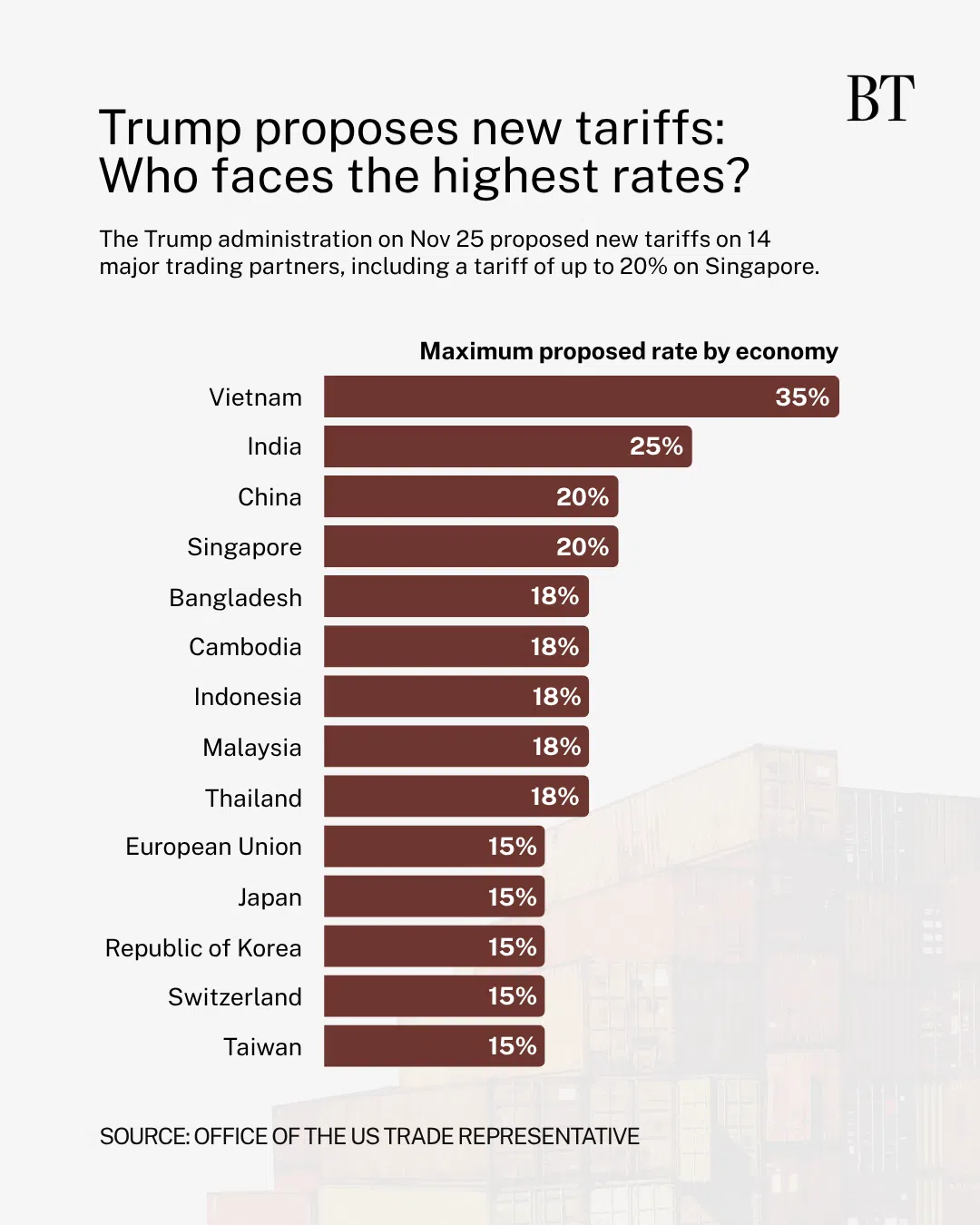
On Wednesday (Nov 25), the Trump administration announced plans to raise tariffs on China, the EU and a dozen other trading partners in response to what US officials say is “structural excess capacity” in manufacturing in those places.
What are the new tariffs the Trump administration announced?
Under the new plan, which is still subject to a public comment process and could change as a result of that or of additional negotiations, the rate for imports from China would rise to 20 per cent.
The same rate would apply to imports from Vietnam, if a trade pact with the US is finalised. Imports from Bangladesh, Cambodia, Indonesia, Malaysia and Thailand would face an 18 per cent tax, and those from India would face a 17 per cent charge if a trade deal with the US is completed.

Products from the EU, Japan, South Korea, Switzerland, and Taiwan would be taxed at 15 per cent, and the rate for imports from Singapore would be 10 per cent. Officials said rates could increase if trade relations deteriorate.
According to a senior US official, the new levies will not stack on top of existing duties of 10 per cent or 12.5 per cent that the Trump administration invoked in July on imports from some 60 economies that supply almost all US imports, accusing them of failing to enforce bans on foreign goods made with forced labour and therefore enjoying an unfair competitive advantage.
For products eligible to be hit by both sets of duties, only the higher rate would apply.
SEE ALSO

The official added that some goods would be exempted from the tariffs, including oil and gas and food products that cannot be grown in the US.
Products that are already subject to tariffs that apply to imports in particular industries or product categories, such as pharmaceuticals, are also exempted.
The new tariffs could be implemented as early as January, the senior official said.
What’s the basis of the new tariffs?
When the Supreme Court invalidated sweeping import duties Trump had imposed citing emergency powers, he first used a different provision – Section 122 of the Trade Act of 1974, to set a flat 10 per cent levy on imports.
Such tariffs are time-limited, however, and Trump’s expired on Jul 24. Since then, he has turned to Section 301 of the same act to replace those tariffs with more durable ones.
Section 301 allows the Office of the US Trade Representative (USTR), under the direction of the president, to impose tariffs in response to other nations’ trade measures it deems discriminatory to American businesses or in violation of US rights under international trade agreements. There is no limit on the tariff rate that can be introduced.
This avenue does not enable an instant rollout of tariffs as the USTR must first conduct an investigation. Section 301 investigations focus on one country, but USTR can conduct parallel reviews of a common concern that relates to multiple countries.
A USTR report released on Jun 2 laid the groundwork for the tariffs based on accusations that trading partners failed to enforce bans on foreign goods made with forced labour.
An investigation launched in March focused on what the USTR calls “structural excess capacity and production in manufacturing sectors”.
In the concluding report, released on Wednesday, United States Trade Representative Jamieson Greer said the offending trading partners had “adopted industrial strategies built on targeting manufacturing, wage and labour suppression, financial and other support, non-market economy inputs, and other market distorting practices that tilt the trade balance in their favour while eroding America’s manufacturing base”.
How have Trump’s tariffs affected consumer prices and the US economy?
Studies by the Federal Reserve Bank of New York and other researchers show tariffs have boosted prices that consumers pay and hurt economic output.
Some economists say the impact has been more muted than they expected, especially after the US Supreme Court struck down most of Trump’s initial tariffs in February and refunds were issued.
The conservative-leaning Tax Foundation estimates that Trump’s tariffs increased taxes by an average of US$1,000 per US household in 2025, before the Supreme Court ruling.
In 2026, it projects, the tariffs will increase taxes by an average of US$820 per US household. The Tax Foundation forecast that the new tariffs will reduce the economy’s long-term capacity by 0.4 per cent.
Have Trump’s tariffs produced the “manufacturing renaissance” the president promised?
There are signs of a manufacturing recovery, but many economists say the higher costs from Trump’s tariffs – especially on imported materials and components companies need to expand in the US – and the uncertainty from ever-changing tariff announcements have chilled hiring and capital investment.
And despite Trump’s repeated insistence that other countries pay the tariffs, most of the higher cost is passed on by US importers to consumers.
Trump often says that investment is pouring into the US from companies that want to avoid tariffs.
But critics have noted that many of the announced investments were tentative, already in the works, and nowhere near the levels Trump has touted.
How did tariffs affect the midterm elections?
Democrats won control of Congress by tapping into voters’ anger over rising prices and diminishing affordability by blaming the high cost of petrol, groceries and other essentials on the Iran war and Trump’s tariffs.
While Trump largely dismissed Americans’ complaints about tariffs, two-thirds of voters in exit polls said the duties have hurt the national economy.
Will Democrats’ control of Congress lead to changes in tariff policy?
Democrats have vowed to roll back Trump’s tariffs, but it is not clear that they will be able to do so. For one thing, Democrats are not united on which tariffs to repeal.
In addition, any legislation aimed at curbing Trump’s tariff powers would need the approval of a two-thirds supermajority of lawmakers in the Senate and the House of Representatives in order to overcome a potential presidential veto. BLOOMBERG
Decoding Asia newsletter: your guide to navigating Asia in a new global order. Sign up here to get Decoding Asia newsletter. Delivered to your inbox. Free.
Share with us your feedback on BT's products and services