

Trump-Xi summit: The meeting is the message, says former US envoy
There is hope that the relationship will not go off the rails, he adds
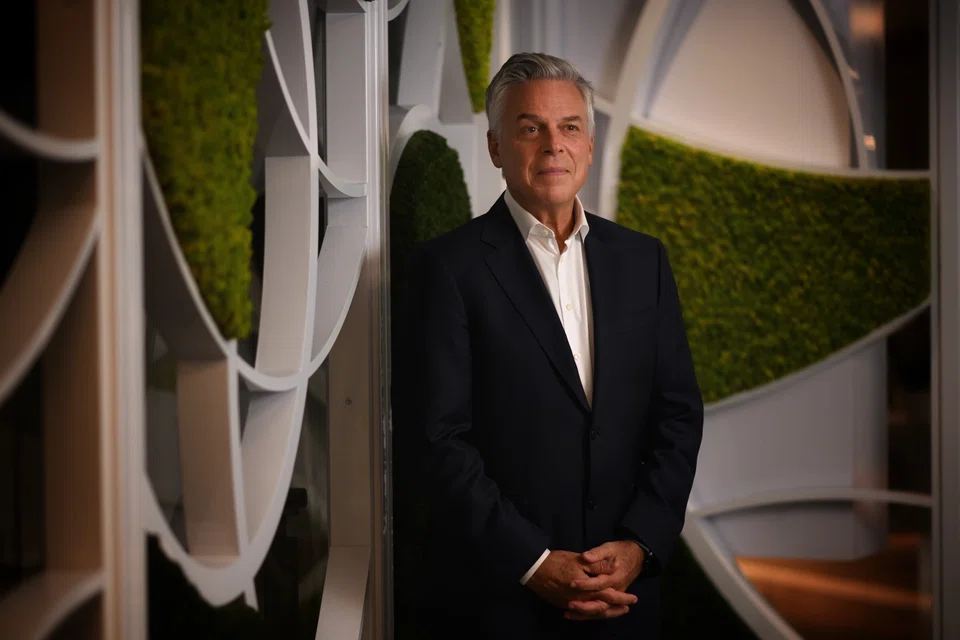
[SINGAPORE] You could say Jon Huntsman, one-time presidential hopeful, two-time governor of Utah and three-time ambassador – he was US envoy to Singapore, China and Russia – knows all about his country’s complicated relationship with China from the start.
In July 1971, he was an 11-year-old visiting his father’s office in the West Wing of the White House, where the senior Huntsman was a staff member.
Then-Colonel Alexander Haig, who was Henry Kissinger’s deputy at the time, asked if the youngster would like to say “hello” to the famed national security adviser, who sat upstairs.
Haig, who would eventually be Ronald Reagan’s secretary of state, led Huntsman Jr past New York-style modern art and into Kissinger’s office. There, he spotted a pair of black suitcases that sat on the floor. Kissinger jokingly asked the young Huntsman if he would help with the bags.
“Where are you going?” Huntsman asked.
“China, but don’t tell anyone,” Kissinger joked back. “It is a secret.”
The significance of that moment was lost on the lad, who would later form a lifelong friendship with Kissinger, including sharing seats on the US Defence Policy Board Advisory Committee.
The secret visit, conducted at the height of the Cold War, witnessed a surge in US-China ties, encouraged the mainland’s rise as a rival to the Soviet Union and helped flower a relationship that held for nearly four decades, until ties began to wither again.
“I used to joke to him that ‘you may have been the architect of the US-China relationship, but I was standing around’,” laughs Huntsman, now vice-chairman and president of strategic growth at Mastercard.
Sobering times for US-China ties
For Huntsman, who was Barack Obama’s envoy to Beijing from 2009 to 2011 – he returned to launch his unsuccessful 2012 presidential campaign – these are sobering times where the China relationship is concerned.
Too aware of the deep fissures, he brings a realist’s eye to Chinese President Xi Jinping’s visit to the White House, and what he refers to as the “China-tracking business”.
“I have been involved with a few of these summits, and by and large, they are theatrical,” he said, while on a visit to Singapore last week.
“But that, in and of itself, is a deliverable. The logistics of getting the Chinese president to Washington, the work involved in preparing the top discussion items in economics, technology, regional affairs... nobody sees that part.
“What the world will see is statecraft, and at a very high level. It would be my hope that we can go deeper in collaboration on issues like the Middle East, which will be a good thing.”
His enduring big concern is that the economic and technological competition between the two powers will veer into the national-security domain of conflict.
“There will be conflict and tensions as far as the eye can see, but that is not what I am necessarily obsessed about,” he added.
“It is: What sort of mechanisms do we have in place to solve problems in some trustful environment. And that is the rub – we have no trust. You have to build it piece by piece, which is a very difficult thing to do.”
This is why, he said, Xi’s visit to the White House on Thursday (Sep 24) is significant.
“Not that we are going to find solutions, but the very fact that we are sitting at a table trying to find solutions is in and of itself a positive thing.
“What I worry about is one of those long estrangement periods when nobody talks, nobody dares to travel and members of the (US) legislature do not dare to show up in Beijing or Shanghai... where you are always assuming the worst impulse in each other.”
The US recently confirmed it had placed weapons in space and I mentioned a column I wrote about the competition extending to that domain, and the two superpowers acting like cars on an unlit highway speeding towards each other.
These days, I said, you need to add artificial intelligence to the priority list of lethal competition, especially since US President Donald Trump has firmly ruled out putting brakes on its development, citing the China factor.
The world has lived with nuclear weapons since 1945 and remains a dangerous place, Huntsman noted. Yet, safeguards exist that most people do not see.
That said, space remains a wide-open area.
“That is a new domain of warfare that will have to be brought in. It is probably on the agenda, along with, maybe, guard-rails for AI. But AI can be a really hard thing to do because China’s model is so different from ours,” he said.
“We have more of a frontier approach with AI – let’s see where it goes. The (Communist Party of China) does not want to lose control of AI. So, you have two competing systems and two competing philosophies, but that isn’t to say you cannot come up with some guard-rails to protect against unintended consequences.”
US needs to re-engage Russia
Still, there is more method to the madness than people might realise, and that offers hope that the relationship will not go off the rails.
That leads me to ask about a leader whom much of Western commentary criticises as mad – Russia’s Vladimir Putin. Trump had come into office confident that he could put an end to the war in Ukraine.
What does Huntsman, ambassador to Russia from 2017 to 2019, which was one of the most tense periods in the relationship, think of the situation? And how would he respond to Russian complaints that Nato’s eastward expansion is at the root of the conflict?
If you talk to key Moscow figures in moments of quiet, he said, they will tell you that Ukraine and its capital, Kyiv, are religious centres for the Russian people, and thus part of their territory.
As he sees it, Putin has had his eye on Ukraine for a long time and now controls almost all of its Luhansk region and most of Donetsk.
And the Russian leader will gain leverage piece by piece, as he has done in Georgia and Moldova.
“He is playing this out, as he does everything, because he is a master of leverage and he gets it on the cheap,” said Huntsman, characterising the Russian as “both arsonist and firefighter”.
“I would say today Putin has the leverage and the upper hand. But you also have the biological clock on him – how long will he be around? We (the US) need to re-engage.”
Aside from Ukraine, a topic certain to be raised in Trump-Xi talks is the situation in West Asia.
Not for the first time, Trump has threatened to annihilate Iran, and he did so again this week. What does Huntsman think of the US initiating that war, alongside Israel?
The former ambassador recalled a conversation with Lee Kuan Yew, whom he knew well and once hosted for three days in Utah.
“I remember that (Lee) turned to me at the outbreak of the Iraq War (in 2003) and said: ‘What have you done?’” Huntsman recalls. “‘You are going to regret this. You do not take on a country you know so little about, one where they’re likely to fight to the last person.’ America has a habit of tripping into conflicts it knows little about. In this case, we will live to regret the decision.”
Would the war going badly for the US affect the looming midterm elections in the US?
Huntsman, who was re-elected governor of Utah in 2008 by a landslide (he left midway in the second term to move to China as ambassador), suggests that cost-of-living issues influence voter behaviour more than distant wars.
“I’ve been through so many election cycles that all come down to the same thing. If you’re not focused on pocketbook issues, you’re going to lose the election... whether it is gas or groceries.
“So, if you look at the numbers in terms of who leads the (debate) around affordability, they typically end up winning the elections. Whenever you take your eye off the affordability question, you’re losing.”
A job-training question
What about jobs? Insecurity about employment is rising worldwide, including in the US, as automation and AI sweep the industrial and office landscape.
As Utah governor, he was credited for presiding over an economic boom in the state and significant job creation – successes he attributes to studying the model developed by Singapore’s Economic Development Board.
Huntsman, who sits on the board of Ford Motor, points out that the automaker has thousands of jobs on offer, positions that pay between US$120,000 and US$150,000 a year. Yet, it has trouble filling the vacancies, because the right people are not available.
“I think it’s less of a job availability question and more of a job-training question,” he responds.
“American states traditionally have not done an adequate job in training the next generation of workers, whether (they are) diesel mechanics, welders or hospital assistants. I know this, because we used to obsess about job training for the next generation.”
Why not another run for the presidency? He would fit the bill – fit at 66, vastly experienced in governing, diplomacy and trade, monied and with looks to match. In short, the perfect antidote for the Republican Party to field after Trump’s chaotic presidency.
Huntsman said for political success in America, one needs to catch historical cycles and the US is currently toggling between extremes – not the moment, perhaps, for a middle-ground operator such as him.
“President of strategic growth at Mastercard suits me just fine,” he quipped. “I have the title – just a slightly different portfolio.” THE STRAITS TIMES
Decoding Asia newsletter: your guide to navigating Asia in a new global order. Sign up here to get Decoding Asia newsletter. Delivered to your inbox. Free.
Share with us your feedback on BT's products and services
TRENDING NOW

Once staunchly pro-China, Malaysian Chinese businesses are now distancing themselves from Beijing

Looking beyond looming CEO succession, should UOB potentially pursue a transformative merger?

Could stablecoins be the future of money?

Grab CEO’s wife Chloe Tong on life with Anthony Tan and finding her purpose

