

Trump’s Greenland tariff threats: What options do European countries have?
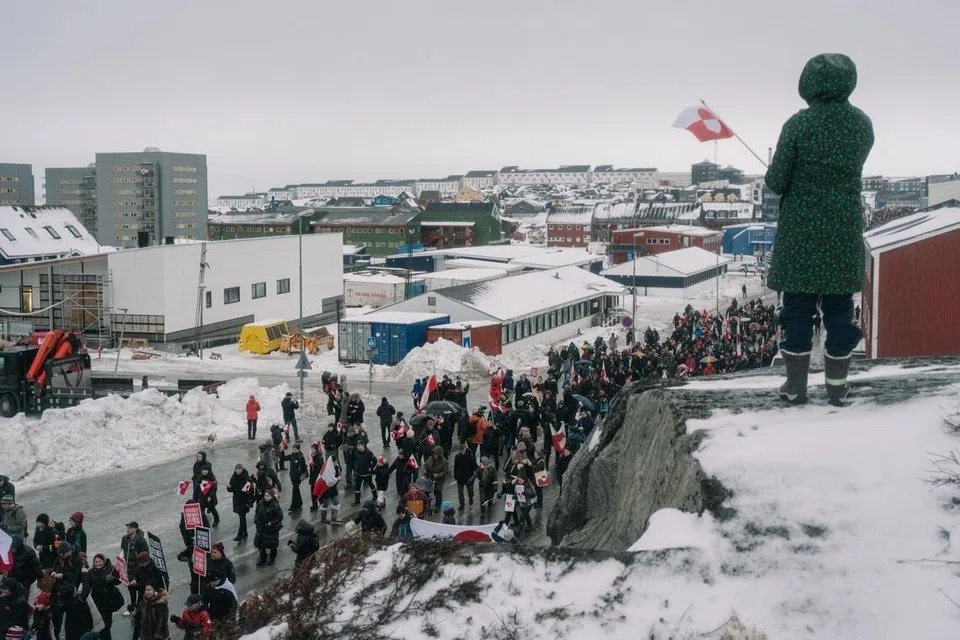
[BRUSSELS] European Union leaders are convening an extraordinary emergency summit in the “coming days” to agree on a joint response to US President Donald Trump’s latest threatened tariffs on eight European countries in a dispute over the possession of Greenland, the Arctic island ruled by Denmark.
“Together we stand firm in our commitment to uphold the sovereignty of Greenland and the Kingdom of Denmark,” Dr Ursula von der Leyen, president of the European Commission, the EU’s executive body, posted in a message on social media.
“We will always protect our strategic economic and security interests,” she added.
But Europe’s governments remain deeply divided over their response to the latest US broadside, with some nations led by the French arguing for the imposition of immediate retaliatory tariffs against the US, while others urge caution.
Mr Trump’s threat to apply a special punitive 10 per cent trade tariff on six EU nations, as well as Britain and Norway – delivered in a post on Truth Social, his preferred social media platform, while the US President was at his West Palm Beach golf club on Jan 17 – has stunned European capitals.
After all, only a few days earlier, the Danish Foreign Minister and a minister from Greenland’s autonomous government signed in Washington an agreement to establish a joint working group of officials from the US and Denmark to discuss their dispute over the ownership of Greenland.
But while Danish Foreign Minister Lars Lokke Rasmussen claimed that his Washington trip had concluded with a deal to hold further talks that respected Denmark’s territorial sovereignty and the right of the people of Greenland to decide their own future, US officials quickly reinterpreted the agreement by claiming that all the Trump presidency agreed to was to discuss with Denmark the modalities of the territory’s handover to the US.
The purpose of the joint US-Danish working group of officials was only to conduct the “technical talks on the acquisition of Greenland”, at a frequency of “every two to three weeks”, Ms Karoline Leavitt, the White House’s press secretary, claimed on Jan 15.
Mr Trump is now threatening that unless they agree to allow the US to purchase or otherwise control the territory, Denmark, France, Finland, Germany, the Netherlands, Norway, Sweden and the United Kingdom will be slapped with an additional 10 per cent tariff to take effect on Feb 1, and a further 25 per cent tariff from June 1.
All eight European countries have attracted Mr Trump’s ire because they recently decided to dispatch small contingents of their armed forces to Greenland.
Trump’s expansionist streak
The deployment was presented as a response to Mr Trump’s claims that Denmark is not only unwilling but also incapable of defending Greenland, the world’s largest island, with a territory almost four times bigger than Alaska. Mr Trump has interpreted the initiative as a hostile move.
Most of his claims that the US needs Greenland for security reasons remain spurious.
Under a treaty concluded in 1951, the US already has the right to do more or less what it wants in Greenland. At the height of the Cold War, over 10,000 US military personnel were deployed on the island. Today, only around 200 US soldiers are there, hardly an indication that Washington is concerned about Greenland’s security.
There is no evidence for Mr Trump’s assertion that, “if you take a look outside of Greenland right now, there are Russian destroyers, there are Chinese destroyers and, bigger, there are Russian submarines all over the place”, all allegedly “waiting to pounce on Greenland”.
If that were the case, the US Navy would have been in the region as well, and it isn’t.
Nor is there any truth in Mr Trump’s claim that possession of Greenland is necessary for the construction of the US “Golden Dome”, his proposed missile defence umbrella. The US Space Force already operates a radar station in Greenland for missile and spacecraft tracking, and Denmark would be only too happy to discuss further similar bases.
It is by now clear that Mr Trump has no interest in diplomatic subtleties or compromises. He covets Greenland – which has an important geopolitical position, natural resources and the potential northern shipping routes around the island – because he wants to join the small number of former US presidents who have gone down in history as those who expanded their country’s territory.
As Mr Trump indicated in his inauguration speech delivered exactly one year ago today on Jan 20, his role model is William McKinley, the late 19th-century president who annexed Hawaii, Puerto Rico, Guam and American Samoa. Greenland is part of a new US imperial project.
European countries’ options
The question is what the Europeans can now do to rebuff Mr Trump’s pressure.
Dropping support for Denmark or encouraging the Danes to give up Greenland is out of the question. Quite apart from the fact that this would negate all the principles Europe claims to uphold, the betrayal of Denmark would tear apart both the EU and the NATO military alliance.
But retaliating against the US tariffs is not an easy option either, because it could suck Europe into tit-for-tat actions with Washington just when Europe thought it had avoided a bigger spat with Washington over Russia’s invasion of Ukraine.
Yet at the same time, the European Commission is still reeling from its failure in 2025 to negotiate a favourable trade deal with the Trump administration and can ill-afford to appear weak again.
In preparation for this week’s emergency summit, EU ambassadors have already discussed the possibility of retaliating by hitting the US with trade tariffs worth €93 billion (S$139 billion), which were already drawn up in 2025 but never implemented.
French President Emmanuel Macron has also called for activating the so-called Anti-Coercion Instrument, which gives the EU powers to target the US services industries, including banking and tech giants.
But Italian Prime Minister Giorgia Meloni, who is close to Mr Trump and spoke to the US President on Jan 18, claimed that Mr Trump merely got the wrong impression about the latest European military deployment to Greenland, and that the US leader remains “interested in listening” to a potential compromise.
Whether a compromise is feasible should become clearer by the time Mr Trump concludes his participation at the Davos economic summit on Jan 22.
The Europeans enjoy one largely unexpected advantage: the tacit support of ordinary US voters. Latest opinion polls indicate that only 17 per cent of Americans approve of Mr Trump’s efforts to acquire Greenland, and substantial majorities of both Democrats and Republicans oppose using military force to annex the island. THE STRAITS TIMES
Decoding Asia newsletter: your guide to navigating Asia in a new global order. Sign up here to get Decoding Asia newsletter. Delivered to your inbox. Free.
Share with us your feedback on BT's products and services
TRENDING NOW

MSCI proposes standalone status for Indonesia; Jakarta stocks plunge 8%

Palm oil stocks slide after Singapore begins looking into which firms responsible for haze

High Court rules against Julius Baer’s Singapore trust arm in US$50 million family trust dispute
Why is the haze so bad in South-east Asia this year?

