

UK economy claws back some growth as Burnham prepares to take power
In the three months to May, economic output grew by 0.7%
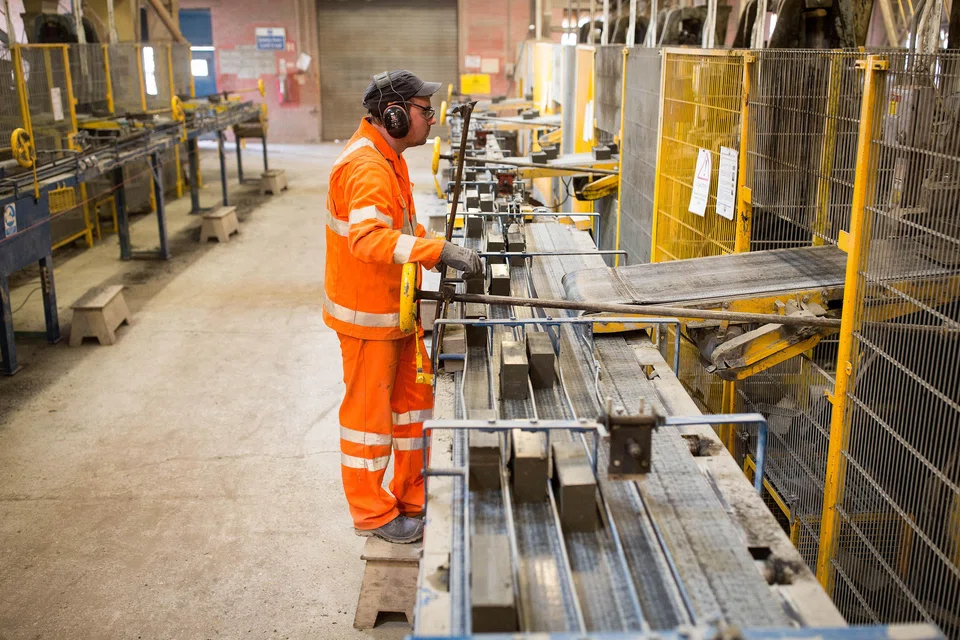
[LONDON] Britain’s economy eked out minimal growth in May as the services industry expanded but other sectors shrank, suggesting fragile confidence among businesses against the backdrop of the Iran war and a change of prime minister at home.
Gross domestic product expanded by 0.1 per cent in May, in line with the median forecast in a Reuters poll of economists and reversing a 0.1 per cent fall in April, official data showed on Thursday (Jul 16).
Services output expanded by 0.3 per cent on the month but industrial production and construction both contracted, falling by 0.5 per cent and 0.8 per cent respectively.
Figures showing robust overall economic growth of 0.7 per cent in the three months to May offered a positive send-off to finance minister Rachel Reeves before her expected replacement next week under new prime minister Andy Burnham.
Reeves’ job appears likely to go to Shabana Mahmood, currently Britain’s interior minister, who is set to be named finance minister next week by Burnham, according to various news reports on Wednesday.
Economy growing near fastest pace in 2 years
An upwardly revised growth figure of 0.8 per cent in the three months to April represented the fastest expansion since the Labour Party came to power and matched the rate achieved under Reeves’ Conservative predecessor Jeremy Hunt in May 2024.
Compared with a year earlier, output in May was 1.3 per cent higher, the biggest annual rise in 10 months.
However, the outlook for the economy remains darkened by the shadow of the conflict in the Gulf and uncertainty over the latest change of political leadership at home – Britain’s seventh in the past 10 years.
On Wednesday, the Organisation for Economic Co-operation and Development said it expected British GDP to grow by only 0.9 per cent this year and 1.1 per cent in 2027, although the forecast for 2026 was the strongest for the major European economies.


Neil Birrell, chief investment officer at fund management firm Premier Miton, said uncertainty around economic policy in Burnham’s government was likely to weigh on growth in the months ahead.
“It’s unlikely businesses and individuals will be actively hiring or spending ahead of getting policy details,” he said. “All that, when the starting point is an economy that is barely growing.”
Sanjay Raja, chief UK economist at Deutsche Bank, saw more positive details in the GDP data and said Britain was likely to remain near the top of the Group of Seven growth table in the April-to-June period.
“In short, PM Starmer hands over the economy to his successor on a much better footing,” he said.
The OECD urged Burnham, who is due to replace Keir Starmer as prime minister on Monday, to keep the government’s budget discipline, tackle high pension spending and address soaring energy prices to speed up the economy.
The Office for National Statistics (ONS), which published Thursday’s figures, said the growth in services over the three months to May was driven by computer programming and advertising alongside the often-volatile pharmaceutical industry.
In May, growth in research and development in medical sciences was particularly strong, the statistics agency said.
Britain’s goods trade deficit narrowed in May to its smallest since January at £18.7 billion (US$25.3 billion), a bigger drop than economists had expected from April’s £24.6 billion.
Imports of refined oil from Saudi Arabia, Kuwait and Qatar – all affected by the closure of the Strait of Hormuz – fell to zero in May, while imports from the US had more than tripled since February and imports from Belgium and the Netherlands had nearly doubled, the ONS said. REUTERS
Decoding Asia newsletter: your guide to navigating Asia in a new global order. Sign up here to get Decoding Asia newsletter. Delivered to your inbox. Free.
Share with us your feedback on BT's products and services
TRENDING NOW

Singapore identifies 7 firms responsible for haze fires, notices issued urging action: Grace Fu

Could stablecoins be the future of money?

Singapore should prepare for prolonged haze until November, says Grace Fu

High Court rules against Julius Baer’s Singapore trust arm in US$50 million family trust dispute

