UK economy grows at fastest pace since Feb 2025
British gross domestic product in July was 1.6% higher than a year earlier

[LONDON] Britain’s economy grew at the fastest annual pace in 18 months in July, helped by a boost from artificial intelligence and extending a strong first-half performance despite headwinds from the US-Iran war, official figures showed on Friday (Sep 11).
British gross domestic product in July was 1.6 per cent higher than a year earlier, the fastest annual rate since February 2025 and above economists’ 1.2 per cent forecast, the Office for National Statistics showed on Friday.
The economy grew 0.4 per cent on the month in July, compared with median expectations in a Reuters poll for output to be unchanged, and output in the three months to July – which smooths volatility – was also stronger than expected at 0.4 per cent.
Much of the growth over the past three months appeared to come from businesses involved in computer programming that were benefiting from the AI boom, the ONS’ Director of Economic Statistics, Liz McKeown, said.
“Looking at the latest month, services also drove growth in July, with computer programming again making the largest contribution,” she added, noting an extra boost for some firms from the men’s soccer World Cup and unusually hot weather.
Sterling was little changed against the US dollar after the data and economists had mixed views about whether Britain’s current economic outperformance would be sustained in the run-up to finance minister John Healey’s first budget next month.
In the first half of 2026, Britain’s economy expanded by 1 per cent, the fastest growth across the Group of Seven large advanced economies and some analysts believe this may in part reflect seasonal effects that have not been fully adjusted for.
“We’re starting to reach the point in the year where we expect growth to peter out,” said Matt Swannell, chief economic adviser to forecasters ITEM Club.
But others were more positive.
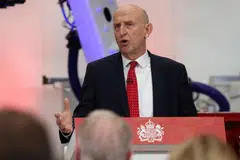

“The UK growth story is becoming harder to ignore,” said Deutsche Bank Chief UK Economist Sanjay Raja. Forecasters were likely to revise up their expectations for full-year growth by 0.1 percentage points after the latest data, he added.
In July, the Bank of England predicted the economy would expand 1.1 per cent over 2026 as a whole, and earlier this week Governor Andrew Bailey told a parliament committee that economic data since then had come in “a bit stronger” than he had expected.
Britain, like other European economies, has taken less of an immediate hit to growth from the US-Israeli war on Iran than economists had feared at the outset.
But the conflict this week pushed oil prices above US$105 a barrel with knock-on impacts on government borrowing costs, which are now at multi-decade highs, and the BOE expects inflation to rise to around 3.2 per cent later this year.
Almost all economists expect the BOE to keep interest rates on hold next week and for the rest of this year, but financial markets think it is increasingly likely that rates will rise in November due to stronger inflation pressures. REUTERS
Decoding Asia newsletter: your guide to navigating Asia in a new global order. Sign up here to get Decoding Asia newsletter. Delivered to your inbox. Free.
Share with us your feedback on BT's products and services