
NEWS ANALYSIS

With UK polls looming, PM Sunak has work cut out to earn voters’ trust
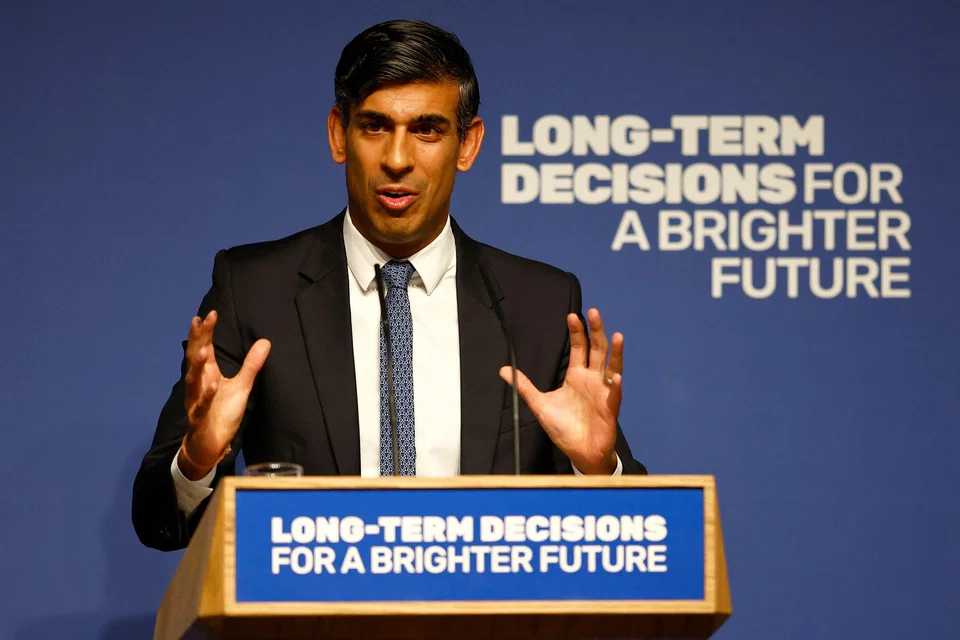
    • Opinion polls suggest that British Prime Minister Rishi Sunak  may not have enough support to win the next general election that's widely expected in late-2024.
    • Opinion polls suggest that British Prime Minister Rishi Sunak may not have enough support to win the next general election that's widely expected in late-2024. PHOTO: AFP
    Published Mon, Oct 30, 2023 · 05:00 AM

    [LONDON] Rishi Sunak – the first Asian to become Britain’s prime minister – has, in the eyes of many voters and political analysts, proven himself to be a pragmatic and fairly competent technocrat since taking over from the much-maligned Liz Truss a year ago.

    But while he has delivered a decent report card since occupying 10 Downing Street, the latest opinion polls suggest that he doesn’t have enough support ahead of the next general election that is expected to take place in the second half of 2024.

    Shortly after succeeding Truss, Sunak – the UK’s youngest prime minister since William Pitt 200 years ago – promised to deliver what he termed as “experienced, disciplined, focused leadership” and a “stable, competent government”. He has partly carried out those ambitious pledges in his relatively short stint in office.


    He has cut the opposition Labour’s lead in the polls from a record 32 points to 20 points today, although this is still a substantial gap to overcome in the coming months. What’s more, Labour recently won two Conservative seats in by-elections.

    Sunak’s main obstacle in front of him is the fact that he is the fourth Conservative prime minister to lead the UK after David Cameron’s exit, shortly after the latter held a referendum that led to Brexit. After Cameron was Theresa May, who failed to unite the right-wing with the centrist Tories; Boris Johnson, an election winner but a poor administrator, and finally Truss, who almost caused a financial collapse with her rushed ‘mini Budget’.

    What this means is that the Conservatives have been in power for the last 13 years, since Gordon Brown stepped down in May 2010 – and there are increasing signs that the electorate wants a change.

    Sunak is aware that he has to overcome Labour leader Keir Starmer’s public trust rating of 40 per cent against his own level of 26 per cent. To swing the polls in his favour, Sunak’s mantra is “long term action to make the UK better”.

    At the start of this year, Sunak made five pledges: to halve the inflation rate, grow the economy, reduce public debt, slash waiting times at the National Health Service (NHS), and stop illegal migrants arriving in small boats from across the English Channel.

    His success rate in achieving these promises has varied. Inflation, which stood at 10.1 per cent in January, has come down to 6.7 per cent. The economy remains sluggish with growth of just 0.6 per cent in the first half of the year.

    Government debt, despite the many austerity policies rolled out by Chancellor of the Exchequer Jeremy Hunt, has risen from 95 per cent of gross domestic product (GDP) to 97.8 per cent. The current budget deficit stands at 5.5 per cent of GDP, or around £140 billion (S$232.4 billion) and new debt has to be issued at rates of about 5 per cent.

    All this means less money for the NHS, which still has to deal with extremely long waiting times and is encumbered by doctors’ strikes. The number of people waiting for routine treatments has risen by 500,000 since January to 7.7 million. There is also inadequate funding to renovate hospitals, schools and prisons across the country.

    Sunak has also slashed government spending on major projects, most notably the HS2 high-speed railway that has seen its original budget more than triple to £106 billion. In early-October, he scrapped a proposed new line from Birmingham to Manchester, and to redirect some of those funds to improve the rail network in the north of England.

    Unemployment in the UK has risen from 3.7 per cent to 4.3 per cent over the 12 months ended July 2023. Wage increases have helped workers counter the higher cost of living, although this has pushed more people into higher tax brackets.

    Sunak’s major coup in the past year was a marked improvement in relations with the European Union to boost trade and business deals. But despite a more relaxed deal with Northern Ireland, he has not managed to restore power-sharing in the UK province.

    On the whole, the key to Sunak’s success at the upcoming polls is to improve the economy and bring inflation down. Much will, of course, depend on whether the Bank of England cuts interest rates and if economic growth is strong enough for Sunak to cut taxes.

    The recent by-election defeats will give him plenty to ponder as he plans his next moves in the coming months. He also needs to work hard to get a fractured Conservative party fully on his side to prevent Labour from securing a landslide victory.


