

UK’s tax-and-spend Budget gives businesses cause for concern
Observers have expressed concern that Reeves has adopted what they say is a ‘shock and awe’ approach
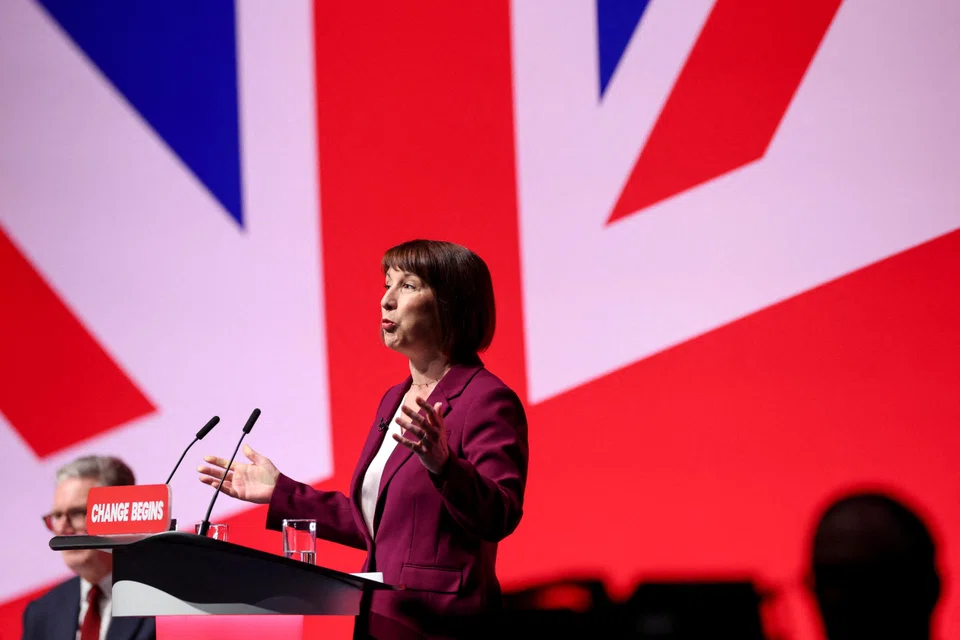
[LONDON] British Chancellor of the Exchequer Rachel Reeves delivered her first Budget this week, one that has already impacted the stock market and which business leaders have described as a “gamble”.
Some observers have expressed concern that Reeves – a 45-year-old who became the first female chancellor to deliver a UK Budget – has adopted what they say is a “shock and awe” approach.
They fear the implications of the massive £40 billion (S$68.5 billion) annual tax rise, with the Budget putting tax on a path to 38.2 per cent of the UK’s gross domestic product – the highest level ever.
They are also concerned about the extensive borrowing that Reeves claimed was necessary to fund the healthcare system and other parts of the public sector. Overall, spending will go up by £70 billion a year over the next five years.
“In broad brush strokes, this was the Budget we had been led to expect: big tax rises, more cash for public services, more borrowing and more investment,” said Paul Johnson, director of the London-based Institute for Fiscal Studies.
“Look beyond the headline numbers and there are two big judgements – one could say they are gambles,” he added.
The first gamble is whether a big cash injection into public services will improve performance, and the second gamble is whether borrowing of £85 billion a year will be worthwhile, said Johnson.
Within hours of Reeves ending her Budget speech in Parliament, the pound, UK government bonds and the stock market all weakened. The yield on 10-year government bonds fell by nearly 12 basis points, while the pound traded around 0.6 per cent weaker at US$1.2937 to the greenback.
Reeves stated that her mantra is to “invest, invest, invest” to boost economic growth, raise employment levels and reduce the UK’s debt burden. She also hopes that heavy government spending on infrastructure would encourage businesses to expand, invest and create more jobs.
In contrast, senior figures in the business community said that her tax rises would create the opposite effect. Some cited the fact that the bulk of the annual tax increase – amounting to £25 billion – would come from the increase in employers’ national insurance contributions.
Karan Bilimoria, the founder and chairman of Cobra Beer and a member of the House of Lords, said: “This is a huge burden on business, and I think that’s going to be a big dampener on the ability of businesses to grow.”
Concerns over wealth tax
Economists, meanwhile, are concerned about the government’s targeting of wealthy individuals. One highlight of Reeves’ Budget was the confirmation that foreign residents in the UK – classified as “non-doms” – will now have to pay taxes on their global income and gains.
An earlier report in The Business Times found that this expected change has already caused an exodus of these ultra-rich to places like Dubai and Singapore.
Reeves predicted that the move would raise tax revenue by £12.7 billion, but critics said it would discourage successful business owners and entrepreneurs from opening ventures in the UK.
“Many of us welcome and support the main budget aims of securing more growth, making good investments and helping more people into work,” said John Redwood, a former Conservative member of parliament for 37 years.
“To achieve the government’s growth ambitions, there needs to be a big uplift in private sector investment, alongside new government projects,” he added. “But that requires a competitive tax regime to attract crucial investment from around the world.”
The Office of Budget Responsibility (OBR) – a non-departmental public body funded by the UK Treasury – said that the Budget measures will cause a “short-term sugar rush as a result of the debt-financed spending splurge”, but won’t change the average rate of growth over the next five years.
Richard Hughes, the head of the OBR, said: “Against a largely unchanged economic and fiscal backdrop since our last forecast in March, this Budget delivers one of the largest increases in spending, tax and borrowing of any single fiscal event in history.”
There were others who said that the Labour government under Prime Minister Keir Starmer was moving in the right direction to rebuild the economy.
“There are some positive announcements; for instance, the increases in government spending and a decent increase to the minimum wage,” said Sharon Graham, general secretary of Unite, the public sector union. “Substantial investment in education and the National Health Service is to be welcomed. But we need to make sure that the investment is in people, not just technology.”
Mike Brewer, the interim chief executive of the Resolution Foundation, hailed the announcement of £326 billion in extra funding for public services and investment in the next five years.
“But it is only the first step to secure strong public services, end stagnation, and lift living standards for all,” he said.






