

US consumer confidence jumps to highest level in nearly two years
The Conference Board’s consumer confidence index jumped to 103.3 this month, the highest level since January 2025
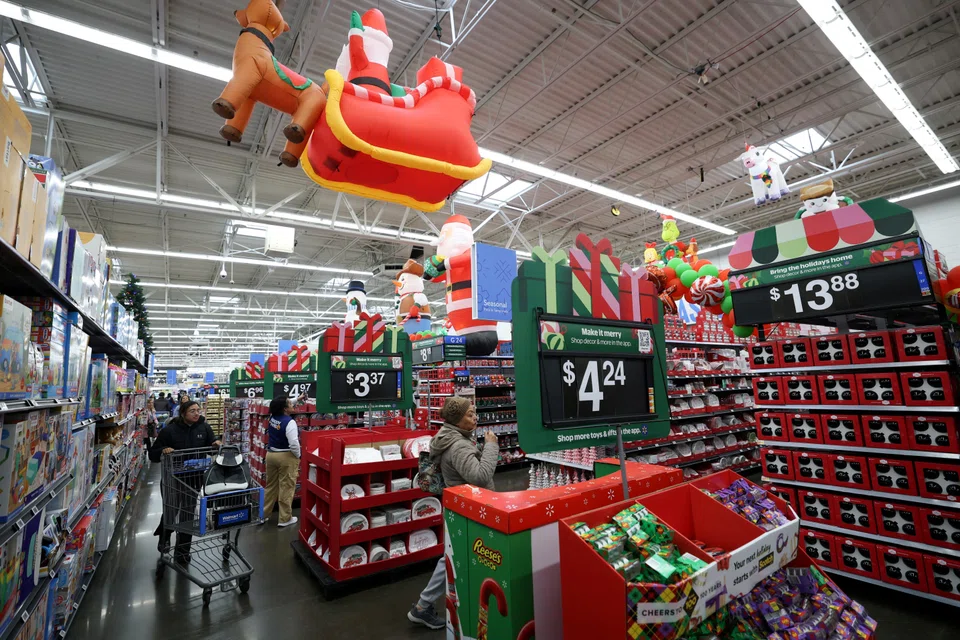
[WASHINGTON] US consumer confidence increased more than expected in November, touching its highest level in nearly two years, amid optimism over labour market conditions and the overall economy following this month’s midterm elections.
The sharp improvement in confidence reported by the Conference Board on Tuesday (Nov 24) was driven by respondents identifying as Democrats and Independents. Confidence among Republican respondents fell slightly.
President Donald Trump’s Republican Party lost control of Congress to Democrats in the Nov 3 elections, which were dominated by anger over the rising cost of living, blamed on tariffs on imports and the US-Israeli war with Iran.
The Conference Board survey noted that “while consumers continued to express frustration with high prices and rising costs, some comments cited hope for the general economy.”
Economists viewed the surge in confidence as a good omen for the holiday shopping season, though the correlation between consumer spending and confidence is weak. Consumer spending has recorded two back-to-back quarters of robust growth even as confidence was in the doldrums.
“The headwinds and uncertainty generated by the midterm elections are no longer posing a risk to the economic outlook,” said Christopher Rupkey, chief economist at Fwdbonds. “Time will tell whether the stock market’s troubles with AI valuations will lead to a slowdown in real consumption spending, that is partly based on the wealth effect, in the final months of the year.”

The Conference Board’s consumer confidence index jumped to 103.3 this month, the highest level since January 2025, from a slightly upwardly revised 91.9 in October.
Economists polled by Reuters had forecast the index at 92.5 following a previously reported 91.7 in October. It mirrored a similar improvement in the University of Michigan’s consumer sentiment survey.
The rise reported by the Conference Board was across all age groups and generations. Consumers with higher household incomes saw the largest improvement in confidence.


“Write-in responses in November were slightly less negative than previous months,” said Fergus McCormick, a senior economist at the Conference Board.
The share of consumers saying jobs were “plentiful” soared to 30.8, the highest reading since May 2025, from 26.2 in October.
The proportion viewing jobs as “hard to get” fell to 18.4. That was the lowest level since October 2025 and was down from 21.4 in October. The survey’s so-called labour market differential widened to 12.4 from 4.8 last month.
This measure closely correlates to the unemployment rate in the Labor Department’s employment report. The decline coincided with an acceleration in job gains in recent months.
Consumers were also more upbeat about the labour market over the next six months, which bodes well for a further decline in the jobless rate.
Inflation expectations elevated
The unemployment rate dropped from 4.5 per cent in November last year to 4.1 per cent in October, though part of the decrease has been due to a smaller labour force amid retirements and the White House’s immigration crackdown.
Nonetheless, signs of a strengthening labour market is likely to clear the way for the Federal Reserve to raise interest rates again beyond December’s anticipated hike as it tries to bring inflation under control.
The Conference Board’s one-year median inflation expectations eased to a still-high 4.5 per cent from 4.7 per cent in October.
Stocks on Wall Street were trading lower as the sharp rally in AI shares following the return of Nvidia CEO Jensen Huang fizzled. The dollar slipped against a basket of currencies. US Treasury yields fell.
Despite the lingering angst over higher prices, more consumers planned to purchase motor vehicles as well as major appliances over the next six months. Some economists continued to expect consumer spending to slow down in the fourth quarter in part because of inflation eroding wage gains.
More consumers planned to buy a house over the next six months, with the share rising to a seven-month high despite elevated mortgage rates and higher home prices.
A separate report from the Federal Housing Finance Agency showed single-family house prices increased 2.5 per cent in the 12 months through September after advancing 2.4 per cent in August.
Mortgage rates have increased by about 130 basis points since the US and Israel attacked Iran at the end of February, data from mortgage finance firm Freddie Mac showed. The average rate on a 30-year fixed-rate mortgage was 7.28 per cent last week.
While the higher borrowing costs have dampened demand, house prices have maintained their upward trend because most homeowners have mortgage rates below 5 per cent.
That is discouraging some from selling their houses and contributing to a national housing shortage, especially of starter homes.
“We expect annual home price growth to slow to below 2 per cent in the fourth quarter and to remain there until early 2028,” said Nancy Vanden Houten, lead US economist at Oxford Economics. “Weaker demand due to high mortgage rates will weigh on prices, although we expect mortgage rates above 7 per cent will also keep sellers to the sidelines.” REUTERS
Decoding Asia newsletter: your guide to navigating Asia in a new global order. Sign up here to get Decoding Asia newsletter. Delivered to your inbox. Free.
Share with us your feedback on BT's products and services
TRENDING NOW

As Indonesia picks new vice-president to succeed Gibran, investors see risks and opportunities

Seatrium to lay off 2% of its Singapore workforce

Singapore telco recovery at least 2 years away despite StarHub-M1 merger, say analysts

Why Singapore, Johor and Riau Islands should build a cross-border ecosystem for AI

