US job openings slide to 14-month low; hiring weak in November
Some employers are also integrating AI in certain roles, diminishing the need for labour
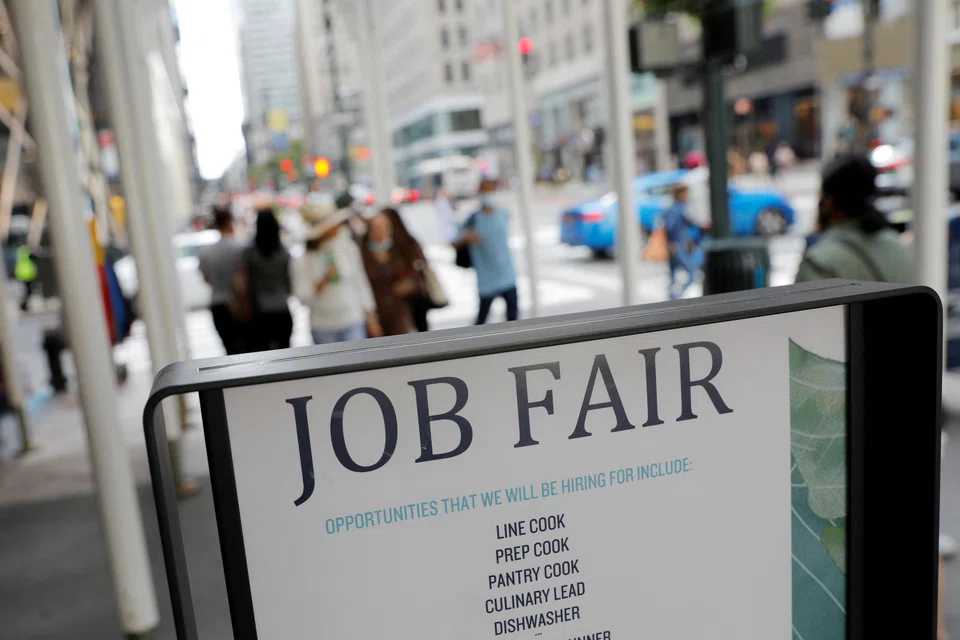
[WASHINGTON] US job openings dropped to a 14-month low in November while hiring resumed its sluggish tone, pointing to ebbing demand for labour amid policy uncertainty related to import tariffs and the integration of artificial intelligence (AI) in some work roles.
Despite the larger-than-expected decline in job postings reported by the Labor Department on Wednesday (Jan 7), employers remained hesitant to carry out mass layoffs, keeping the labour market in what economists and policymakers call a “no hire, no fire” state. That bolstered economists’ expectations that the US Federal Reserve would keep interest rates unchanged later this month.
“The November Jolts estimates show a notable decline in job openings and little sign of deterioration in labour market conditions,” said Marc Giannoni, chief economist at Barclays.
Job openings, a measure of labour demand, dropped 303,000 to 7.146 million by the last day of November, the Labor Department’s Bureau of Labor Statistics said in its Job Openings and Labor Turnover Survey, or Jolts report. That was the lowest level since September 2024. October’s openings were revised down to 7.449 million.
Economists polled by Reuters had forecast 7.6 million unfilled jobs in November following the previously reported 7.7 million in October. There were 0.91 job openings for every unemployed person in November, the lowest level seen since March 2021. Businesses with headcounts of between 50 and 999 accounted for the bulk of the decline in job postings.
Small businesses reported an increase in job openings.
The decrease in overall job openings in November was led by the accommodation and food services industry, which saw vacancies plunge by 148,000. Unfilled jobs in the healthcare and social assistance sector decreased by 66,000. These two sectors were among the main drivers of job growth in 2025.
There were 108,000 open positions in the transportation, warehousing and utilities sector, while unfilled jobs in the wholesale trade industry fell 63,000. Government job openings decreased by 89,000, mostly at the state and local government level. Federal government vacancies increased by 8,000.
But job postings increased 90,000 in the construction sector and jumped by 121,000 in the retail industry, likely as stores geared up for the holiday season. The overall job openings rate fell to 4.3 from 4.5 per cent in October.



Hiring dropped by 253,000 positions to 5.1 million in November, consistent with lacklustre job gains even as economic growth was robust in the third quarter.
The decline in hiring was nearly across all business sizes, and most pronounced in the healthcare and social assistance sector, where hiring fell by 76,000. The overall hires rate dropped to 3.2 from 3.4 per cent in October.
Economists say policy uncertainty, mostly related to import tariffs, had left businesses reluctant to increase their headcounts, resulting in a jobless economic expansion. The US Supreme Court is expected on Friday to rule on the legality of US President Donald Trump’s sweeping global tariffs.
Some employers are also integrating AI in certain roles, diminishing the need for labour.
Economists argue that the labour market is experiencing structural challenges rather than cyclical weakness.
Layoffs remain historically low
Layoffs dropped by 163,000 to 1.7 million. Resignations increased by 188,000 to 3.2 million, lifting the quits rate to a still-low 2 from 1.9 per cent in October.
“Although layoff activity remains modest, we note that the low rate of voluntary exits raises the risk that employers who are looking to dial back headcount may need to increasingly resort to layoffs in lieu of attrition,” said Sarah House, a senior economist at Wells Fargo.
Stocks on Wall Street were mixed. The US dollar was steady against a basket of currencies. US Treasury yields fell. The US central bank is expected to keep interest rates unchanged in January. Minutes of the Dec 9 to 10 meeting published last week showed deep divisions at that meeting.
The BLS is likely to report on Friday that nonfarm payrolls increased by 60,000 jobs in December after advancing by 64,000 in November, a Reuters survey of economists predicted.
Though the ADP’s national employment report showed private employment rebounded by 41,000 jobs last month after decreasing 29,000 in November, economists cautioned against reading too much into the increase.
The monthly ADP estimate has historically diverged from the government’s private payrolls count in the employment report.
“The visual signal from today’s headline is that jobs were gained in December, but at a relatively slow pace,” said Carl Weinberg, chief economist at High Frequency Economics.
Attention is likely to centre on the unemployment rate for fresh clues on the health of the labour market and near-term monetary policy outlook. The jobless rate is projected to have eased to 4.5 per cent in December after accelerating to more than a four-year high of 4.6 per cent in November.
The November unemployment rate was partially distorted by the 43-day federal government shutdown, which also prevented the collection of household data for October. The unemployment rate for October was not published for the first time since the government started tracking the series in 1948.
A third report from the Institute for Supply Management showed its nonmanufacturing purchasing managers’ index increased to 54.4 in December from 52.6 in November, with a measure of services employment rebounding to 52 after contracting for six straight months. At face value, that suggested strong momentum in the economy heading into the new year.
The economy this year is expected to get a tailwind from tax cuts and fading trade policy uncertainty.
“Stable and consistent economic growth in 2026 should keep services in a solid expansionary state over the year with upside if stimulus impacts are substantial,” said Ben Ayers, senior economist at Nationwide. REUTERS
Decoding Asia newsletter: your guide to navigating Asia in a new global order. Sign up here to get Decoding Asia newsletter. Delivered to your inbox. Free.
Share with us your feedback on BT's products and services