

US labour market on solid footing; rising mortgages pressuring housing sector
The average rate on a 30-year fixed-rate mortgage has jumped nearly 100 basis points since the Iran war started
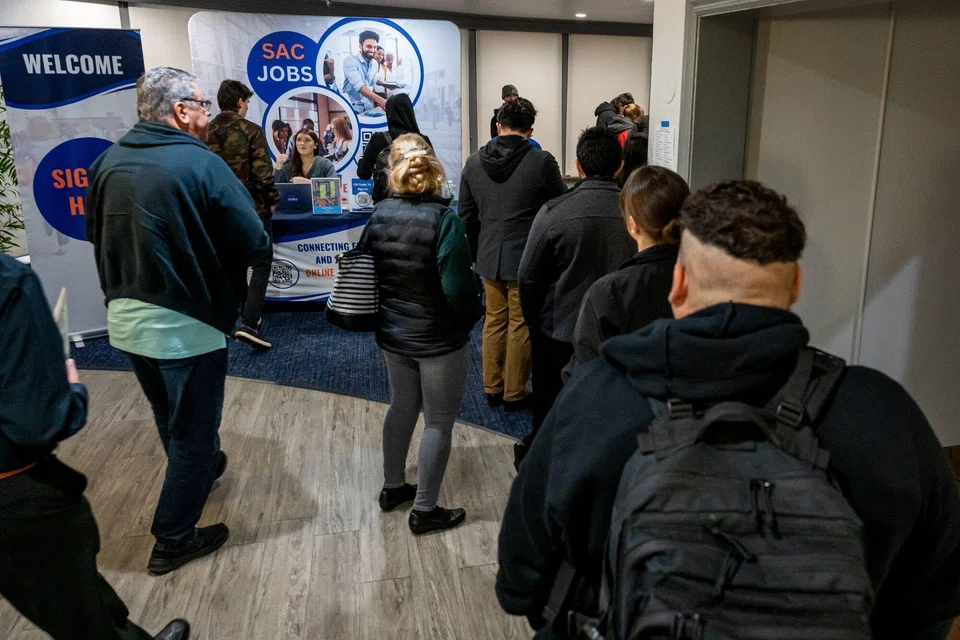
[WASHINGTON] The number of Americans filing new claims for unemployment benefits unexpectedly fell last week, though the decline was likely exaggerated by the Labour Day holiday, with the underlying trend pointing to continued labour market stability.
The labour market has regained its poise after wobbling through much of summer. That gives the Federal Reserve room to focus on fighting inflation stemming from the Middle East conflict.
The US central bank on Wednesday raised interest rates for the first time since July 2023 and flagged further increases in borrowing costs in the months ahead.
“The exceptionally depressed number last week might reflect seasonal adjustment issues related to Labour Day, but the underlying picture remains encouraging,” said Samuel Tombs, chief US economist at Pantheon Macroeconomics. “For now, then, the Fed will remain laser-focused on inflation.”
Initial claims for state unemployment benefits dropped 10,000 to a seasonally adjusted 196,000 for the week ended Sep 12, the lowest level since mid-July, the Labor Department said on Thursday. Economists polled by Reuters had forecast 208,000 claims for the latest week.
The surprise drop likely reflected volatility around last Monday’s holiday. Claims are difficult to adjust for seasonal fluctuations around moving public holidays. The four-week moving average of claims, considered a better measure of labour market trends as it irons out week-to-week volatility, fell 2,750 to 203,250 last week.
Fed Chairman Kevin Warsh singled out the labour market as “one basic sign of strength,” adding that policymakers believed “that the unemployment rate is basically running consistent with full employment.” The Fed’s overnight benchmark interest rate was hiked by 25 basis points to the 3.75 to 4 per cent range.
The claims data covered the week during which the government surveyed employers for the nonfarm payrolls component of September’s employment report. The four-week average of claims was little changed between the August and September survey weeks, suggesting steady labour market conditions.
Nonfarm payrolls increased by 162,000 jobs in August after job growth slowed sharply in the prior three months.



The claims report showed the number of people receiving unemployment benefits after an initial week of aid, a proxy for hiring, dropped 39,000 to a seasonally adjusted 1.730 million during the week ended September 5, the lowest level since January 2024.
Economists said the so-called continuing claims had also been impacted by seasonal adjustment issues.
“Continuing claims are at similar levels to May 2023, a time when the unemployment rate was only 3.6 per cent,” said Abiel Reinhart, an economist at JPMorgan. “The pattern of residual seasonality in continuing claims is different than for initial claims, and continuing claims could edge higher again starting in late September.”
The unemployment rate was at 4.1 per cent in August. It is being held down by low layoffs and a smaller labour force, amid slow population growth, retirements and a clampdown on immigration.
Economists say businesses remain hesitant to boost hiring in the face of headwinds, including the US-Israeli war with Iran, which is driving up oil prices and stoking inflation.
Stocks on Wall Street rose as investors took heart from a pullback in oil prices, though they stayed above US$100 a barrel on fears the Middle East conflict could widen.
The dollar eased against a basket of currencies. US Treasury yields fell, with the yield on the benchmark 10-year note sliding to around 4.947 per cent after rising above 5 per cent this week.
Mortgage rates surge
Rising inflation is boosting mortgage rates, putting pressure on the housing market.
A separate report from the Commerce Department’s Census Bureau on Thursday showed permits for the future construction of single-family homes dropped 1.8 per cent in August to a seasonally adjusted annualised rate of 878,000 units. Building permits increased 1.3 per cent on a year-over-year basis.
The decline over the month in permits followed on the heels of news on Wednesday of a slump in single-family homebuilder sentiment to a one-year low in September.
The National Association of Home Builders blamed the deterioration in morale on rising mortgage rates as well as worsening labour shortages because of an immigration crackdown and higher prices for materials amid import tariffs.
The average rate on a 30-year fixed-rate mortgage has jumped nearly 100 basis points since the Middle East war started. It averaged 6.95 per cent in the latest week, the highest level since January 2025, data from mortgage finance firm Freddie Mac showed.
The drop in permits overshadowed a 7.6 per cent surge in single-family homebuilding to a rate of 918,000 units. Single-family housing starts increased 5.2 per cent year-over-year in August.
Building permits for housing projects with five units or more, a very volatile segment, dropped 3.1 per cent to a rate of 467,000 units last month. Overall building permits fell 2.7 per cent to a rate of 1.394 million units. They increased 3.5 per cent on a year-over-year basis in August.
Multi-family homebuilding plunged 22.5 per cent to a rate of 344,000 units in August. Multi-family housing starts decreased 15.5 per cent on a year-over-year basis.
Overall housing starts fell 2.6 per cent to a pace of 1.275 million units. They decreased 1.2 per cent on a year-over-year basis in August. Residential investment has contracted in five of the last six quarters.
A third report from the National Association of Realtors showed contracts to buy previously owned homes increased 0.3 per cent in August. Contracts, however, plunged 4.7 per cent year-on-year.
“The housing market is not the brightest dot on the Fed’s radar right now, with multiple supply and price shocks hitting output and demand all at once,” said Carl Weinberg, chief economist at High Frequency Economics. “The Fed cannot fix what is wrong in this sector with monetary policy.” REUTERS
Decoding Asia newsletter: your guide to navigating Asia in a new global order. Sign up here to get Decoding Asia newsletter. Delivered to your inbox. Free.
Share with us your feedback on BT's products and services
TRENDING NOW

DBS, OCBC, UOB rout lops billions off STI as inflation, rate concerns spook investors

Grab CEO’s wife Chloe Tong on life with Anthony Tan and finding her purpose

OCBC sheds S$8 billion in value as shares close nearly 6% down; analysts cautious on banks

Deal between tycoon friends sparks scrutiny of Philippine power sector

