Xi plays long game on US chip retaliation after Nvidia whiplash
The scale of the new curbs’ impact will hinge on how thoroughly the measures are enforced
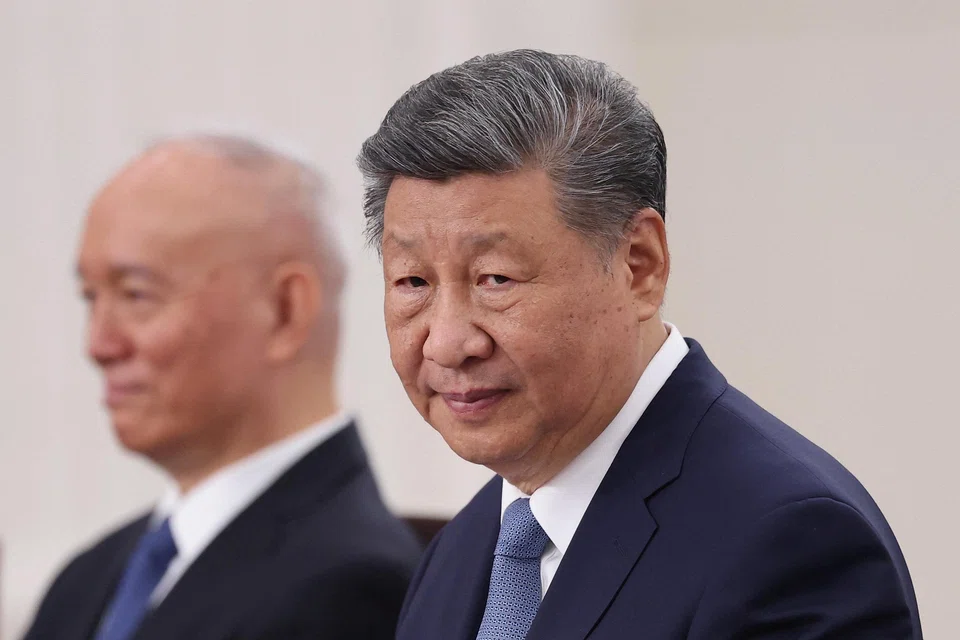
[BEIJING] After a week of whiplash over Jensen Huang’s future and new US chip curbs, Beijing sent a clear message to Washington about their trade truce: China is holding up its side of the bargain, for now.
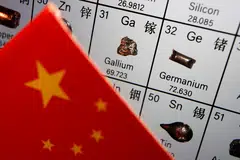
Days ahead of a looming deadline, China’s commerce ministry on Tuesday (Nov 24) extended its pause on US export curbs for some critical minerals key to making goods from chips to military equipment, including gallium, germanium and antimony.
That decision was seen as an important test of a detente between the world’s largest economies, after the US in November imposed new rules to limit Chinese access to advanced semiconductors.
Shortly after, China Southern Airlines subsidiary announced it had agreed to buy 50 Boeing 737-8 jets – the American giant’s biggest order from a Chinese airline since 2017, and one that helped meet a pledge from a May summit between US President Donald Trump and his Chinese counterpart, Xi Jinping.
Both moves followed Trump’s lobbying of Nvidia to bring back Huang as CEO – a comeback that reinstates one of America’s biggest supporters of selling high-end chips to Beijing.
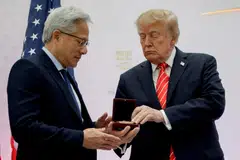
While there is no evidence the moves were connected, the gestures show China is biding its time for any retaliation as it seeks to manage disputes directly with Trump, who will meet Xi again in December at a Group of 20 leaders’ gathering in Florida.

Zhou Mi, a researcher at China’s commerce ministry, said Beijing wants to uphold the consensus reached by the two presidents, and recognises that different US agencies have “different practices”.
“We’re having some patience for the US as it tries to decide what they want to do,” he added. “There’s still a possibility of taking action in the future. We do have many options.”
China’s response will ultimately depend on the impact of US actions on its interests, especially those of Chinese enterprises, Zhou added.
SEE ALSO

Incentive for keeping ties stable
For Xi, the domestic political calendar adds incentive for keeping ties with the US stable.
China’s top leader is entering the closest thing his country has to campaign season ahead of a major leadership congress next year.
While Xi is widely expected to clinch a fourth term in office at that huddle, purges are still rocking the highest echelons of power, demanding his attention at home – China on Tuesday probed its fourth Politburo member of this cycle.
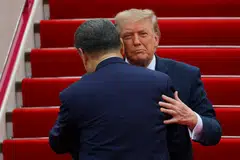
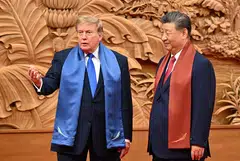
China appears to be betting Xi’s personal rapport with Trump, which was on display last week at a summit in Shenzhen, can help ride out the current turbulence.
The US unveiled its sweeping new curbs in the aftermath of the Republican Party’s defeat in the midterm elections, and reported that Huang conducted an affair with an alleged Chinese spy. Both moves gave momentum to calls from China hawks in Washington to tighten measures on Beijing.
The scale of the new curbs’ impact will hinge on how thoroughly the US enforces the measures.
Nearly a third of China’s advanced compute had been forecast to come from renting overseas data centres by the end of 2027, while another 7 per cent would come from chip smuggling, according to estimates by the Institute for Progress, a Washington-based think tank.
Both avenues are now under scrutiny.
China’s commerce ministry said last week the restrictions violate understandings reached by the two leaders – code for the trade truce – and warned of unspecified countermeasures if Washington proceeds.
Allowing the gallium suspension to expire would have let Beijing retaliate without announcing new restrictions.
While China probably planned the extension before Huang’s return, the decision to announce it several days early could have been designed to send Trump a message, said Dennis Wilder, the CIA’s former deputy assistant director for East Asia and the Pacific, who is now a senior fellow at Georgetown University.
“It’s very reassuring to the Chinese to have the president come out so forcefully in support of Jensen Huang, who is one of their best friends in the US,” said Wilder.
“For the Chinese, the Jensen Huang thing is a huge victory because it says that Trump, whatever other people want to do in tech exports, believes in tech exports to China.”
Beijing has not ruled out retaliation in the long run – especially if more curbs are announced.
Zhao Minghao, deputy director of Fudan University’s Center for American Studies, said China was keeping the trade truce alive while preventing the artificial intelligence dispute from spilling over, rather than rewarding Huang’s return.
China is compartmentalising the latest curbs from the truce rather than looking past them, he added. “Beijing retains a re-escalation switch if Washington’s next chip move goes further.”
Another looming flashpoint is Washington’s Section 301 investigation into manufacturing overcapacity, which could bring additional tariffs on Chinese goods and put further pressure on the truce.
US Trade Representative Jamieson Greer said he expects the probe to conclude by year-end in a recent Bloomberg Television interview.
Critical minerals
China first imposed its US-specific critical minerals ban in December 2024 in retaliation for the Biden administration’s widening chip curbs.
It suspended its enforcement last November after Trump and Xi struck a trade truce in South Korea, setting Nov 27, 2026 as the expiration date.
The extension brings the suspension into line with other elements of the truce, including tariff relief and a pause on additional Chinese export controls on rare earths set to expire on Jan 10.
China’s dominance of critical mineral supply chains proved a powerful source of leverage in last year’s trade war, when Beijing’s export controls helped pressure Washington to back down.
China accounts for 99 per cent of global production of primary low-purity gallium, about 80 per cent of natural graphite output, and 36 per cent of mined antimony, according to US Geological Survey estimates for 2025.
The agency also identified China as the leading global producer and exporter of germanium metal in 2025, without specifying its share.
Critical minerals are not the only means China has to gain leverage over the US, said Brian Wong, an international relations expert at Hong Kong University.
He listed strategic regulatory reviews and market access pressure on American multinationals as other options as well.
“Beijing is opting for calibrated patience over immediate confrontation,” he added, “but its coercive options remain firmly on the table.” BLOOMBERG
Decoding Asia newsletter: your guide to navigating Asia in a new global order. Sign up here to get Decoding Asia newsletter. Delivered to your inbox. Free.
Share with us your feedback on BT's products and services