A year after Doge, Trump administration is quietly hiring again
Job announcements at government’s main hiring portal are up 23% in March from the month before
[WASHINGTON, DC] During the first year of his second presidency, US President Donald Trump dispatched a chainsaw-wielding billionaire to loudly eliminate more than 300,000 federal jobs in an unsparing attempt to shrink the government.
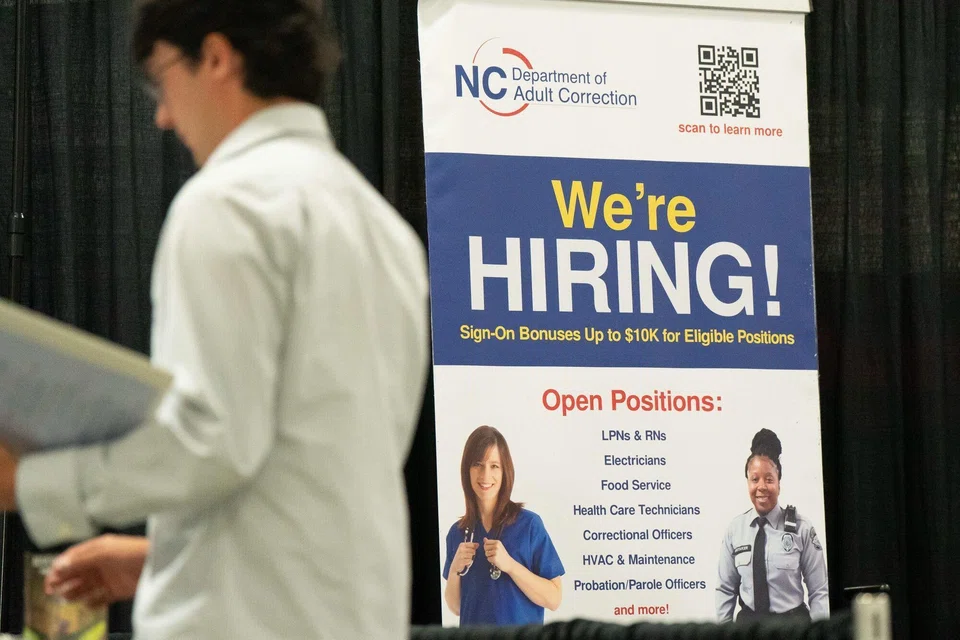
Now, the Trump administration is quietly hiring again.
Job announcements posted to the federal government’s main hiring portal were up 23 per cent in March from the previous month. The government has launched new recruiting drives targeted at tech staff, lawyers and project managers.
The budget proposal that Trump submitted to Congress this month would authorise a small increase in the total full-time equivalent employment in 2027.
Though those numbers are not directly comparable to actual employment, they would give the government headroom to grow the workforce.
“I’m trying to be louder on hiring,” said Scott Kupor, the director of the Office of Personnel Management (OPM), in an interview.
Kupor, a former managing partner of Andreessen Horowitz, was confirmed by the Senate six weeks after Tesla CEO Elon Musk left the White House in 2025.
Musk’s self-styled Department of Government Efficiency, or Doge, had launched a shock-and-awe campaign to vastly downsize the federal workforce through a combination of early resignation incentives, mass firings and micromanagement.
Those sweeping efforts have largely run their course, and courts have struck down some Trump administration efforts to impose layoffs.



Federal government employment is now the lowest it has been since 2009, approaching the two million employee mark. But by the end of the second quarter, Kupor expects federal hiring to turn a corner.
“If things stay on trajectory, which I expect, we will be net positive for the year,” he said.
Those top line numbers conceal significant churn, however.
Trump’s 2027 budget would dramatically reduce civilian head counts at the Departments of Agriculture, Education and Labour, as well as at National Aeronautics and Space Administration.
But other agencies would experience net increases, including Commerce, Defense, Interior and Transportation.
“The areas where they’re planning to hire are not the areas where they have decimated the workforce. It’s different areas,” said Jacqueline Simon, the policy director for the American Federation of Government Employees, the largest union of federal workers.
She added: “Can these people turn around and apply for a new federal job? Yeah, they can start all over again – but only after a period where they have no rights and are probationary employees all over again. It’s not an attractive prospect.”
Kupor’s job is to recruit top talent to a federal government that is simultaneously growing and eliminating jobs. This comes as the same technology and demographic trends upending the broader US workforce disrupt it as well.
He has to do it against a political backdrop of Trump’s attacks on the civil service, which the president said is part of a “Deep State” undermining his administration.
After a cavalcade of Doge headlines, Kupor acknowledged that tension.
He described last year’s reductions as part of a “reshaping”, which includes getting rid of low performers but also hiring for the skills the government needs.
“I don’t have a hard time keeping two things in my mind on that, but I understand it,” he said.
“I think good people want to be in a high-performance culture. We are trying to say, let’s hire great people on merit-based principles – not on tenure and proxies for it – and when they come in here, let’s hold people accountable.”
Civil service advocates said that the administration’s efforts to strengthen the workforce are an improvement, but do not show that they have learnt the lessons of last year’s chaotic cuts.
“They fired – in a non-strategic, arbitrary way – a huge number. And they demolished the morale of those that remain,” said Max Stier, the president of the Partnership for Public Service.
“So they’re at best trying to recoup lost ground that they created, that they caused. And they’re not yet fully grappling with the importance of valuing the workforce itself.”
Kupor said that he is doing that by pushing through a number of regulatory changes to streamline hiring and firing.
The change in a 19th-century hiring policy, known as the “rule of three”, will expand the pool of qualified applicants for a position.
OPM is also seeking to update credentialling requirements. It will overhaul a performance review system that gives top marks to more than 90 per cent of federal supervisors.
Stier said that many of those reforms were long overdue. But they were dwarfed by Trump’s efforts to undermine civil service protections.
The president is expected to sign an executive order that could move as many as 50,000 federal employees to a new classification, which would make it easier for them to be fired.
Youth movement
Musk’s short and tumultuous tenure in Washington brought about a culture clash within the new administration, as a cadre of young Doge staffers helped to overhaul obsolete systems but also ran afoul of privacy and security protocols.
Kupor said the government needs to find a way to attract more young tech talent. Less than 8 per cent of US government employees are under 30, indicated OPM data, against 23 per cent for the workforce overall.
The government is trying to narrow that gap through social media campaigns that appeal to online gamers, space aficionados and other communities that it has not always reached.
Its pitch: Come work on some of the biggest tech challenges while building valuable skills.
“No experience, no problem,” read one post promoting EarlyCareers.gov – a new recruitment site for federal agencies.
By courting younger workers, Kupor said, the government can increase headcount while also keeping overall employment costs lower.
But Stier noted that the age curve has gotten older under Trump’s first year, not younger.
“Why is that?” He said. “Because the Trump administration, in its fury at the workforce, went after probationary workers – and actually disproportionately removed that younger, tech-savvy cohort that we so desperately need.” BLOOMBERG
Decoding Asia newsletter: your guide to navigating Asia in a new global order. Sign up here to get Decoding Asia newsletter. Delivered to your inbox. Free.
Share with us your feedback on BT's products and services