

Zohran Mamdani is sworn in as mayor of New York City
He is the city’s first Muslim and first South Asian leader
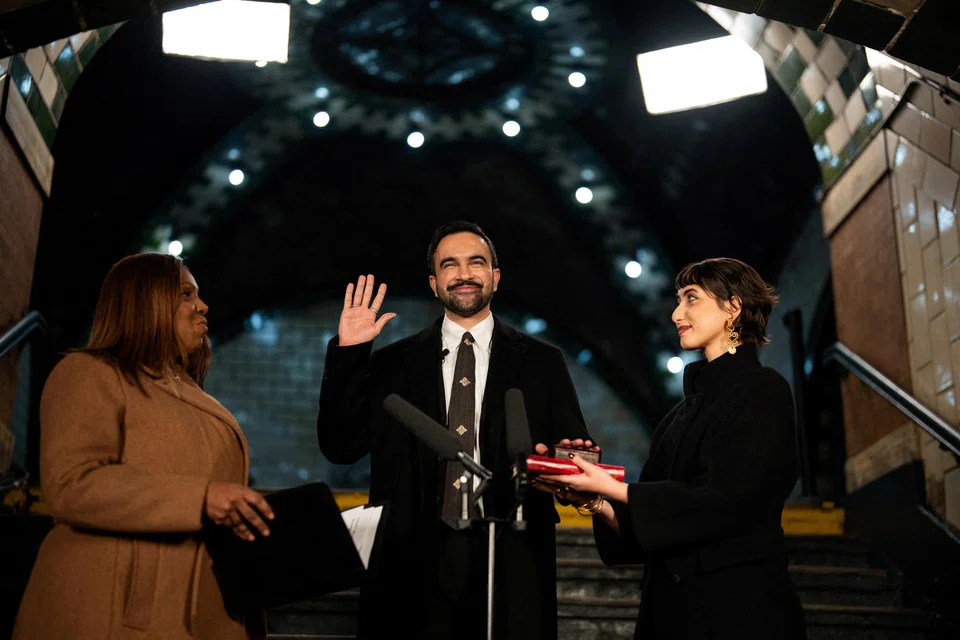
[NEW YORK] Zohran Mamdani, the left-leaning populist who deployed a mix of charm, social media savvy and an unyielding focus on affordability to catapult him to political stardom, was officially sworn in as mayor of New York City early on Thursday (Jan 1), just after the New Year’s Eve ball dropped in Times Square.
The ceremony, held underground at an abandoned showpiece of a subway station by City Hall, caps Mamdani’s year-long rise from obscure state lawmaker to international figure, embodying the hopes of New Yorkers and Americans across the country who were enthralled by his journey to becoming the city’s first Muslim and first South Asian mayor.
Four minutes before midnight, Mamdani, 34; his wife, Rama Duwaji; and Letitia James, the state attorney-general, disembarked from a No 6 train into the grimy, dimly lit – yet stunning – subway station.
They promptly took their places on the steps beneath a dramatic archway emblazoned with the words “City Hall”. And then they waited, a bit awkwardly, a bit jovially, for the arrival of the appointed hour.
And finally, after an impromptu countdown to midnight and cries of “Happy New Year!”, Mamdani placed his left hand on two Qurans held by his wife, raised his right hand and recited the oath of office. (One Quran belonged to his grandfather, the other belonged to Arturo Schomburg, a Black historian and writer.)
James swore in Mamdani as a smattering of family, allies and reporters looked on. She said, to cheers: “Congratulations, Mr Mayor.”
Mamdani then signed the oath of office, handed the requisite US$9, in cash, to the city clerk, Michael McSweeney, and signed a leather-bound book so the clerk could attest to the validity of his signature on future city documents.
The swearing-in ceremony took all of 10 minutes. The mood was understated, and the crowd intentionally intimate, with roughly 20 people in attendance, including the parents of Mamdani and Duwaji.
“He has led people ever since he could, I think, so it doesn’t seem like out of the blue, it seems very much in the river of things,” Mamdani’s mother, film director Mira Nair, said after the brief ceremony. “But this was unimaginable, but I think quite beautiful.”
SEE ALSO
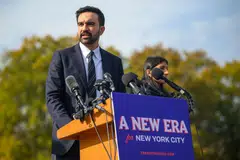
A public inauguration will take place at 1 pm on Thursday on the steps of City Hall, an event that will feature two of Mamdani’s most powerful colleagues on the left: Senator Bernie Sanders of Vermont, who will administer a ceremonial oath of office; and Represenative Alexandria Ocasio-Cortez, who will make opening remarks.
The cinematic optics of political messaging
The earlier swearing-in was held in a long-shuttered relic from New York City’s past, an artefact from an era when leaders sought to merge beauty with utilitarian needs: The old City Hall subway station, which, with its tiled arches, chandeliers and vaulted ceilings, opened in 1904 as a showcase destination among New York’s 28 original subway stations.
Mamdani, who, as a state legislator, helped bring free buses to parts of the city, is both an unabashed champion of transit and inordinately skilled at the cinematic optics of political messaging.
Much about the event was freighted with symbolism, starting with the choice of James, the New York attorney-general and arch-antagonist of President Donald Trump, to administer the oath of office.
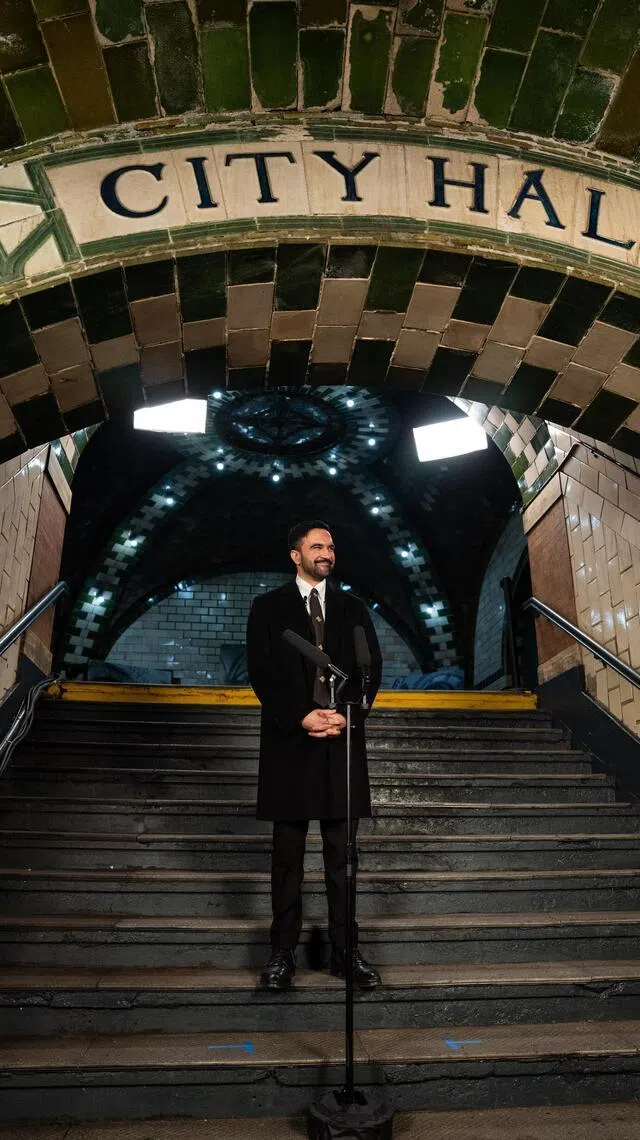
The ornate station itself embodied a belief that New York leaders could elevate life for millions of New Yorkers by creating a grand subterranean vascular system. It is, Mamdani said after midnight, “a testament to the importance of public transit, to the vitality, the health, and the legacy of our city”.
Then, Mamdani invited his newly minted transportation commissioner, Michael Flynn, to stand by his side.
Mamdani made only limited remarks after his midnight swearing-in. He is expected to be more expansive on Thursday afternoon, when he is likely to embrace a message of hope and possibility for ordinary New Yorkers.
The day after he won the general election, Bhairavi Desai, a labour leader born in the Gujarat state of India, where some of Mamdani’s family traces its roots, found herself crying.
“All I could think was, as someone who grew up poor, was raised by parents who died poor, that for the first time in my lifetime, I was going to see a mayor that loved poor people – that loves the poor and despises their poverty,” she said.
She added that the corruption that surrounded former mayor Eric Adams and his administration, as well as what she called “the blatant racism” of Trump, has caused a lot of cynicism.
“I think with Zohran, what you see is what feels like this endless capacity of compassion and a real honestness,” she said.
Monumental tasks ahead
It remains to be seen how far those qualities will carry him, as the tasks confronting Mamdani are monumental, and New Yorkers are famously unforgiving.
He will oversee 300,000 employees working in dozens of city agencies – many of those agencies, individually, the largest of their kind in the nation – while attempting to make more affordable a city that 8.5 million people call home and that is subject to economic headwinds beyond his control.
He will grapple with a police department he once called racist. He will manage America’s most Jewish city at a time when many Jewish New Yorkers remain sceptical of a politician who came up in the pro-Palestinian movement and still refuses to denounce a phrase – “globalise the intifada” – that they see as a call for violence.
And then there is his actual agenda.
A self-described child of privilege, Mamdani ran for office vowing to make New York more affordable by establishing universal day care, freezing rent for rent-stabilised apartments, and making city buses fast and free.
The rough annual price tag for those initiatives is US$7 billion, and he will need state support for them at a time when Kathy Hochul, the moderate Democratic governor of New York, is facing re-election and potentially harrowing federal budget cuts.
But the private and public swearing-in ceremonies are not the place to dwell on such challenges. Rather, the spotlight will be on the assembly member who skyrocketed to international fame and whose youth and inexperience makes him redolent with possibility.
Following the ceremony, Mamdani left the underground station via a hatch into City Hall Park, some 80 years after it shut its doors to passengers, and commenced his life as mayor. He was spotted minutes later in his new offices at City Hall.
Later on Thursday, he will appear on City Hall’s steps at a celebration that is expected to be jubilant and heavily attended. The transition team anticipates some 40,000 spectators, including Adams, who did not attend Mamdani’s private swearing-in.
Adams spent the last minutes of his mayoralty where it began, in Times Square, pushing the button to launch the ball drop.
Earlier, in Lower Manhattan, near where Mamdani made a popular video using halal food trucks to illustrate the rising costs in New York, vendors could not hide their excitement over the incoming mayor.
Saudi Mahmoud, 44, said he voted for Mamdani, and hoped that he would ease the cost of living, citing his plan to make city buses free. He added that for the nearly two decades since he arrived in New York from Pakistan, it had been hard to envision a Muslim mayor here.
“Before? No,” he said. “But now, it’s OK.” NYTIMES
Decoding Asia newsletter: your guide to navigating Asia in a new global order. Sign up here to get Decoding Asia newsletter. Delivered to your inbox. Free.
Share with us your feedback on BT's products and services
TRENDING NOW

Singapore updates renewable energy certificate standard to tackle greenwashing; unveils new solar efforts
Director of PR firm sacked for secretly recording internal meeting loses wrongful dismissal claim
Indonesia says gas export cuts to Singapore remain within contract terms

Time for MAS, SGX to scrutinise issue managers

