2026 BMW iX3 review: Shocking real-world range
The brand’s biggest ever technology gamble is wrapped in the body of an electric family SUV with long legs and a nice face
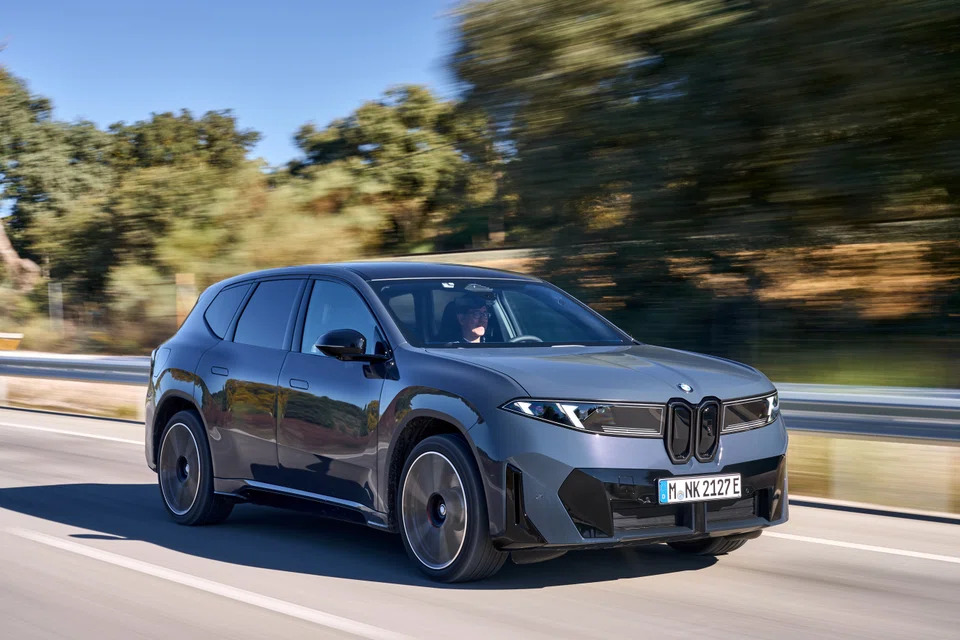
[RONDA, MALAGA] A private track for wealthy car enthusiasts is the last place I expected to drive an electric sport utility vehicle (SUV) like the new BMW iX3. With its ultra-smooth tarmac, the Ascari Circuit, high in the hills of Andalusia, is more of a playground for Porsches and Ferraris.
Yet, here I was in southern Spain, being gleefully ushered into an electric vehicle (EV) that represents BMW’s massive bet on its future. “Use the track to play with the car a little bit,” a chassis specialist said when I climbed behind the wheel. “See how the car reacts and see how it has no delays in following your inputs.” He didn’t have to tell me twice.
BMW clearly had a point to make in letting the press fling the iX3 around Ascari’s banked corners, technical bends and blind crests. Beyond being just another new model, the iX3 debuts a technology platform dubbed “Neue Klasse”, or “new class”.
Tellingly, the name is lifted from a model line that rescued BMW from bankruptcy in 1962, and set the stage for definitive cars like the 5 Series and 3 Series.
The Munich-headquartered company poured more than 10 billion euros (S$15.1 billion) into the new platform, its single largest investment in tech development ever, after the pandemic gave management a chance to sit back and rethink what a modern BMW should be.
The result you see here is the starting gun for 40 new or upgraded cars that BMW intends to roll out by 2027.
Fruit of all the spending
The iX3 is also the model that reveals the fruit of all that spending: a new electronics architecture that controls everything with four powerful computers instead of dozens of small ones, new battery and motor tech, a new software platform, a new user interface (UI) and above all, a new design language.
Put another way, if buyers dislike what the new iX3 has to offer, BMW itself will be neck deep in goulash.
On paper, the new iX3 definitely impresses. The iX3 50 xDrive that will spearhead the model’s launch has two motors that belt out 469 horsepower, enough to hurl the nearly 2.4-tonne BMW to 100 kmh in only 4.9 seconds.
With new cylindrical cells that are more space efficient, and new chemistry that is 20 per cent more energy dense, the iX3’s battery pack has a large capacity of 108.7 kilowatt-hours, enough to power it for up to 805 km on a single charge.
That’s a best-case scenario number, but the iX3 is impressively long-legged in the real world. Or at least, the mountainous, Spanish countryside part of the real world, where I did my level best to convert battery power into white-knuckle acceleration repeatedly.
Even then, I ended up consuming 70 kWh over 310 km – which implies I would have run out at 475 km, a laudable distance when you’re trying to burn energy instead of save it.
Nevertheless, BMW’s new 800 volt architecture means the iX3 regains range fast; a 400 kW charger can push 372 km into the battery in just 10 minutes, which is almost as good as a petrol stop.
Different kind of speed
At Ascari, it was a different sort of speed that impressed me. Cars tend to feel slow on empty tracks, and electric cars accelerate with so little drama and noise that they mask the sensation of speed, but the iX3 took to Ascari’s curves like a barracuda to water.
It gets up to speed so rapidly and with so much composure that you end up drastically underestimating how fast you’re going. That’s my excuse, anyway, for entering a lane change manoeuvre at 145 kmh when the target speed was 120, and knocking half the cones down as a result.
That blunder aside, I discovered that the iX3 is impossibly easy to drive quickly. Through high-speed bends it’s benign, neutral, grippy, while tighter turns reveal how it’s agile and tidy, with none of the sloppiness you’d expect from a heavy family SUV.
If the electronics were helping, I didn’t feel their hand. A new dynamic control brain that BMW calls the “Heart of Joy” without a trace of irony replaces dozens of scattered ECUs with a single brain that can oversee things about ten times faster.
It acts as the iX3’s dynamic puppet master, coordinating the motors, brakes and steering in real time so you never feel the strings being pulled. More importantly, it stays behind the curtain, so to the driver, the car simply feels like a well-sorted BMW.
Polished demeanour
Out on the road, that character softens into a smooth, polished demeanour. The ride is firm, yet it’s impressively well-damped, and the braking is incredibly smooth. The iX3 I drove didn’t have air suspension or active shock absorbers, and for a car that rides on old-fashioned steel springs, its overall composure was its single most remarkable quality.
As a matter of fact, despite being a fiend on the track, the iX3 is a family SUV at heart.
The nearly 2.9-m wheelbase gives it as much rear legroom as today’s X5, and the packaging is excellent: 520 litres of boot capacity (1,750 with seats down) is paired with a 58-litre frunk.
Every version comes with six-way electric front seats and a wireless charging pad, two high-power USB-C ports and, alas, air-con vents that you have to aim with the digital screen, which is a major faff. There’s every chance you’ll be doubly annoyed by that on a hot day, too, because the glass roof doesn’t come with a sun shade.
All that sunlight pouring into the cabin does plenty to give it an open, airy feel, but it also reveals how hard and shiny many of the plastics are.
In general, the cabin materials simply don’t feel expensive enough for what the iX3 is supposed to represent, especially in the back where the plastics are plainly workmanlike. It’s a letdown, and a worrying one because this is a car that’s meant to signal BMW’s future.
Customising projection
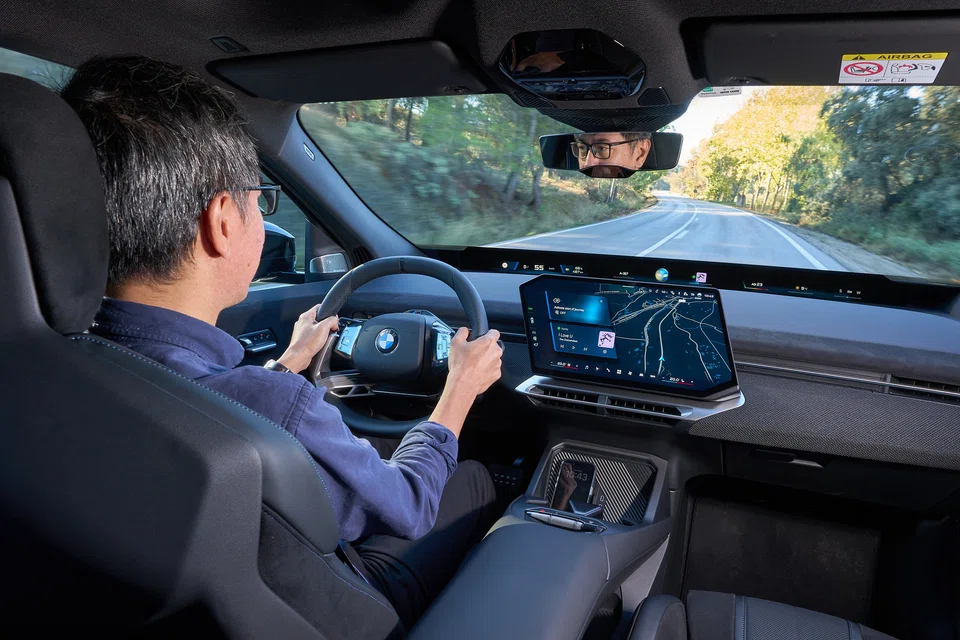
I do like the new Panoramic iDrive system, though. The 17.9-inch touchscreen is squished down into a parallelogram so it naturally angles toward the driver, and it works in tandem with a 1.5-metre, pillar-to-pillar Panoramic Vision projection that you can customise.
Both look slick and are oddly immune to glare, and the driver information sits far enough away to be wonderfully clear for my 50-year-old eyes.
BMW OS X, the new operating system, does take some learning. I wouldn’t call it intuitive because you do have to hunt around for certain functions, but familiarity should sort that out. I would have liked physical controls for the air-con, but at least the digital ones have permanent places on the screen.
Panoramic iDrive sounds and looks gimmicky at first, but it’s a welcome break from the iPad-on-the-dashboard approach to screens that every other EV maker seems to take. Just as well it looks so good, too, because it’s coming to every new BMW.
In fact, the iX3 pushes the reset button on BMW’s styling direction both inside and out. The slender kidneys (you can’t call them grilles because they no longer function as such) and horizontal light signature are a relief from the grotesque oversizing of recent years.
The next generation of BMW SUVs will have a similar face, while the saloons will have a design that plays up horizontal lines.
Prettier and more cohesive
In any case, the iX3 strikes me as a prettier, more cohesive car than the current combustion X3. More importantly, it’s still instantly recognisable as a BMW.
That matters because, by my estimates, it will cost around S$390,000 at today’s Certificate of Entitlement premiums, and people will only part with that kind of money if the iX3 50 speaks clearly to what BMW stands for.
We’ll find out the true price closer to the car’s Singapore launch in July, but while we’re on the subject, BMW is planning a single-motor version that could have a smaller battery, possibly called the iX3 40. That one would have less performance and less range, and could be closer to S$340,000 in price – again, pure speculation on my part.
Those sums still put the iX3 at a premium over the EVs pouring in from China or California, but people have spent the last half-century paying more for a BMW without complaint. Part of it is image (you do hold your head a little higher when you drive a BMW), and part of it is the promise of a good time behind the wheel.
Having driven it, I’d say both apply to the iX3, which means like most BMWs its sales aren’t a question of desire, but affordability. For a company betting its entire future on this platform, it’s neue or never.
BMW iX3 50 xDrive Motor Power/torque 469 hp / 645 Nm Battery type/Net capacity Lithium-Nickel Manganese Cobalt / 108.7 kWh Charging time/Type 11 hours (11 kW AC), 21 minutes 10 to 80 per cent (400 kW DC) Range 679 to 805 km (WLTP) 0-100 kmh 4.9 seconds Top speed 210 kmh Efficiency 17.9 to 15.1 kWh/100 km Agent Eurokars BMW or Performance Motors Price S$390,000 with COE (estimated) Available July 2026
Decoding Asia newsletter: your guide to navigating Asia in a new global order. Sign up here to get Decoding Asia newsletter. Delivered to your inbox. Free.
Share with us your feedback on BT's products and services