

Cross-sector collaboration needed to tackle social impact: panel
Crises present opportunities for philanthropy to step up and fill the gaps, panellists add
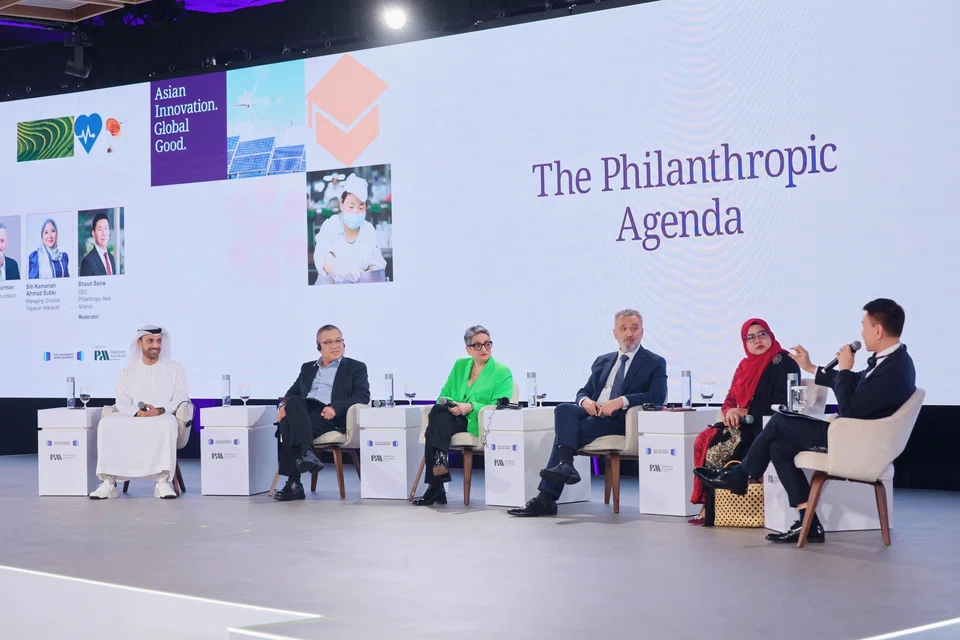
[SINGAPORE] The public, private and philanthropic sectors need to come together to solve complex social and environmental issues and drive social impact, said speakers at The Philanthropic Agenda panel at Philanthropy Asia Summit (PAS) 2026 on Monday (May 18).
This is especially important as the world faces challenges and crises. However, crises present opportunities for philanthropy to step up and fill the gaps, they added.
Siti Kamariah Ahmad Subki, managing director of Yayasan Hasanah, the impact-based foundation of Malaysia sovereign wealth fund Khazanah Nasional, said: “Climate shocks, economic uncertainty, social fragmentation, declining trust and rising inequality – all of this is forcing philanthropy to rebalance its portfolio of investments, and hence our interventions.”
For example, the Emirates Foundation launched an initiative in 2022 to reduce food loss and waste, in line with the United Nations’ Sustainable Development Goals.
Ahmed Talib Al Shamsi, CEO of Emirates Foundation, said: “The public sector has a bigger role in creating policies and legislations for any cause. The private sector has the innovation, tools and sometimes the funding to see through some of these causes…
“Philanthropy is the main orchestrator in mobilising feedback and people for long-term impact.”
In this particular case, the public sector came in by introducing policies to allow the foundation to redirect food surpluses for other purposes. Meanwhile, companies were able to test new innovations, particularly in regard to circularity.
Al Shamsi said: “Without the ‘4P’ – public, private and philanthropic partnership – philanthropy will not move as fast, and we will be working in silos.”
So far, the ongoing initiative has collected and diverted more than one million kg of food waste, and 76,600 kg of compost was converted into fertiliser, based on 2023 statistics.
SEE ALSO



However, challenges may also arise when it comes to collaboration, as parties may be unsure or hesitant to act due to uncertainty in project outcomes.
In an interview with The Business Times, panel moderator Shaun Seow, CEO of Philanthropy Asia Alliance (PAA), the Temasek Trust initiative that organises the summit, said: “I think there’s a bit of inertia in philanthropy, but we just have to step up… by bringing parties to talk together (and through) convening platforms like PAA and PAS.
“We can’t underestimate the power of convening because through such interactions, trust is built between various parties.”
Siti Kamariah added that the different philanthropic players should interact closely with beneficiaries and communities on the ground to build trust and gain a deeper understanding of how to help them.
Taking risks
On the panel, Shamina Singh said Mastercard has unlocked nearly US$600 million in credit over the last three years to help more than 10,000 female small-business owners in Vietnam.
She is the payment processing giant’s executive vice-president of sustainability, as well as the founder and president of the Mastercard Center for Inclusive Growth.
Focusing on capital, digital capabilities and access to networks, Mastercard’s multi-year partnership with global humanitarian agency Care helps to equip these women with entrepreneurial skills and gain access to capital and financial services.
“Philanthropy is part of a capital stack that can de-risk lending and de-risk the things that business dollars can fund,” she added.
Similarly, Jonathan Berman, CEO of Shell Foundation, said taking risks is essential when it comes to funding philanthropic projects – particularly in the private sector, as the public sector often pulls back from funding or managing such projects.
“Private capital is the largest and only pool to achieve the scale that we need, but to leverage that private capital, you need to be able to lead and take risks that others won’t take, and you need to get comfortable with that,” he noted.
Seow said the outlook for the philanthropic sector is positive. “Five years ago, Asian philanthropy was very much about funding one project, or traditional chequebook philanthropy. Today, we’re seeing people motivated to want to try things differently.”
On Monday, a new report – Philanthropy as Risk Capital in Asia: Bridging Innovation to Impact, written by the Centre for Asian Philanthropy and Society and commissioned by PAA – was launched at PAS.
It examined 10 case studies in the philanthropic sector spanning healthcare, climate and digital inclusion.
The report found that funders – mostly individual philanthropists and families – are willing to commit long-term capital to scale solutions. Beyond traditional grants, funders are exploring different ways for financing, from concessional capital to equity.
When it comes to collaboration, the report stated that projects with the greatest reach achieved this via early engagement with the government.
Separately, on Tuesday, CapitaLand launched the second edition of its Community Resilience Initiative (CCRI), with new funding of up to S$4 million.
Tony Tan, executive director of CapitaLand Hope Foundation (CHF) and chief corporate officer of CapitaLand Development, said: “CCRI 2026 builds on the 2025 foundation by shifting from one-off funding to sustained, outcome-driven solutions that strengthen the broader social impact ecosystem.”
The funds will go to 12 organisations across China, India, Singapore and Vietnam that support children and youth. Grantees can gain access to a new Outcomes Achievement Fund “upon successful delivery of defined results”, said the real estate group.
“Through CHF’s support and expanded partnerships, the initiative aims to build organisational capacity, scale proven models and deepen cross-sector collaboration, while enhancing access to regional networks,” Tan added.
Decoding Asia newsletter: your guide to navigating Asia in a new global order. Sign up here to get Decoding Asia newsletter. Delivered to your inbox. Free.
Copyright SPH Media. All rights reserved.
TRENDING NOW

Once staunchly pro-China, Malaysian Chinese businesses are now distancing themselves from Beijing

Looking beyond looming CEO succession, should UOB potentially pursue a transformative merger?

Could stablecoins be the future of money?

Grab CEO’s wife Chloe Tong on life with Anthony Tan and finding her purpose

