

Daughters of Tomorrow tackles youth employability for women with StanChart, Community Chest
Their Yes programme aims to benefit 300 young women in its first year
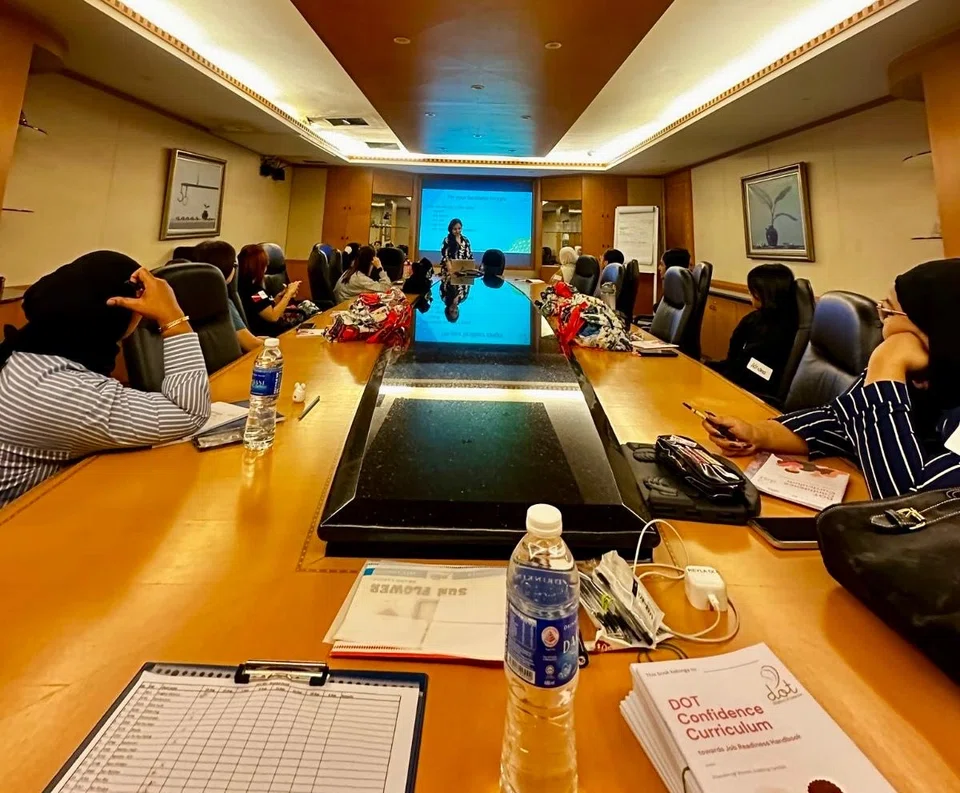
[SINGAPORE] Non-profit Daughters of Tomorrow (Dot) has launched its Youth Employment for Success (Yes) programme to help younger women in Singapore become more employable and secure a job.
The three-year programme, in partnership with Standard Chartered and Community Chest, helps beneficiaries build capabilities such as developing adaptability and problem-solving skills; connects them to employment opportunities; and motivates them through coaching that builds self-agency and resilience.
The tie-up started in July and is backed by Standard Chartered Foundation, which has pledged US$6 million to tackle youth employability.
Part of the funds will go towards the Yes programme, while the other part will be used for an Asean blue economy programme to explore opportunities in coastal and marine ecosystems.
Patrick Lee, chief executive, Singapore and Asean, StanChart, said: “Young people continue to face structural and systemic barriers that limit their access to sustainable employment and financial independence… These challenges stem from factors such as unequal access to skills training, limited employer networks (and) restricted access to finance.”
In particular, the funds will be used to develop new workshops and activities, as well as for outreach programmes and employer engagement.
Dot aims to benefit 300 young women in Singapore in the first year of the programme.
Lee said this commitment is “timely”. “Globally, one in five youth are not in employment, education or training. This includes 19 million young people in Asean alone, where young women are 1.5 times more likely to be unemployed compared to men.”
Targeting a younger demographic
Dot traditionally works with women in their 30s and above. However, Kaylee Kua, executive director of Dot, noted that many beneficiaries do not move out of the poverty cycle even after being employed.

“A lot of them are the sole breadwinners, but they are working in jobs with a take-home salary of less than S$2,000, so they remain in a state where they are still living hand to mouth – unable to save up or provide better opportunities for their children,” she said.
Therefore, Dot is looking to target beneficiaries from a younger demographic – aged 18 to 35. It is currently reaching out to institutions such as the Institute of Technical Education and polytechnics.
Kua added: “We want to go upstream to this group to set them on a different career trajectory from the get-go, so that employment is part of the equation in their family planning, instead of the current profile of older women that we serve that give up their careers in their early days to take care of their families.”
Based on her observations, a lot of the younger generation look at the gig economy as a “promising pathway” because they can earn a higher initial salary compared with full-time employment. However, this could lead to challenges in the long term.
“They will be unable to gain certain kinds of transferable skills in the workplace, to make sure that when they are in their 30s or 40s, they can continue to be gainfully employed instead of relying on the gig economy,” Kua said.
Dot will place greater emphasis on soft skills such as problem-solving skills. “For example, clients can run a project together and learn workplace skills,” she added.
A different approach
Dot is currently doing a landscape study with its youth beneficiaries, and early insights indicated that systematic programmes are no longer as efficient among younger women.
Hence, for the Yes programme, Kua said: “From next year, we’ll introduce more activity and workshop-based services for the younger groups. They are going to be less formalised and have less structure.”
However, the non-profit will still teach both hard and soft skills, such as digital literacy and foundational IT skills.
34-year-old Jane (a pseudonym), was referred to Dot in December 2024 and enrolled in its other programmes earlier this year.
She said: “Through Dot, I gained stronger communication skills and greater self-awareness from the Dot Confidence Curriculum, which helped me overcome self-doubt. The Basic IT and Workplace Digital Literacy programmes improved my computer skills, which boosted my confidence and employability.”
Supported financially through Dot’s Upskilling Fund, Jane was able to obtain a permanent part-time role as a security officer that fits her family’s routine, allowing her to care for her nine-year-old son.
For the Yes programme, Dot will work with employer partners who can create job opportunities that are suitable for beneficiaries. It is also looking for corporates to join and provide mentors.
Dot has an in-house monitoring and evaluation team that will regularly track how each beneficiary is faring with the programme.
The non-profit will also roll out Stoplight, a web-based coaching tool that helps beneficiaries assess themselves across multiple indicators such as income and employment. Based on their assessment, the beneficiaries can tell Dot what kind of support they need.
By the end of the programme in 2028, Kua hopes beneficiaries not only obtain a job and achieve career progression, but also form an alumni network to support other beneficiaries.
“We understand that for the younger generation, peer support is more important than having structural support from an organisation. Being able to form an alumni network will have great long-term impact for Dot,” she added.
Decoding Asia newsletter: your guide to navigating Asia in a new global order. Sign up here to get Decoding Asia newsletter. Delivered to your inbox. Free.
Copyright SPH Media. All rights reserved.






