Go green with these local brands

Quinn and Oliver quinnandoliver.com
As a regular consumer, Jerrine Koh acknowledges the convenience of plastic packaging.
But as a sustainably conscious one, she's more than concerned about how that plastic is disposed of.
"When it comes to single-use packaging for consumer products, we are producing at a speed way faster and creating more waste than we can recycle," says Koh.
Likewise, her business partner Shanna Ng worries about the kind of planet her children will inherit. "We read about the detrimental effects on our planet as a result of human consumption, and I believe we can do our part in one way or another to create a sustainable future," says Ng.
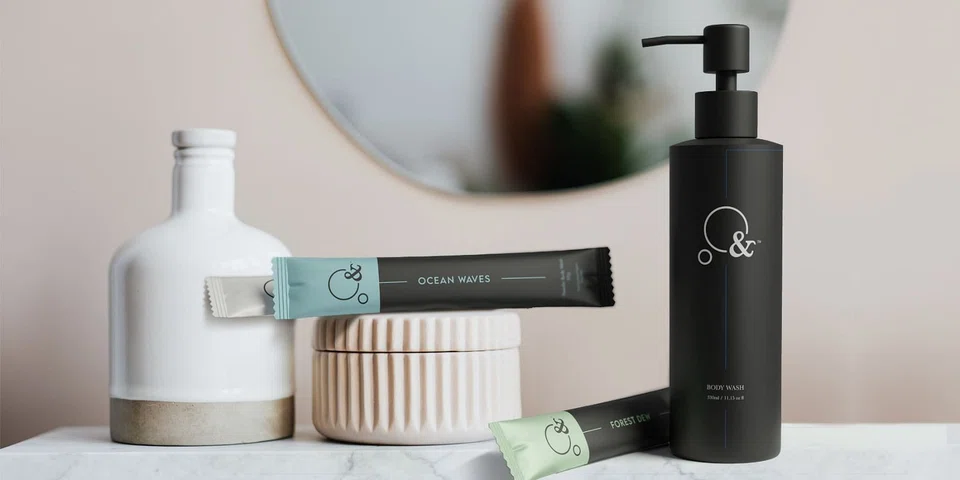
The duo, who run a boutique creative resource agency together, came up with Quinn and Oliver, a range of powder body wash in food grade stainless steel containers. Customers only need to fill the bottle with some water, add the powder wash and shake before using.
'%3e%3cpath%20d='M12.1475%2025.5262C13.7713%2025.4295%2014.94%2023.913%2014.94%2021.8832C14.94%2019.5359%2013.474%2018.093%2011.5917%2018.093C11.3745%2018.093%2010.9582%2018.093%2010.8393%2018.1413V25.2086L11.8891%2025.5745C11.8891%2025.5745%2012.207%2025.5262%2012.1475%2025.5262ZM11.4934%2017.6281C13.2567%2017.6281%2014.3843%2016.4292%2014.3843%2014.4501C14.3843%2012.372%2013.275%2011.2973%2011.4339%2011.2973H10.8393V17.6305H11.4934V17.6281ZM6.66078%2025.6482L7.39265%2025.5492C8.02617%2025.4502%208.26403%2025.3053%208.26403%2025.1097V11.6149C8.26403%2011.4193%208.1451%2011.3709%207.23484%2011.249L6.68137%2011.173L6.6219%2010.7588H11.9508C15.7153%2010.7588%2017.0624%2012.0797%2017.0624%2014.1578C17.0624%2015.9666%2015.7748%2017.1909%2013.4969%2017.6305V17.7041C16.111%2017.948%2017.6571%2019.5382%2017.6571%2021.7636C17.6571%2024.3318%2015.8937%2026.0417%2012.1109%2026.0417H6.60132L6.66078%2025.6482Z'%20fill='%232B2B2B'/%3e%3cpath%20d='M20.6287%2025.6505L21.5596%2025.5515C22.1725%2025.4779%2022.4104%2025.3076%2022.4104%2025.112V11.249H21.9346C20.073%2011.3479%2018.982%2013.0095%2018.408%2014.6227L18.1907%2015.5018H17.6555L18.1701%2010.7588H29.3837L29.6421%2015.4787H29.1664L28.9491%2014.6227C28.3728%2012.8645%2027.3047%2011.2743%2025.5002%2011.249H24.9856V25.1856C24.9856%2025.3812%2025.1251%2025.4548%2025.9965%2025.5515L26.7695%2025.6505L26.829%2026.0417H20.5693L20.6287%2025.6505Z'%20fill='%232B2B2B'/%3e%3c/g%3e%3cdefs%3e%3cclipPath%20id='clip0_5242_21648'%3e%3crect%20width='24'%20height='16.8'%20fill='white'%20transform='translate(6%2010)'/%3e%3c/clipPath%3e%3c/defs%3e%3c/svg%3e)
There is no need for single use plastic packaging because the bottles can be reused, and the body wash also comes in refill sachets. "We reduce plastic waste pollution by not ever having to discard a plastic bottle. We also reduce carbon emissions because the powder refills are light-weight where we eliminated water as a component, compared to traditional heavy liquid-filled containers," says Koh.
It took the pair a year of experimenting with different formulas and variations with their factory partner in Thailand.
"We had to ensure that the end product has good viscosity, washes well, the powder has good dissolvability with any water type while maintaining the integrity of the ingredients," says Koh.
But does living sustainably mean higher prices? Koh says when the brand first launched, prices were higher as the products were produced in smaller batches.
"However, with time and intensive R&D, we are now able to develop the products in a more cost-efficient way while being price competitive with conventional liquid body wash brands," says Koh.
Ng adds: "Customers have asked us to expand the product range. It is a very positive feedback, and we will look into it."
MAE Syne shootyourself.me
One man's trash is two men's treasure, just ask Ian Sam and Eshton Chua, who for the last 2 years have been restoring unwanted kimonos and giving them a new lease of life, under their label Syne Studio.
Sam and Chua previously worked in the fast fashion industry and were concerned by the large amounts of waste that was created. It spurred them to start Syne Studio.
Sam collects kimonos and Chua likes how traditional clothing can be modernised. "The kimono would thus be an easy step up from typical jacket forms to a piece that works as a bridge between casual outfits, smart casual and formal styles," he says.
The kimonos are sourced directly from Japan. They come in varying conditions - the better conditioned ones end up in secondhand stores, while worse ones end up in the bin.
"We have been able to connect with these suppliers to take the bales, packed with kimonos in whatever condition," says Sam.
The duo restore the kimonos themselves, cleaning off stains and hand stitching pieces back together. The restored kimonos are stylish enough to be part of everyday wear. "There are those who wear it as a fashion piece, pairing it as outerwear but with a deeper story to it, both historically and for what it represents in the culture of sustainability and the circular fashion economy," says Sam.
They recently launched MAE Syne, a collection of vintage high-end kimonos with extreme detailing using traditional techniques. "We started Syne as an initial invitation to the world of sustainable fashion, and MAE Syne is our foray into sustainable luxury," says Chua.
Sam adds: "All MAE Syne pieces showcase details that were originally meant for the highest tier of Japanese cultures. The new collection features exclusive pieces that can never be recreated, and are for an audience that lives within that realm of luxury."
MAE Syne was started as a suggestion from food consultant Ryan Hong, who also runs Shoot Yourself, a self photography studio. Hong had bought a Syne Studio kimono and felt that a more luxurious collection was missing, hence MAE Syne.
To let customers better appreciate MAE Syne, Hong has given his studio a Japanese touch, with a little Zen sand garden and bamboo racks displaying the kimonos. "The trick is to inspire the thoughts and theme of Japan meets modern Singapore, says Hong.
The Kint Co thekint.co
When Zen Lin started retailing Fitty, an activewear label, a few years ago, her mission was to sell quality and affordable gear that fits all body shapes.
The outdoors and sports enthusiast says starting Fitty taught her a lot about the activewear and fashion industry.
"However, it didn't sit right with me because I realised I was doing this at the expense of the environment," says Lin.
Fitty gear was made from virgin raw materials. "When the customers have outworn their activewear, these items will be heading for the landfill and there's no way to decompose them or reuse them," Lin says.
After almost a year of research, she relaunched Fitty as The Kint Co. But it is more than just a name change. The Kint Co's activewear is made from post-consumer plastic bottles, which have been crushed into pellets and then spun into yarn made of recycled polyester fibres (RPET). A sports bra is made from 10 recycled plastic bottles, and leggings are made from 15 such bottles.
"The only way to grow long-term is to switch to a more sustainable fabric. Right now we use RPET for our activewear, and this fabric can be broken down and recycled repeatedly into other products, with no effects on its quality," says Lin.
Lin has also switched from using untreated craft paper, to biodegradable bags, to compostable cornstarch bags, to water-soluble packaging.
Lin, however, feels that more can be done. She says that production of RPET still uses energy and also produces carbon emissions. "I don't think it is possible to be 100 per cent sustainable. It is a constant work in progress," says Lin.
She does her part by making sure that the products are produced in an environmentally responsible way. In addition, Lin works with reforestation companies, where a tree is planted for every order.
Lin still has the uphill task of converting customers to make green choices. "Most people think the label "sustainable" means "double the price", but it's not necessarily so. It's for us to communicate and show them how affordable and accessible our products are as a brand," says Lin.
Porcelain porcelainskin.com
Since 2015, home-grown premium skincare brand, Porcelain, has been making small and consistent changes on the sustainability front. That year, it began formulating its products with more sustainably harvested or lab-developed ingredients.
Its plastic bottles are made from recyclable plastics and where possible, the brand uses glass bottles and droppers to minimise non-recyclable waste.
While online orders for its products have gone up over the years, this has required more packaging. The brand now uses biodegradable bubble mailers, corrugated cardboard boxes and acid-free tissue paper printed with soya-based ink to minimise the strain on local waste management systems.
Its sustainable efforts extend to its spas where light fixtures are made from old Porcelain bottles, and even the therapists' uniforms are made from fabric using a mix of natural fibres and sustainably harvested wood.
Their efforts have not gone unnoticed by customers. "They have been very enthusiastic about sustainability, more so than we had expected," says a spokesperson, adding "we draw inspiration from the feedback we receive from our customers."
Its latest move comes after requests from customers to manage their empty bottles. Now, when customers return clean empty bottles of any brand for recycling, they are rewarded with points, which allow them to try Porcelain products.
"At Porcelain, it is all about doing well and doing good. We aim to better the lives of those we interact with through building deeper relationships while being highly conscious of the impact and value we create in the world," says the spokesperson.
The Powder Shampoo thepowdershampoo.com
For the last 4 years, Lynn Tan has been making sustainable choices when it comes to daily necessities. She's switched to using reusable cotton pads, laundry strips and effervescent hand washes, and always brings along her own shopping bags when buying groceries.
On the supermarket shelves, there was 1 item that bothered her a lot - shampoo.
"Almost all are packed in single-use plastic and are non-refillable," says Tan. "A lot of water is used to produce liquid shampoo. Clean water is scarce and should be kept for consumption versus for production."
So she decided to create The Powder Shampoo. Like its name implies, the shampoo comes in a powder form. To use, sprinkle some on the hand and then add water to lather, or add it to wet hair.
Tan says that because The Powder Shampoo is not diluted by water, a 100 gramme bottle can give 100 washes.
The shampoos come in different formulas to suit various hair types. Tan says the biggest challenge starting the brand was finding the right shampoo formulas. But she had 20 years of experience selling botanical hair care to draw on to identity the right ingredients needed.
Since plastic bottles irked Tan, her shampoos are sold in recyclable aluminium bottles and refills come in paper pouches.
Tan also decided to sell her shampoos in 100 gramme sizes rather than smaller ones that are available from other brands. "I did it, knowing full well that my customers will enjoy more value for money and will also take a longer time to re-purchase," she says. It might not make business sense, but Tan says she wants her customers to not over consume.
In addition, Tan is also planting a tree for every bottle sold. Her goal is to plant 1,000,000 trees by 2030. She has also set her sights on expanding her product range, with the launch of powder hair conditioners and body wash in the near future.
Left-handesign left-handesign.com
Stationery made from recycled paper are plentiful, but those from Left-handesign can give anyone green fingers.
The greeting cards and notebooks have seeds embedded in them, while pencils and pens come with seeds enclosed in a tiny capsule at the end.
Rather than throw the stationery in the bin, users can place the stationery in a pot and the seeds will eventually grow into greens such as tomato, marigold, basil and chilli.
Touted as Singapore's first plantable stationery and lifestyle brand, Left-handesign is the brainchild of Radhika Mayani, self-confessed stationery and nature lover.
Mayani, who left her corporate job in advertising to start Left-handesign was looking to "provide a solution instead of creating just another brand in the crowded market," she says.
She came upon the idea of plantable stationery, which would allow users to connect with nature through a product that has zero waste. "It's a beautiful feeling when you give new purpose to your products when they reach their end of life," says Mayani.
The plantable stationery costs more than regular ones because of the materials needed and also because each is handmade, but that hasn't stopped customers from snapping them up.
"Our customers are mostly driven to make the switch to eco-friendly, sustainable, conscious products in their daily lifestyle. Also, when they hear/see this concept, they are intrigued how you can 'plant' after using," says Mayani.
Still, there is the challenge of converting a consumer into a repeat customer.
But Mayani isn't deterred by it. She adds that the ongoing pandemic has made people more aware about having a sustainable lifestyle, and has seen an increase in demand from corporates ordering stationery for their offices or clients.
Chopvalue SG chopvalue.com.sg
Ever wondered what happens to disposable chopsticks after they have been used? Many end up in the landfills, but some have been turned into furniture and homeware, produced by ChopValue, a Canadian company that recycles chopsticks from restaurants, houses and schools to turn them into useable items.
In 2021, entrepreneur Evelyn Hew brought the franchise to Singapore. Hew is no stranger to the business of sustainability. She is the founder of a Smartcity Solutions, a sustainability consultancy that provides IoT (Internet of Things) solutions to the waste management industry in Singapore. Hew stumbled across a video of ChopValue and decided that Singapore needs this too.
ChopValue SG currently partners with 110 restaurants, 4 hospitals and a few schools for its chopsticks recycling programme. Each month, it collects 2 tonnes worth of used chopsticks.
"With the pandemic, the concept of takeaway food or purchases is common. As such, the usage of one-time use disposables has increased significantly," Hew adds.
At its factory in Loyang, chopsticks are sorted, washed and dried at high temperatures to destroy any bacteria. They are then pressed into blocks before they are assembled to form desks, cheeseboards and decorative wall panels.
Hew says that most of their customers are new homeowners or those renovating their homes. "The concept of an upcycled product is relatively new in the Singapore market, and it takes time for the public to accept products that were created by something that was deemed as waste.
However, those who have made a purchase like the concept, and they also want to support a local brand," says Hew.
While getting sufficient material isn't a problem, it has been a challenge finding skilled woodworkers in Singapore. Hew hopes to expand the team regionally and has plans to collaborate with local designers too.
Decoding Asia newsletter: your guide to navigating Asia in a new global order. Sign up here to get Decoding Asia newsletter. Delivered to your inbox. Free.
Copyright SPH Media. All rights reserved.