DINING OUT

Michelin chefs Mano Thevar and Sun Kim bring heartfelt Korean-Indian cooking to Tambi

The chefs of Thevar and Meta put their own spin on food of their heritage
Published Thu, Jul 27, 2023 · 09:02 PM
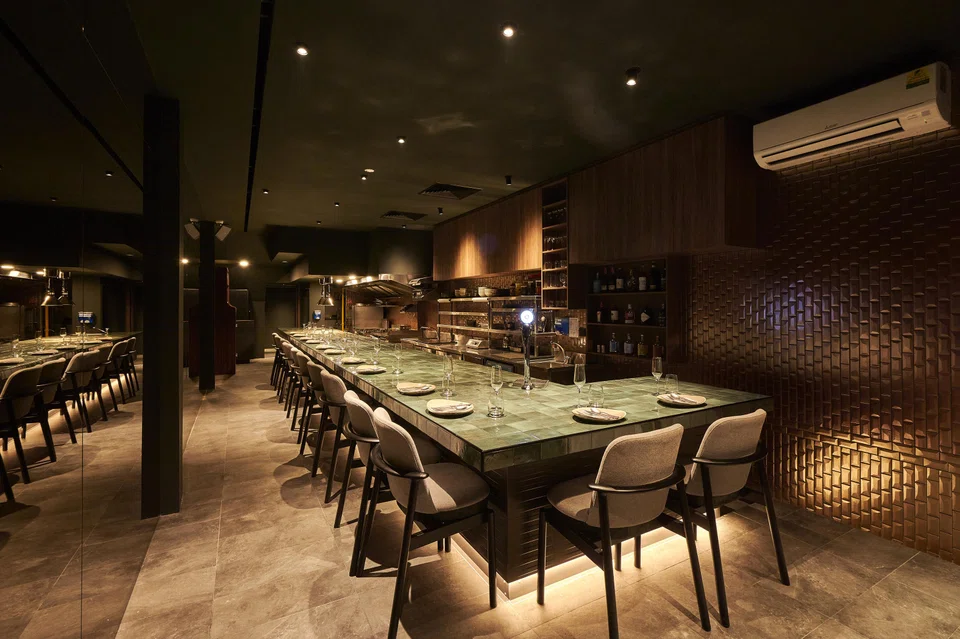
    • The setup is deliberately casual counter-style so you can  just relax and be yourself – even if you can’t hear yourself.
    • The setup is deliberately casual counter-style so you can just relax and be yourself – even if you can’t hear yourself. PHOTO: TAMBI

    NEW RESTAURANT

    Tambi 47 Amoy Street Singapore 069873 Tel: 9838 8401 Open for dinner only Tues to Sat: 6 pm to 11 pm.

    SOMEWHERE between the cold, slippery bibimmyeon and hefty pork rib biryani at Tambi, you’re convinced that Mano Thevar and Sun Kim are really fraternal twins who were separated at birth. Reunited by some culinary twist of fate, they’ve found their happy-ever-after with the kind of brotherly bond that would make even real siblings jealous.

    Tambi is affectionately translated as “little brother” (but think twice before calling anyone else that), so you know this is less restaurant and more testament of the two chefs’ relationship.

    With three Michelin stars between them – for Thevar’s namesake eatery and Kim’s Meta – there isn’t much left for them to prove cuisine-wise.

    But as buddies turned business partners turned late-night supper masher-uppers (think chicken curry and kimchi), their next step is a no-brainer – co-chefs.

    Asean Intelligence

    Get insights into businesses across South-east Asia

    Get the free report

    Now, this is where you stop thinking that Tambi is some groundbreaking dissertation by award-winning chefs on the crossroads of Indian and Korean cooking culture. Not when the best thing on the menu is an awesome Maggi mee goreng topped with a fried egg, cooked in a raging fired wok that smokes all pretence from its Amoy Street space, leaving behind a happy burp of contentment from diners who are sometimes just hungry for less.

    And for those with the familiar rejoinder, “I can get mee goreng at my favourite prata shop for one-quarter of the price” – oh shut up already.

    Of course, there’s plenty of R&D behind the food: Thevar’s homemade “Grandma” soya sauce for the fried not-instant-noodles; gauging the flour ratios for the perfect murtabak crunch; tinkering to get the right balance of sticky-sweet-salty glaze on the charred pork rib. The end result is food that’s guided by comfort but made with Michelin know-how.

    And it’s pretty cheap, making good on the chefs’ promise to make it affordable as a thank-you for all the support they’ve had through the bad times and good. Most dishes on the short a la carte menu set you back by S$18 to S$28, and the priciest item is a S$58 wagyu bulgogi roti. If you wanted to, an S$18 plate of kimchi nasi goreng and a beer would do you just fine for dinner. But it’s hard to resist adding on, so any resulting wallet damage is on you.

    The setup is deliberately casual counter-style so you can just relax and be yourself – even if you can’t hear yourself. Thevar and Kim have many supporters and they are very noisy. You can sit upstairs where there’s an elegant dining room, but it wouldn’t be as fun.

    We don’t know if the chefs plan to be at Tambi personally from time to time, but they should. Thevar himself was there when we visited – unobtrusive but watchful over a young team that cooks confidently without missing a beat. The wok chef is our favourite – all that loud clanging, smoke and smells just herald good things to eat.

    Just be warned there’s nothing subtle about the food. Flavours are robust and in your face. It’s salty, oily, spicy, crunchy, overwhelming – and somewhere in this lot you’ll find plenty to like.

    Plump Irish oysters that come with two dips – gochujang and rasam. PHOTO: TAMBI

    In our case, it’s the oysters. A comparative splurge at S$36 for a half dozen, they’re Irish, fat and very fresh. See whether you’re Team India or Team Korea with two dips – one a sweetish gochujang that feels token, and the other a mellow, complex rasam with a mix of magical spices at the bottom that bring out the oysters’ best sides.

    Bibimmyeon features cold slippery noodles in an intense spicy sauce. PHOTO: JAIME EE

    Tambi’s version of Korean cold spicy noodles bibimmyeon (S$18) could drag any dead taste buds back from the afterlife – the springy somen holding on to its chewy bite while drowning in a potent, pungent sauce of gochujang, kimchi, chilli powder, mentaiko, tobiko and other aggressors.

    Equally assertive is beef tartare appalam (S$28) or Korean yukhoe in overdrive. Chopped raw beef is salty-sweet and over-sauced with gochujang, served with a runny egg yolk to mix in and a curry powder-dusted papadum (appalam) for you to crush and scoop up the mixture. 

    Crispy murtabak is filled with oxtail and bone marrow. PHOTO: JAIME EE

    Our less-extreme palate swings towards bone marrow murtabak (S$18) – crisp, chewy fried  parcels packed with shredded oxtail and fatty marrow – way more fun than the original, with sweet-sour pickled onion to lighten the carb load.

    Prawn tosai pajeon are Korean pancakes with an Indian sothi dipping sauce. PHOTO: TAMBI

    After the prawn tosai pajeon (S$28), we don’t want Korean pancakes done any other way. It’s already a win for the crunchy edges and tender middle, but the clincher is the tangy, coconut milky sothi dressing that you dip it in. 

    Caramelised charred pork rib is served with fragrant spiced biryani. PHOTO: TAMBI

    Whatever the reason to pair a caramelised char siew-like pork rib with biryani (S$28) we support the decision since the rib is fall-apart tender with a charred, glazed finish, and the rice deeply spiced, fluffy and speckled with pomegranate seeds. 

    Wok hei-infused maggi goreng is topped with a crispy fried egg. PHOTO: JAIME EE

    But it’s still a notch below the maggi goreng (S$18) – where Korean potato noodles leave their stodgy “mee” counterparts in the shade with an infusion of wok hei, curry spices and Grandma’s special sauce. Add a crispy sunny-side egg and you’ll want for nothing else. Except maybe the homespun banana coconut pie (S$16) for its toasty shredded coconut topping and jammy banana filling, finished off with chantilly cream.

    Ultimately, Tambi is rooted in simplicity, down-to-earth goodness and an affectionate approach to cross-cultural cooking. You can almost feel the love. You might want to spread it too.

    Rating: 7

    Decoding Asia newsletter: your guide to navigating Asia in a new global order. Sign up here to get Decoding Asia newsletter. Delivered to your inbox. Free.

    Copyright SPH Media. All rights reserved.