When wine becomes crucial to cultural identity
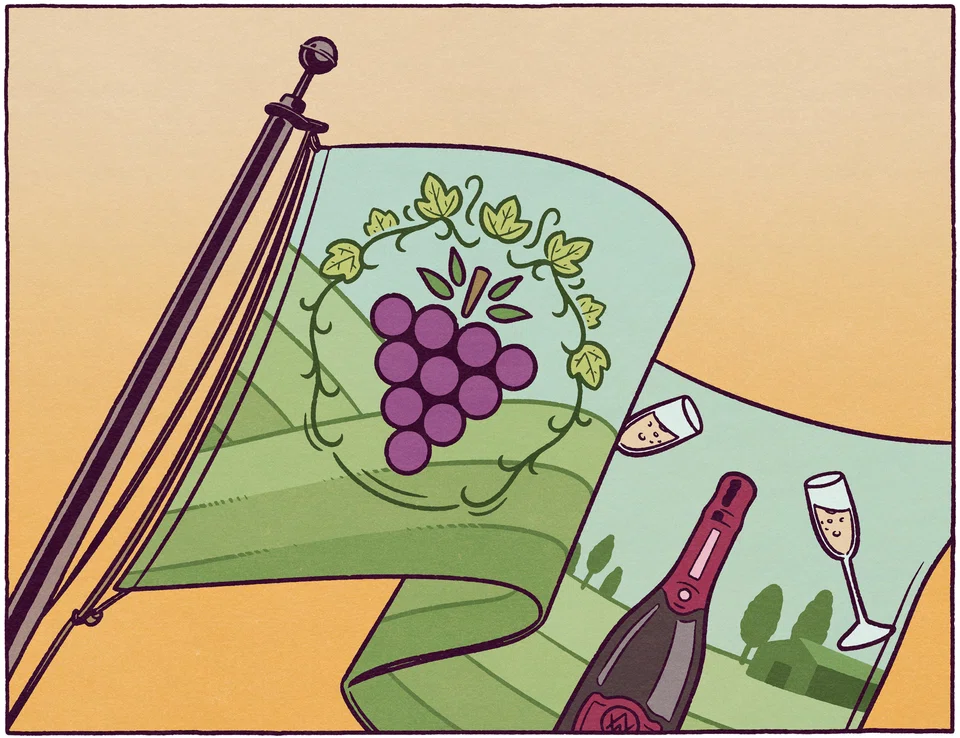
FOR most people, wine is a commodity on a shelf, a treat for when the mood strikes. For mass-market companies, wine might as well be pencils or paper towels – merchandise to move. But for serious-minded producers and fans, wine has a far deeper meaning that cuts almost to the core of human existence.
Among those who understand this view of wine are autocrats and would-be dictators. Throughout history, authoritarians have sought to suppress cultural expressions that deviate from the party line, whether books, film, music, religion or wine. It is no less true in our own times.
Within the last century, dictatorial governments have routinely tried to destroy wine production, if that suited their needs. They have bent and shaped traditions to fit their own desires. They have also seen wine as a desirable commodity, looting vast amounts for themselves as the Nazis did in France during World War II.
The Soviet Union routinely sought to transform the local winemaking customs of its constituent republics, discouraging, for example, the winemaking culture of Georgia, and instead creating vast state vineyards that could supply enormous amounts of wine for the Russian market.
Likewise, in the Alentejo region of south-eastern Portugal, the tradition of making wine in clay talha, amphoralike vessels, largely disappeared in the mid-20th century as the dictatorship of Antonio de Oliveira Salazar pushed the country into centralised wine production.
In Spain under Franciso Franco, regional methods died off as the government channelled wine into bulk production. Growers were encouraged to leave the countryside for factory work in the cities, abandoning vineyards and other agricultural pursuits.
As each of these countries became more democratic over the last few decades, local wine cultures were resuscitated. The diverse wines of Spain, Portugal and Georgia are now among the most interesting and exciting in the world.
But this history is still playing out today, in Ukraine, in Armenia and in Iran.
In February, Vines and Threads, an event in Providence, Rhode Island, aimed to raise awareness of how Russia’s invasion of Ukraine threatened its distinctive culture. The event included discussions and presentations of fashion and style, music, food and wine, including a tasting of the sparkling wines of Artwinery, said to be the largest sparkling wine producer in Eastern Europe.
Artwinery is in Bakhmut, which has been the centre of intensive fighting in eastern Ukraine. It was originally constructed during the Stalin era, when Ukraine was part of the Soviet Union. Since Ukrainian independence, it has been making fine sparkling wines using the Champagne method, primarily with a blend of chardonnay, riesling and aligote, an unusual combination for a Champagne-style wine.
As the early fighting in Bakhmut began in spring 2022, Russians bombed the city indiscriminately, except, apparently, for Artwinery.
Nathalie Lysenko, Artwinery’s export manager, suggested in 2022 that the Russians wanted to protect the winery or the 50 million bottles that were stored in a huge network of gypsum caves deep underground so that they could steal the wine. They considered whether to destroy it, she said.
Instead, Artwinery last year began to secretly transport a sizeable portion of the bottles, to warehouses in safer locations in Ukraine. The winery would not disclose exactly how many bottles were moved or where they are now. The Russians have now occupied the winery.
“As we have clearly seen from the fate of other Ukrainian enterprises in occupied territories, such as the Prince Trubetskoi winery in Kherson, Russians rob and destroy everything they can reach,” Lysenko said in an e-mail.
Ukrainian wine history dates back almost 3,000 years, she said. It has survived both Soviet centralisation efforts and temperance campaigns during the Gorbachev era, during which top-flight vineyards in the Crimean Peninsula, a major Ukrainian growing region, were uprooted. Artwinery itself had to find new sources for grapes after Russia’s 2014 invasion of Crimea.
Amazingly, Artwinery is planning to export 140,000 bottles to the US this year, said Gayle Corrigan of Saparavi USA, Artwinery’s American importer.
As the war goes on and Ukrainians continue to face death and hardships, wine is not so important except as a symbol. But its role as a crucial element of cultural identity is explicit at less-fraught moments when authoritarian rulers suppress or prohibit its production.
Somm: Cup of Salvation, a new documentary that will be released later this year, examines the role of wine in the identity of both Armenia and Iran, neighbouring countries in which wine production has been interrupted by violence and autocratic government.
This fourth film in the Somm series, directed by Jason Wise, is different from its processors. Instead of spotlighting the hopes and dreams of sommeliers, its focus is larger, on the cultural importance of wine itself.
The absorbing film follows Vahe Keushguerian, an Armenian winemaker, and his daughter, Aimee, who works with him at their production facility, WineWorks, in Yerevan, Armenia’s capital.
Along with Georgia to the north, Armenia is part of the Caucasus region, which is considered to have been among the birthplaces of wine thousands of years ago, long before political divisions separated the region into countries. Wine was integral to Armenian culture until its 19th century subjugation by both the Ottoman and Russian empires, Keushguerian said, followed by the Armenian genocide at the hands of the Ottomans in the early 20th century. After a brief period of independence, it was subsequently absorbed into the Soviet Union.
“The Soviet Union said, ‘You guys don’t do wine, you do brandy,’” Keushguerian said. As he tells it in the film, the Soviets forced growers to abandon their hillside vineyards and the ancient varieties they used for wine. New vineyards were planted in the flat areas, where farming could be industrialised, with the grapes the Soviets preferred for brandy.
“The old vineyards stayed,” said Aimee Keushguerian, whose birth coincided with the fall of the Soviet Union. “They were essentially untouched for 120 years. Now we’ve adopted wine as our identity.”
Iran, too, once had a thriving wine industry, particularly among Kurds and Zoroastrians. It ceased after the Islamic Revolution in 1979, and hundreds of wine-producing facilities were destroyed. But some of the old vineyards survived, particularly in hard-to-reach hillside areas, with their produce consumed as table grapes.
Keushguerian wondered about these old vineyards and conceives in the film of a plan to buy grapes in Iran, where Armenians can travel relatively freely, and bring them back to Armenia to make wine at his facility.
“I was curious about the varieties, and how they were linked to the more familiar grapes,” he said during a visit to New York earlier this year.
In a scene depicted with dramatic flair, Keushguerian takes a trip to the north of Iran, skeletal camera crew in tow, semi-clandestinely looking for old vineyards with unusual varieties. In the remote hills in the province of Kermanshah, almost 500 km west of Tehran, he finds what he wants – glistening purple grapes he identified as the rasheh variety.
He arranges to buy 22 tonnes, which he has shipped back to the WineWorks facility. This is where, in 2021, he produced both red wine and sparkling rose. Some of these bottles will be sold legally in the US, under the brand Molana, referring to a nickname of Rumi, the 13th-century Persian poet and scholar. It will be labelled, “Wine of Iran, made in Armenia”.
The notion of Iranian wine may seem inconsequential to many people, but not to members of the Iranian diaspora like Moe Momtazi, who, with his wife, Flora, founded Maysara winery in Oregon in 1997.
As a young boy in Tehran, he remembers his father making wine in their basement, and storing it in earthen vessels. He learned about farming from his grandfather. But in 1982, the Momtazis fled Iran. He eventually established a successful engineering firm before turning to wine and agriculture.
“In Persian and Zoroastrian culture, wine is considered a very sacred thing,” he said to Inc magazine. “After the Islamists came to power, a lot of things were taken away from Persians. But wine stayed in our blood.” In the film, he calls it “sun’s radiance in a liquid form”.
His daughter, Naseem Momtazi, the president of sales at Maysara, is more straightforward: “To see something that was so important for your family taken, it’s hard.”
Using recent genetic analysis of grapevine varieties, researchers have traced the domestication of wine grapes to 11,000 years ago, which would make grapes – and wine – among the first forms of agriculture. Wine may have been so important among early nomadic humans that it was a chief reason for settling into fixed communities. It was among the building blocks of civilisation.
Individual bottles don’t often rise to this level of profundity. Wine may be no more than a simple pleasure for many people. But when threatened it’s also precious enough to defend, which, in a sense, makes it sacred. NYTIMES
Decoding Asia newsletter: your guide to navigating Asia in a new global order. Sign up here to get Decoding Asia newsletter. Delivered to your inbox. Free.
Share with us your feedback on BT's products and services