

Goh Chok Tong as seen through a hall of mirrors
The second volume of his biography is a mix of narrative, interviews and essay. Combined, it makes a richer portrait

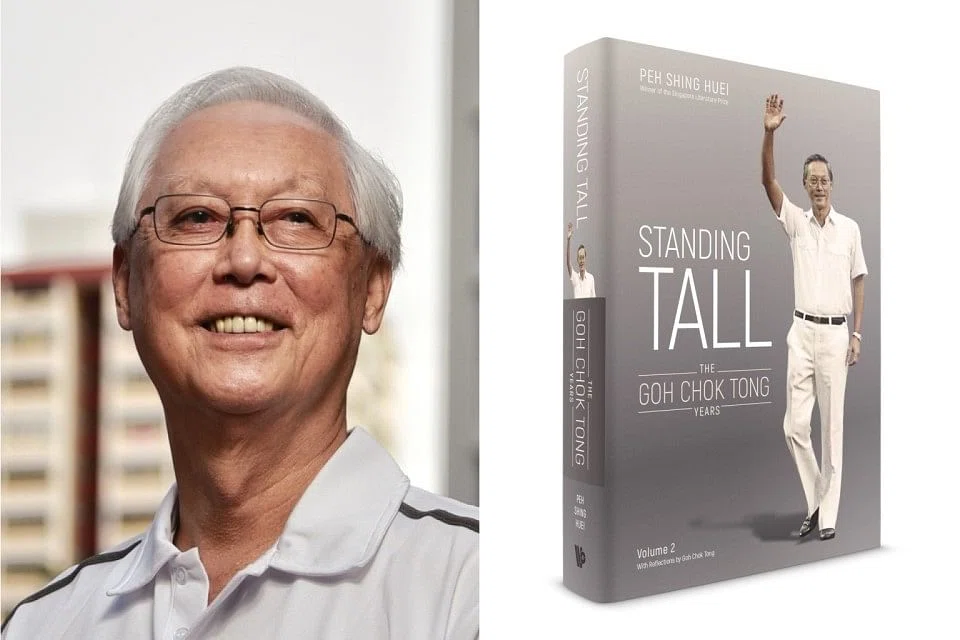
EMERITUS Senior Minister Goh Chok Tong says he has no plans to stand as Singapore's next President when elections for the post roll around by 2023. "But then, neither did I plan to be Prime Minister," he adds with a laugh.
That is according to one of 17 interviews held over nine months with the former prime minister, yielding the second volume of his biography - Standing Tall: The Goh Chok Tong Years.
MParader
His "Will-I, won't-I" response on the presidency elicited my amusement. Its coyness seems typical of a man I have always found enigmatic.
This was the prime minister of my childhood years, before I knew or cared anything of politics. I remember little of him from that time. It is as though he simply appeared in my consciousness one day: a white-haired "MParader", a gentle giant with dad jokes.
"MParader" is of course, his Facebook moniker. It is a nod to Marine Parade, where he served as Member of Parliament for 44 years: longer than I have been alive.
Having amnesia like mine is a perfect reason to read this book. It is less about understanding the man himself, though Mr Goh is certainly an interesting one, and more about how his life changed Singapore.
For a former prime minister, I suppose the difference is slim.
Drama hound
"This book is not your usual authorised biography," Mr Goh warns. He adds: "Peh Shing Huei, my biographer, is a writer with a flair for drama."
That does seem true of Peh, who writes with a snappy, energetic style; and is clearly enamoured with his material. He refers to the work as a "screenplay of a book", and to Mr Goh as its "leading man".
As a result, the 366-page volume is far from any memoir Mr Goh might have written for himself. But it is certainly a readable thriller.
Mirror maze
Much like the first volume (Tall Order), Standing Tall comes with a foreword and afterword penned by Mr Goh. Most chapters contain interview extracts, mixing narrative with Q&A. Each chapter by Peh is paired with a short reflection by Mr Goh.
The result is something of a hall of mirrors, presenting different versions of the man, depending where you look.
There is the man who stars as the book's dramatic subject. Then there is the man in the interviews, fielding probing questions from Peh and his writing team. (His verdict, on the chances of a third member of the Lee Kuan Yew family becoming prime minister: he is quite sure it will not happen, "as far as my eyes can see".)
Finally there is the man himself, writing in his own voice. At times, he is didactic, often, jovial; and occasionally, touchingly direct.
No individual format - narrative, interview, or essay - has a dominant claim to truth. Combined, they offer a richer portrait. The formula works.
The plot afoot
Peh might be something of a drama hound. But looking back, the drama fairly writes itself.
There is the hijacking of SQ 117, just months after Mr Goh took office. Or the disappointing showing by the People's Action Party (PAP) in his debut General Election of 1991.
In short order came the double-resignations of Cabinet stalwarts Tony Tan and S. Dhanabalan. The next year, word came that both deputy prime ministers - Lee Hsien Loong and Ong Teng Cheong - had lymphoma.
Among the more fascinating arcs explored is Mr Goh's political evolution. He sought to govern as an "understanding elder brother", in his words - compared to predecessor Lee Kuan Yew's sterner disposition. But after his 1991 electoral setback in particular, he began to show more of his hard edges.
In 1994, he reprimanded writer Catherine Lim over her criticism of the government. After performance artist Josef Ng snipped his own pubic hair at an art event, the National Arts Council pulled funding from unscripted performances for the next 10 years.
Controversially, he also linked public housing upgrading with voting for the PAP. And under his leadership, the party filed defamation suits against opposition politicians Tang Liang Hong and J. B. Jeyaretnam. This ended in bankruptcies, and Mr Tang's self-imposed exile in Australia.
But politics aside, Mr Goh made lasting policy moves. He broadened social safety nets with MediFund and Edusave. He achieved his landmark pledge of a "Swiss standard of living", defined by per capita income.
He seized economic growth amid an increasingly globalised world, loosened immigration and struck trade deals - including one from the famed golf game on a dark and stormy night with then-US President Bill Clinton, which yielded the US-Singapore Free Trade Agreement.
Not least, he stabilised Singapore throughout successive crises, from the 1997 Asian Financial Crisis and the dot-com crash to the Sept 11 attacks in 2001, and the deadly Sars virus in 2003.
These episodes, and more, are retold in the book.
A 'damn good government'?
Singapore needs a "damn good government and a united population", writes Mr Goh.
Was his administration such a government? In a mirror maze, it all turns on perspective in the end.
Those who baulk at arts censorship, call for a more level playing field in politics, or lament the perceived excesses of globalisation and immigration, will have objections.
And yet, this was a government under which the nation prospered, despite successive crises. Going by the ballot box, it was also a government that became more popular over time.
Regardless the verdict, Mr Goh insists his biographies are not meant to record his achievements or evaluate his performance as prime minister. "I have no need nor desire for accolades," he writes. "I am also more interested in the future of Singapore than what has passed."
"All rivers eventually flow into the sea and disappear. So will my river of life," he muses. He turns 80 on May 20.
"Singaporeans come and Singaporeans go. But Singapore must go on forever."
- Standing Tall - The Goh Chok Tong Years is sold at all major bookstores, including Kinokuniya, Times the Bookstore and Popular. It retails at S$59.92 (hardcover) and S$29.96 (paperback), including GST.
READ MORE: 'Give the 4G team some time': ESM Goh on leadership transition
Decoding Asia newsletter: your guide to navigating Asia in a new global order. Sign up here to get Decoding Asia newsletter. Delivered to your inbox. Free.
Copyright SPH Media. All rights reserved.






