

Halogen’s entrepreneurship programme helps underserved youth develop business ideas
Through the nine-month NFTE, students develop a prototype or minimum viable product
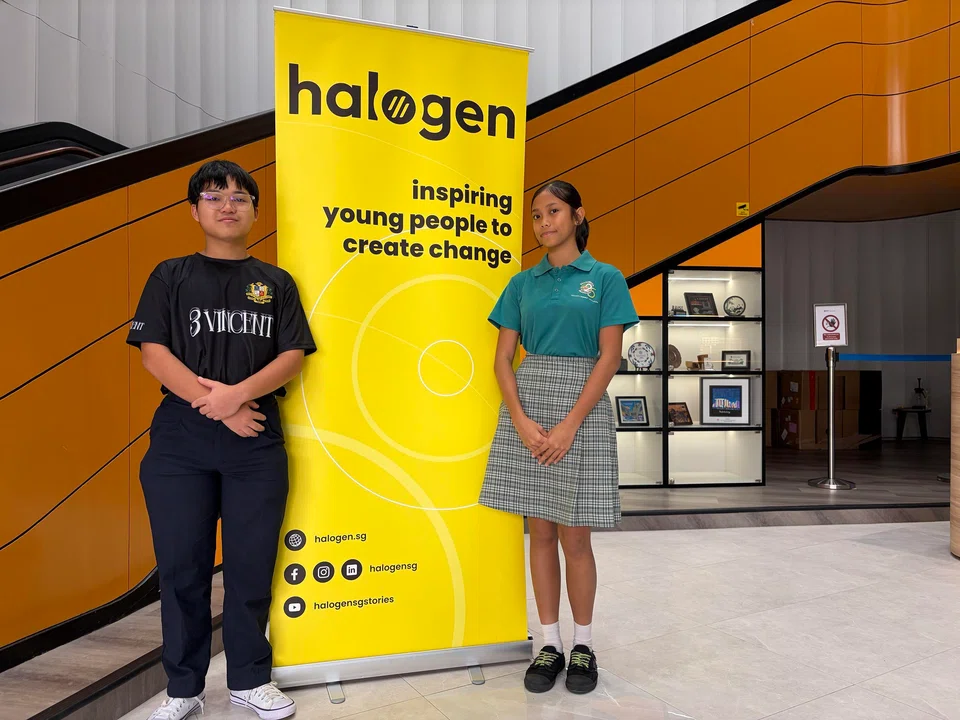
[SINGAPORE] An app connecting lonely seniors to nearby activities at community centres, where they can sign up for programmes – this is what Heartlink aims to do.
Hakimah Amani Putri, a 15-year-old student of Evergreen Secondary School, came up with Heartlink’s concept to help seniors stay active.
The app’s proposed features include maps and navigation, mother-tongue language options, scam blocking and family location-sharing.
There is also a reward system for seniors to claim supermarket vouchers if they use the app for an entire month.
Hakimah was a participant at non-profit Halogen’s Network for Teaching Entrepreneurship (NFTE) programme, which helps youth from underserved communities develop business ideas and entrepreneurial skills.
Another participant this year was 15-year-old Joshua Choo from Assumption English School, who developed the idea of help@jacks, an anti-bullying app for students aged 12 to 16.

“I have been bullied before and I was treated really horribly by others. The gap I noticed in society is that people don’t take bullying seriously. I want to spread awareness (of this issue),” he said.
The app offers anonymous reporting, an artificial intelligence therapist and access to a 24/7 helpline. Choo also hopes that providing a way for students to work with counsellors on safety plans will encourage them to speak up.
This year’s NFTE had 603 participants, all between the ages of 15 and 17, from 26 secondary schools in Singapore. Nearly 60 finalists took part in a four-day showcase in November.

Halogen runs NFTE in partnership with participating schools, bringing facilitators into schools to deliver the curriculum.
The programme culminated in the NFTE Youth Entrepreneurship Challenge finale on Friday (Nov 13), in which Hakimah was a top-six finalist. The six had to pitch their ideas to a panel of judges, with the winner getting the chance to take part in a global challenge in the US.
Developing an entrepreneurial mindset
Throughout the 50-hour programme, which took place over nine months, the students developed a business idea and entrepreneurial mindset, while learning business skills.
Halogen’s hands-on curriculum covered opportunity recognition and product innovation; market research and testing; competition and unique value proposition; marketing; and costs, pricing and profitability. By the end of the programme, they developed a business prototype or minimum viable product.
The aim of NFTE is to uplift underserved youth through entrepreneurship education and tackle social mobility, said Chloe Ting, the head of academy of Halogen Singapore who oversees the programme.
She added: “The focus is more on character mindsets and soft skills – the ideas are not ready to be in a startup fund tomorrow.”
Ting observed that the majority of students come from underserved communities – including lower-income backgrounds – and lack access to such programmes.
“In the schools that we work with, we noticed that better opportunities for leadership and extracurricular activities go to students who are more outstanding in terms of academics,” she said. “So the starting line is different.”
Students pick up soft skills such as communication, presentation and language skills, which they can apply if they pursue part-time jobs or higher education.
Ting noted that many of them become more interested in working or studying after participating in NFTE, as they build their confidence and self-esteem.
Corporate volunteers were involved in NFTE, supporting students in market research, financial planning and presentation skills. They also organised visits to workplaces and funded the programme.
Hakimah said she received a lot of support from the volunteers throughout the programme.
“I was losing confidence and not proud of my idea, and I kept comparing myself to other people. But (their support) made me change my mindset, and I realised I shouldn’t give up so easily,” she noted.
This year’s key NFTE funders included CapitaLand Hope Foundation (CHF), Bitdeer and UBS Singapore.
CHF has committed S$250,000 to support NFTE. CapitaLand staff volunteered their time and expertise to the programme, as well as took students to its property lyf one-north to experience a working environment and interact with professionals.
Tony Tan, executive director of CHF and chief corporate officer of CapitaLand Development, said: “What resonated with us about the NFTE programme is that entrepreneurship is used as a way for young people to develop skills that go beyond starting a business.
“They learn to identify problems, think creatively, turn ideas into action and learn from setbacks. For underserved youth in particular, building that confidence can help broaden the pathways they see for themselves.”
Decoding Asia newsletter: your guide to navigating Asia in a new global order. Sign up here to get Decoding Asia newsletter. Delivered to your inbox. Free.
Copyright SPH Media. All rights reserved.
TRENDING NOW

South-east Asia has lost Nvidia’s best salesman

Higher rates, weaker spending: Is the Philippines entering stagflation?

Who is Leo KoGuan, the Singapore-based billionaire backing Nvidia’s Jensen Huang?

Demand, tech capabilities position Apac and AI as Skyscanner’s next growth frontiers: CEO Bryan Batista

