

The joy of text
US book publisher Random House's copy chief says we should look beyond pomp and pedantry to enjoy writing.
BOOK REVIEW
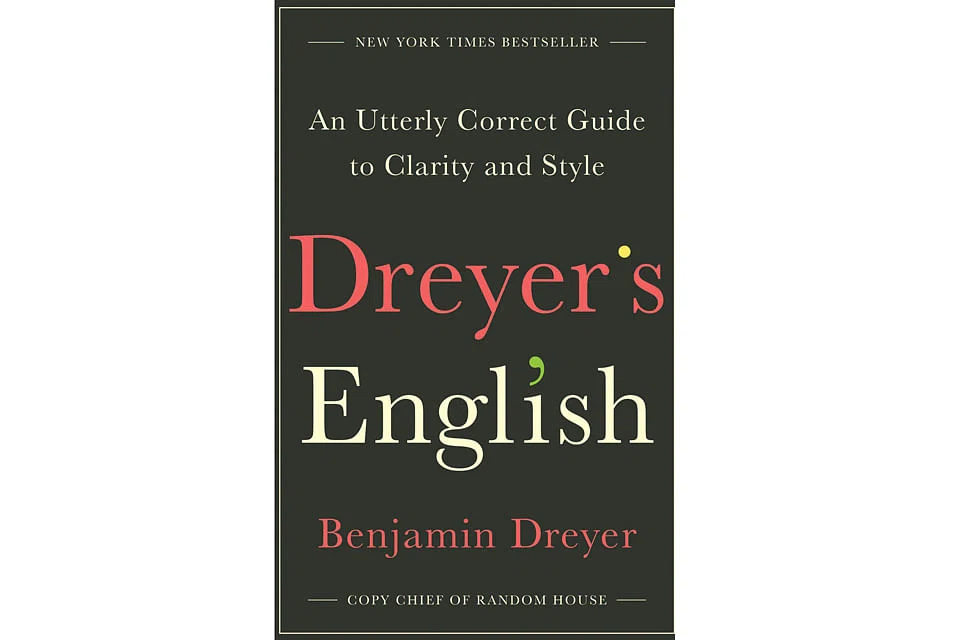
Dreyer's English - An Utterly Correct Guide to Clarity and Style (Random House, 2019) By Benjamin Dreyer Available at Books Kinokuniya S$29.91 (Hardback; includes GST)
HOW many times have you tripped on your own writing and screeched to a halt at the keyboard with these head-scratchers: "Is it anymore or any more?"; "What in heaven's name is an Oxford comma?"; "Should I use like or such as?"
Thankfully, there's help. And yes, all the above befuddlements are addressed.
Benjamin Dreyer, the veteran Copy Chief Sitting Bull of US publishers Random House has distilled his years of book-editing experience into a 291-page hardback face-saver for hapless writers of every stripe - from self-exiled wannabe novelists to the rest of us, the Great Unwashed, who cringe at writing even an email.
Mr Dreyer's book started out as a revision of an internal Random House memo to guide copy editors and proofreaders at Random House. That memo swelled to more than 20 pages.
The vice-president and executive managing editor of the New York-based publisher then began to develop it into a book, which was published by in January, and debuted at No 9 on the New York Times Bestseller List almost immediately.
"I'm a prescriptive descriptivist," the 61-year-old editor recently told Sam Leith, the Spectator's literary editor, in a podcast.
For the uninitiated, prescriptivism is a linguistic term that extols the values of proper speech and writing, without flouting rigid rules of grammar, syntax et al. On the other hand, descriptivism explores the way language is used organically, sometimes with scant regard for the grammarian's rulebook.
"Copy-editing should be invisible," he goes on to explain to Mr Leith. "I've become more embracing, less stiff-necked about prose over the years... It's really to enhance the language, rather than narrow it down."
One of the most surprising exercises Dreyer insists his readers try is to go a week without using the word "actually". He says we will never miss it, and in his book, he has disavowed the punctuation mark and promised he would never use it again for as long as he lives!
The Oxford comma
Punctuation takes up quite a bit of newsprint and he does come across as quite the prescriptivist when he lays down The Law - but always with dollops of wit and never ponderous - for vocative commas, the series comma, the comma splice and, of course, the notorious Oxford comma:
"Highlights of his global tour include encounters with Nelson Mandela, an 800-year-old demi-god and a dildo collector."
Wait a minute. Was Nelson Mandela a fetishist? Now, read that sentence with the Oxford comma in place:
"Highlights of his global tour include encounters with Nelson Mandela, an 800-year-old demi-god, and a dildo collector."
There is no dearth of such metaliterature as Mr Dreyer's book that helps to improve both one's written and spoken English: Eats, Shoots & Leaves by Lynne Truss, Woe Is I by Patricia T O'Conner or The Elements of Style, by William Strunk Jr and EB White, are excellent resources.
To get a sense of where we are linguistically on the written/spoken map in Singapore, you need go no further than the "Comments" section of Facebook, YouTube or even your own family members' responses to social media events:
"Whahh, why garmen always do like dat?"
"Yahh lor, so hate to read newspaper. Read handphone aredi so pek chek."
"Nehmind, call me lor. No need to type what?" And this gets scarier when it cascades into emails meant for formal correspondence.
Almost 20 years ago, then prime minister Goh Chok Tong launched the Speak Good English Movement to address the serious issue of communication as more and more Singaporeans resorted to Singlish. It was felt that the spread of pidginised English would undermine Singapore's ability to communicate in the lingua franca of business - namely Standard English. The public reaction was that it was too preachy.
Today, two decades later, the chairman of the movement's new steering committee, Jason Leow, is hoping that will change. Posters at bus shelters across the island with the updated and more upbeat clarion call: "Let's be understood from Newton to New York" is catchy, fun and more accessible. He says Good English is a way of connecting with colleagues, bosses, business associates and friends, and it is now a "movement" - not a "campaign".
What seems to elude Singaporeans - 20 years ago and now - is that it is not wrong to enjoy Singlish, which is rich in indigenous colour. But you have to earn it - meaning, you get to revel in it only after you have mastered the basics of Standard English.
And this is at the crux of Dreyer's English. This book is an indispensable reference for anyone who wants to develop a "mindfulness" for proper English, through revisions and paring down of one's own work.
Beyond delivering a narrative that is grammatically correct, he challenges you to try to put your heart into your writing - and learn to enjoy text, the way he sees his stable of writers wrangling with copy every day.
What is important about Dreyer's English, is not what the author berates about punctuation and grammar, but really about what comes after you put his book down.
Beyond the scaffolding, the skeletal structure of a sentence, you begin to see how you can flesh out your own writing by adding sinews to the bare bones and viscera that come from carefully curated descriptive terms and turns of phrases. In short, affective gems that animate your prose and, who knows, may be the start of a personal style of writing - your "writerly voice".
And, at this point, I must admit, I wrote this entire piece without using the adverb "actually" even once.
Copyright SPH Media. All rights reserved.
TRENDING NOW

Once staunchly pro-China, Malaysian Chinese businesses are now distancing themselves from Beijing

Cliff Tan has 7 million followers and a 4-month waitlist. Why won’t he expand his business?

Grab CEO’s wife Chloe Tong on life with Anthony Tan and finding her purpose

Singapore F1 to proceed despite haze; no changes planned to outdoor entertainment

