

BMW iX5: When will hydrogen pick up steam?
 Add BT as a preferred source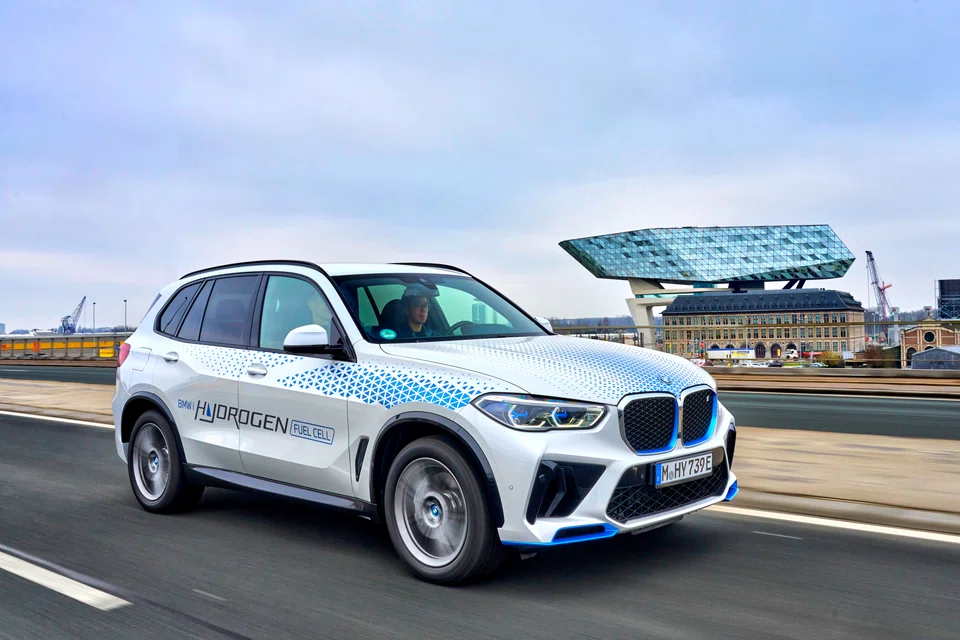
BMW is the latest major carmaker to bet that drivers will some day take to a technology that others have dismissed as too expensive or too impractical: hydrogen fuel cells.
In February, the German luxury brand began to roll out a small fleet of its BMW iX5 Hydrogen, a version of its X5 sport utility vehicle (SUV) heavily modified to run on hydrogen gas. The plan is to build nearly 100 of them and put various stakeholders behind the wheel, starting with the press and then members of the European Parliament, many of whom recently voted to outlaw the sale of combustion engines in the European Union by 2035.
BMW first dabbled with hydrogen in 2006, building a version of its 7 Series flagship that combusted the gas in a modified petrol engine. It considers that approach a dead end because it still produces a tiny amount of emissions, and because using fuel cells means a car can travel 60 per cent further on the same amount of hydrogen.
BMW won’t actually sell the iX5, but will use it to champion and demonstrate fuel cell electric vehicle (FCEV) technology. It will also let the company’s hydrogen hopefuls find out what people actually think of it after trying it out for themselves.
“We as engineers can have a lot of great ideas, but what’s the feedback about the ideas?” said Jurgen Guldner, the general program manager, hydrogen technology, at BMW.
Guldner and his team also want to find out how the cars hold up in daily use, and how ordinary drivers actually use them. “Mainly what we have here is an electric vehicle (EV) that you can use like a gasoline car today, and this combination doesn’t exist so far,” Guldner said.
The engineer is only right about that first part. FCEVs are effectively electric cars, but by using hydrogen to generate their own electricity on the go, they can refuel in minutes like today’s cars.
Stopping to fill the iX5’s tanks at a hydrogen filling station in Antwerp that supplies cars, trucks and boats took us less than four minutes. The BMW’s 6-litre tank capacity gives it around 500 km of range, at a pump price that works out to roughly 12 euros (S$17.12) per 100 km.
But Guldner is wrong in his assertion that FCEVs are new. Information Trends, a market research firm, estimates that more than 56,000 fuel cell vehicles have been sold around the world so far. Around 30,000 were sold in the last two years, suggesting that the technology is starting to take off.
Hyundai and Toyota lead the FCEV market with standalone hydrogen models that have been on sale for years, but the iX5 suggests that BMW is almost ready to join them. As I found out behind the wheel, it feels like it could have rolled out of any showroom.
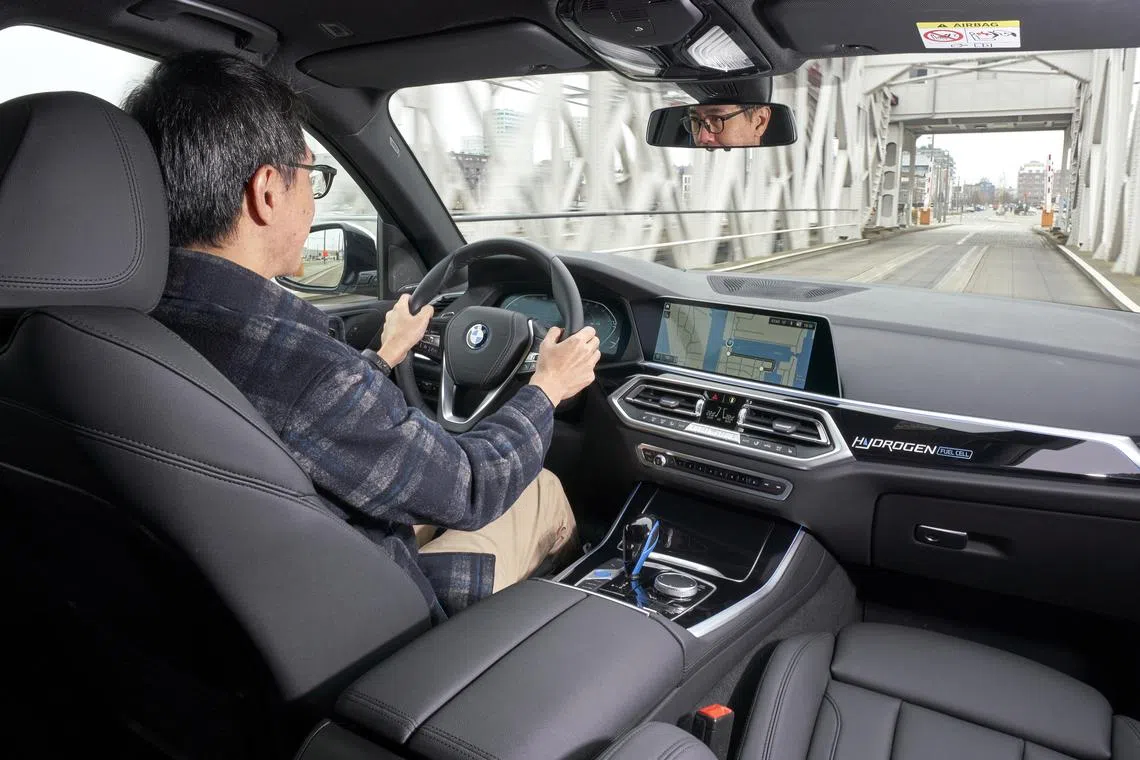
The iX5 certainly goes like a BMW. “I really like your driving style!” whooped Thomas Hoffman, an engineer who rode shotgun with me, when I put my foot down hard and sent the hefty SUV bounding up the road with the force of 401 horsepower.
Powered by a rear motor borrowed from the iX, BMW’s flagship electric car, the iX5 hustles along with the same instantaneous response you’d expect from a modern EV. It needs less than six seconds to hit 100 km/h, and emits visible clouds of pure water vapour on the move.
Noise from a whirring air compressor can make some FCEVs noisy, but the iX5 is silent. Inside, the controls are identical to those of any X5. Its most extraordinary trait is how ordinary it feels.
The irony is that the iX5 feels so production-ready because every example is painstakingly assembled by hand. Hoffman told The Business Times (BT) that the hydrogen team starts with an ordinary X5 and strips it down to its shell so it can be rebuilt with FCEV hardware. The first step? Reshaping the car’s floor to accommodate two large hydrogen tanks. Each is made of multiple layers of carbon fibre, and is strong enough to store hydrogen at 700 times atmospheric pressure.
If the idea of sitting on top of all that flammable gas makes you nervous, it shouldn’t. Toyota has shown video clips of bullets shattering against its own, similar tanks, and BMW says the iX5 has passed every collision test it needs to. “In a crash, the main focus is to protect the passengers,” Guldner said. “The hydrogen tanks are located in the middle of the vehicle so they’re in a very safe zone.”
BMW buys fuel cells for the iX5 from Toyota as part of a collaboration that goes back a decade, but assembles them into its own stack. With some pride, Guldner and his team say their 125 kilowatt pile of fuel cells is currently the most powerful in the industry.
Yet, carmakers have some way to go before economies of scale and technical improvements make fuel cells commercially viable. “We have climbed about 50 per cent to 60 per cent of the mountain,” Koji Sato, the incoming chief executive of Toyota Motor Corporation, told BT in December. “There is still room for improvement in terms of performance.”
Hoffman, the engineer who rode beside me in the iX5, said BMW expects its next generation of fuel cells to be smaller by a third. The company is also working on new shapes and materials for hydrogen tanks so the gas can be stored more efficiently in its next-generation models.
But hydrogen continues to have its detractors, not least in Elon Musk. The chief executive officer (CEO) of Tesla, a pure electric car company, once derided fuel cells as “fool cells” and continues to speak out against hydrogen as an energy storage medium, calling it “dumb” last year.
Jorgo Chatzimarkakis, the CEO of Hydrogen Europe, a trade body with more than 400 members, said early-stage criticism of unfamiliar technology is nothing new. “(Musk’s) arguments remind me very, very much of the arguments 20 years ago against photovoltaic: ‘It’s too expensive. It’s the champagne of the energy transition,’” he said. “Of course it’s expensive, because we’re just starting!”
But Chatzimarkakis’ overall view is that FCEVs and EVs are both needed in a post-combustion world, and that each tech has its place. Batteries are still so heavy that an electric truck would need a tonne of them for every 100 km of range, for example, so fuel cells would be ideal there. “We love batteries, but we don’t want to see batteries on trucks. It doesn’t make sense. We’re not stupid,” he said. “We can have wonderful fuel cell trucks. We want both to be complementary.”
For now, FCEVs face an obvious stumbling block: there are fewer than 1,000 hydrogen fuelling stations around the world. A future of battery powered cars powered by a widespread charging network seems much more within reach.
Yet, Forschungszentrum Jülich, a German research group, estimates that building charging infrastructure for EVs starts out cheap but eventually becomes more expensive with scale. That’s because the electricity grid itself needs upgrading once enough chargers are up and running, which causes the cost curve to inflect.
In contrast, converting existing filling stations to dispense hydrogen is easier and cheaper. The research group calculated that Germany will need to invest at least 51 billion euros to accommodate EVs, but could spend 11 billion euros less to do the same for fuel cell cars.
Whatever happens on BMW’s home turf, hydrogen’s potential as an energy carrier means it is set to play a clean energy role here. At last October’s Singapore International Energy Week, Deputy Prime Minister Lawrence Wong said that low-carbon hydrogen could potentially supply up to half of Singapore’s power needs by 2050.
Guldner expects BMW’s FCEVs to appear much sooner than that. He predicts that the brand’s fuel cell models will cost the same as its electric cars by the second half of the decade. “We think hydrogen will become primetime in the next few years,” he said. “We think that the infrastructure in various markets will be built up in the next few years, and then the markets will develop.”
After waiting since 2006 for its hydrogen bet to pay off, BMW can afford to wait a few more years.
Decoding Asia newsletter: your guide to navigating Asia in a new global order. Sign up here to get Decoding Asia newsletter. Delivered to your inbox. Free.
Share with us your feedback on BT's products and services
TRENDING NOW
Singtel Q1 gain drops 71% to S$818 million in absence of Airtel stake sale; weaker Singapore business

Sembcorp raises interim dividend despite 72% H1 profit slide to S$150 million on Alinta deal costs
How BYD disrupted Singapore’s car market – and why the strategy is turning on itself
CDL H1 profit jumps three times to S$301 million on strong condo sales, doubles interim dividend

