

Ferrari Daytona SP3: The 2m-euro slice of revenge
Limited in number and available only by invitation, the Ferrari Daytona SP3 is a tale of sweet revenge on wheels
 Add BT as a preferred source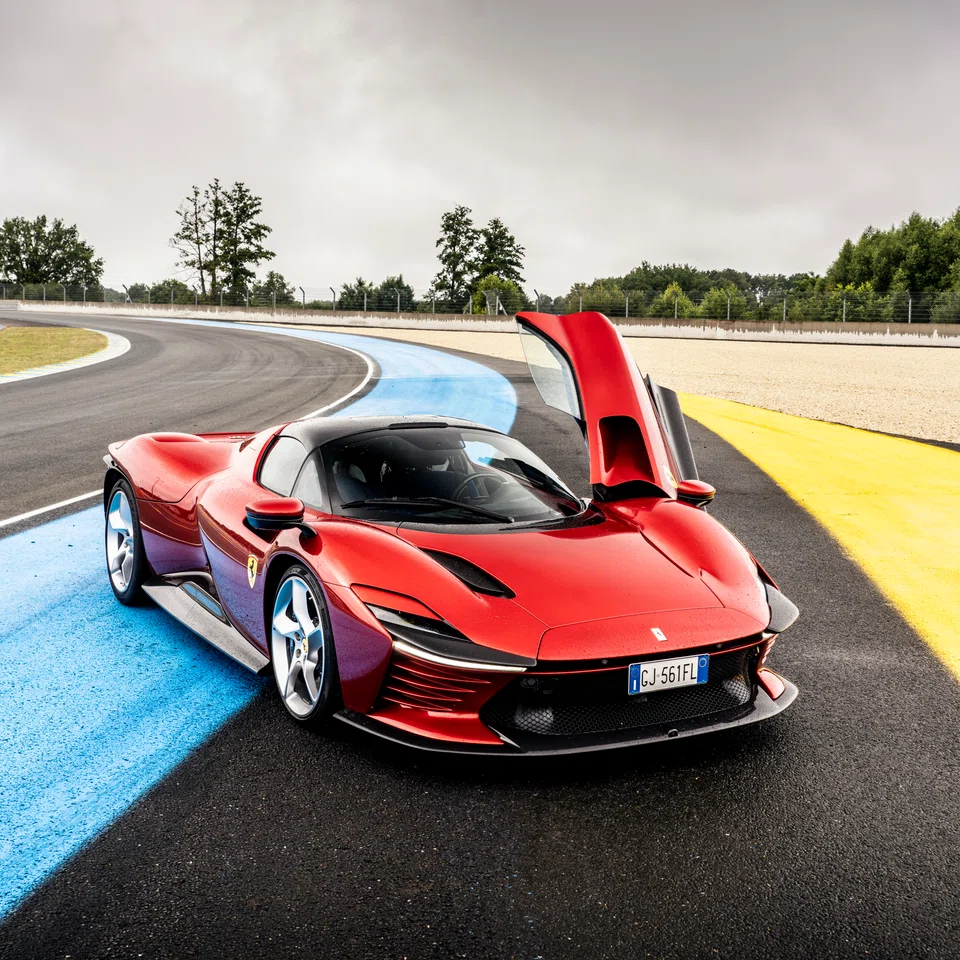
THE Daytona SP3 is a special Ferrari today, inspired by special Ferraris from yesterday. So special, in fact, that just driving one of them was enough to make the brand’s chief development driver cry.
“This car is unbelievable for the transmission noise. It’s not only about the engine,” said Raffaele di Simone, taking up the tale of driving a sports prototype from the 1960s, when Ferrari’s racing rivalry with US giant Ford was most intense.
“It’s like, ‘Wheeeee…’” he said, doing his best to imitate the frantic noise of a vintage Ferrari’s gearbox under maximum strain at the historic Imola racing circuit. “That makes me really crazy. I was crying in the pit lane, because the experience in Imola was unforgettable.”
Ferrari may be best known today for putting the glamour in Formula 1 racing, but its place in endurance competition is no less vital. Thanks to Hollywood, people think of Ford’s victory at the 1966 24 Hours of Le Mans as the climax of a proxy war between Henry Ford II and Enzo Ferrari, but less well known is the story of how the Italians took their revenge soon after. That’s where the Daytona SP3 rolls into the picture.
Built from carbon fibre to make it light yet strong, the Daytona is a modern interpretation of Ferrari’s 330 series of impossibly sensual racing cars. “In this car, we wanted to transfer the idea of a racing car of the 60s, through modern technology and futuristic design,” explained Stefano Frigieri, the Daytona SP3’s marketing manager.
The SP3 label tells you this is Ferrari’s third homage to its historic sportscars, which are part of an “Icona” line of models built in limited numbers. The first 2 Icona cars, 2019’s Monza SP1 and Monza SP2, were speedsters inspired by the petite racers of the 1950s. Ferrari only built 499 pieces, and collectors (among them Gordon Ramsay, apparently) snapped up every last one, even before a single example saw the light of day.
Icona cars are effectively a customer loyalty programme, Ferrari-style. The factory itself, and not your local dealership, decides who gets to buy one. “How do you move up in the hierarchy? We tend to promote clients that are very loyal to the company,” Frigieri explained. Factors such as how many Ferraris a customer owns, which Ferraris they own and how often the customer takes part in the brand’s events are part of the selection process.
The payoff for making the shortlist is the chance to own not just a Ferrari that a newly-minted crypto bro wouldn’t have access to, but a valuable collectible. A Monza SP2 reportedly sold for US$3.2 million last year, nearly double the retail price. Not that Ferrari condones such profiteering, mind you. “Clients that basically want to do business buying and selling the car – that is a behaviour that we absolutely don’t promote,” Frigieri said.
But such is the Icona series’ pull anyway, everyone who bought a Monza SP1 or SP2 directly from Ferrari also bought a Daytona SP3 (which means a certain foul-mouthed UK chef has one), at 2 million euros (S$2.81 million) apiece before taxes. To accommodate a growing fanbase, Ferrari deigned to build 599 Daytonas; predictably, it had no trouble finding the extra 100 buyers.
That meant that, in order to let The Business Times (BT) have a go in a Daytona, Ferrari effectively had to borrow one from a customer. Needless to say, that didn’t do much for my nerves, nor did the fact that the Daytona is a ridiculously wide car.
To compound matters, Ferrari put its most powerful V12 engine ever into the Daytona, a screaming, violent, 6.5-litre thing with 845 horsepower and the ability to send you breathlessly to 100 km/h in just 2.9 seconds. Thrashing away just centimetres behind the driver, it sends a howl straight to your ears when provoked, and fills the air with a mechanical commotion even if you’re just pootling around in traffic.
The Daytona doesn’t really mind being driven slowly, but you’re constantly aware of the engine lurking in the background, waiting to unleash some fearsome acceleration, punctuated by fast gear-changes that feel like the gearbox is trying to jab you in the kidneys.
For all that, Ferrari’s aim with the car was not to make it as fast as possible. Instead, di Simone’s test team and the engineers wanted the Daytona to walk the tightrope of being exciting to drive like a racing car from history but without being physically exhausting. “Just to give an Icona the sensations of the past would be very difficult and completely anachronistic,” di Simone told BT. “We have to remember, this car is for the customer to do 3 days in Puglia with his wife, maybe 500 km a day. They have to enjoy the sensations of the car.”
Frankly, I took as much pleasure from just staring at the Daytona as I did driving it. With its voluptuous curves, pinched waist and mirrors out on stalks, it lays its 1960s provenance bare. But what’s striking about the SP3 is what’s not there: the racing cars that inspired it came before engineers put wings on cars, so the Daytona has a similarly unblemished body. It does have features that exploit the airflow, using it to keep stable at high speed or cool the brakes and engine, but they don’t stick out everywhere, like on modern supercars.
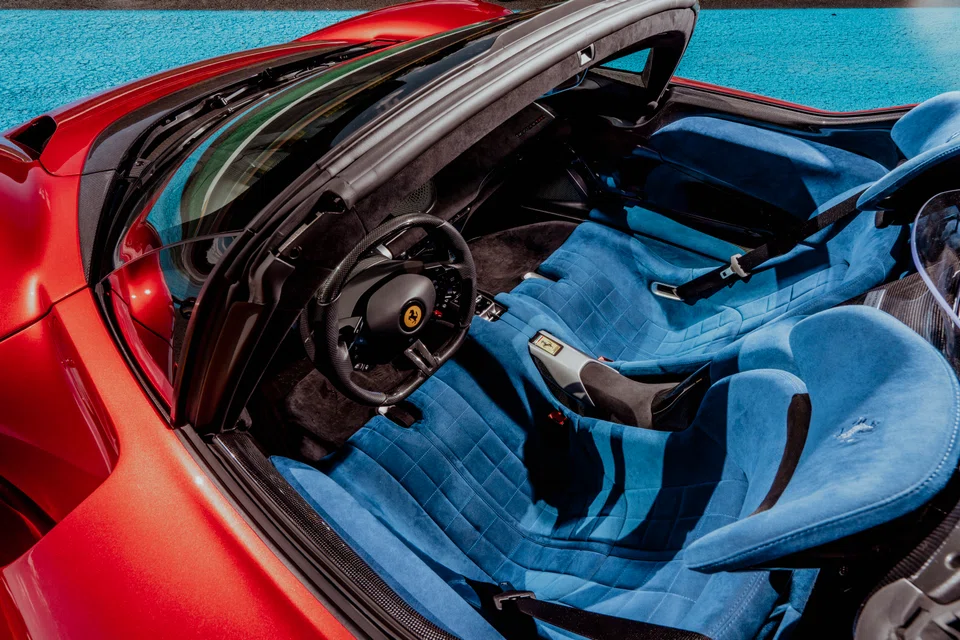
If just seeing a Daytona is a treat, climbing aboard it is an occasion. You dip down to find the catch that tilts the doors up so dramatically, and contorting your way into the cabin feels like a yoga move. The seats are fixed in place – instead, the pedals and steering wheel move towards you – which has you practically sitting on the floor, and you peer ahead through a curved windscreen, not unlike the ones a 60s racing hero would have.
Evoking that past is the whole point of the Daytona, especially since it’s named after the race in Florida where Ferrari paid Ford back for its Le Mans defeat. Straight after Ford’s famous win, Ferrari’s sportscars took a 1-2-3 victory so commanding that the team had the luxury of staging a photo finish on American soil, thereby ensuring that the image of 3 scarlet racers crossing the line together would grace newspaper covers across the country.
If the Daytona SP3 was meant to embody the spirit of those cars, one of which brought Raffaele di Simone to tears, it certainly succeeded. Returning it to Ferrari made me want to cry a little, too.
Decoding Asia newsletter: your guide to navigating Asia in a new global order. Sign up here to get Decoding Asia newsletter. Delivered to your inbox. Free.
Share with us your feedback on BT's products and services
TRENDING NOW
NDR 2026: Singapore to create new Western island to support 'new generation of industries'

MSCI drops S-E Asian heavyweights Sembcorp, GoTo and Ayala Land from global benchmarks
E-commerce is killing ‘real’ commerce, says China’s beverage king Zhong Shanshan

Asia-Pacific aviation: is up really the only way?

