

Lamborghini CEO says he’ll ‘have to see’ if sports cars survive EV transition
Chief executive Stephan Winkelmann tells BT what keeps him up at night about running sports car specialist Lamborghini
 Add BT as a preferred source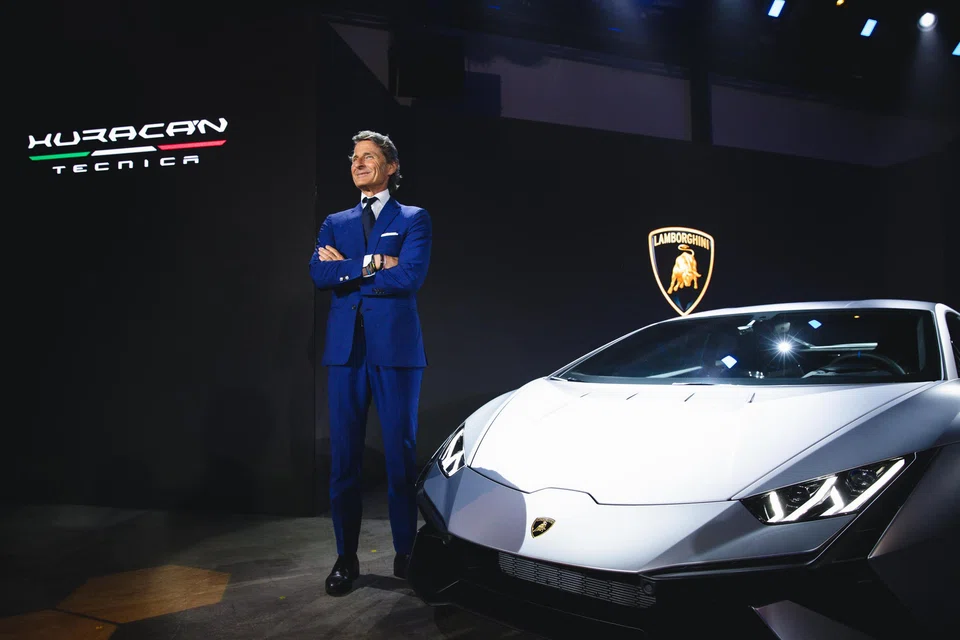
Lee Lilian &
Leow Ju-Len
THE world economy may be starting to look like something pulled backwards through a hedge, but Stephan Winkelmann is immaculately turned out as always.
The global chief executive of Automobili Lamborghini is never seen in anything but a tailored suit, but for a casual chat with The Business Times, the German-born executive, who runs one of the world’s most glamorous car companies, is in short sleeves that show off toned, veiny arms and an athletically lean frame. At 58, he looks as healthy as the bull on Lamborghini’s crest.
The company itself is in the pink, too. Last month, Lamborghini announced record third quarter results, with year-to-date operating profit hitting 570 million euros (S$813 million), 68.5 per cent higher than in the same period of 2021.
It also delivered a best-ever 7,430 cars in the period, with the brand’s sport utility vehicle (SUV), the Urus, accounting for the majority (4,834 units).
Best of all for Lamborghini, the wealthy’s appetite for its high performance cars shows no signs of slowing down. The order books are completely full for the next 18 months.
That should be good for its CEO’s mental health, but Winkelmann isn’t putting his feet up. Asked what keeps him up at night, he laughs and says: “A lot of things.” On the one hand, there is background anxiety that employees and their families depend on him to make the right decisions, he says, and on the other hand, there is the need to make the right product calls to keep buyers buying. Then there are strategy decisions and market conditions to grapple with.
Navigate Asia in
a new global order
Get the insights delivered to your inbox.
But the main reason Winkelmann is fretful: Like all legacy car makers Lamborghini has to make the tricky transition to the post-combustion era of motoring. In other words, just as it is zooming along at top speed, the company has to make a dramatic swerve.
Winkelmann has already outlined Lamborghini’s broad plans for electrification. Last year, he said the brand would go fully hybrid by 2024 and halve the emissions of its product range in the process. “This is the first step, and what we see is that this is already something which is completely accepted by our customers,” he says. “The next step is full electrification.”
That will involve launching a relatively high-riding, electric grand tourer with two seats for adults up front and smaller chairs in the back, plus following up its bread-and-butter SUV with a battery-powered sequel. “We have a plan, we have to see how this works out, to go full electric with the Urus, and we are planning a fourth model, which will be a GT car, a 2+2 with more ground clearance. This should be the first full electric car, appearing in 2028,” he says.
A pair of electric cars would be a straightforward model plan even for a relatively small player like Lamborghini, but the challenge for Winkelmann and team is to make sure that its products retain their boisterous character.
Powerful batteries and instantly responsive motors are making fast acceleration a commodity, says Winkelmann, so Lamborghinis will have to keep serving up the thrills in other ways.
“At the end of the day, the handling behaviour, how you brake, how your steering reacts, how the pedals are reacting, how you’re gonna come out of a corner, these are the basic things which we have to prove. Today there is no electric car which is doing it like we expect,” he says. “We have our key ideas, we’ll work on them and we’ll be ready when the first car is out.”
As for what a Lamborghini will sound like when it no longer has the kind of howling combustion engine that has been a hallmark of the brand for decades, Winkelmann is less certain.
He admits that internally, Lamborghini folk are split on whether the electric cars should sound electric (that is, nearly silent) or if they should have aural emitters that replace the music of combustion. He himself is undecided, but says he has driven many electric cars to get a sense of what other brands are doing. “It’s an interesting thing,” he says. “But it’s too early to say now.”
But just as uncertain is whether the electric car world will even have room in it for Lamborghini’s sleek two-door cars. “We’ll have to see if we can continue with the super sportscars,” Winkelmann says.
He is hoping that synthetic fuels, which are carbon-neutral, will prolong the lifespan of the combustion engine, but says it is ultimately up to regulators to decide the future of the car and agree on common standards so that manufacturers have a defined technical path to follow.
“At the end of the day we cannot build one car for Europe, one car for Singapore and one car for the US,” he says. “We are not in a hurry right now because we don’t need to decide immediately. There is still time because the new cars have a life cycle. We also have to test the market and see how our customers will react to electric vehicles.”
Lamborghini may have the luxury of time, but Winkelmann says the company operates under the pressure of scrutiny. “It’s like we are playing in the Champions League, there is a lot of attention around us,” he says, laughing. “Which is good! I think that’s the right way.”
In a sense, Winkelmann has given himself plenty to live up to. Since taking the top job in 2005, he has overseen a six-fold increase in Lamborghini’s sales. All he did, as he puts it, was to “awaken” the brand when he took over, and then broaden its appeal by adding an SUV to its lineup.
The coming shift to electrification is something Winkelmann boils down to one key task. ”You have to make the shift acceptable, and make people dream like they do today about the cars,” he says. If thinking about the business keeps him up at night, at least Lamborghini’s boss is content to leave the dreaming to others.
Decoding Asia newsletter: your guide to navigating Asia in a new global order. Sign up here to get Decoding Asia newsletter. Delivered to your inbox. Free.
Share with us your feedback on BT's products and services
TRENDING NOW

The retirement advice that worries me the most
Haidilao co-founder’s family buys second bungalow in Cluny Hill for S$85 million

From hawker stall to Enterprise Award winner: How Han Keen Juan scaled the Old Chang Kee empire

Yeo’s, Tiger Beer and now Gardenia – flight of food manufacturing from Singapore might be just as planned

