Mistral: The topless car at the top of Bugatti’s world
The Mistral is Bugatti’s farewell to a legendary engine, but it could also be a rewarding investment. What does it take to buy in?
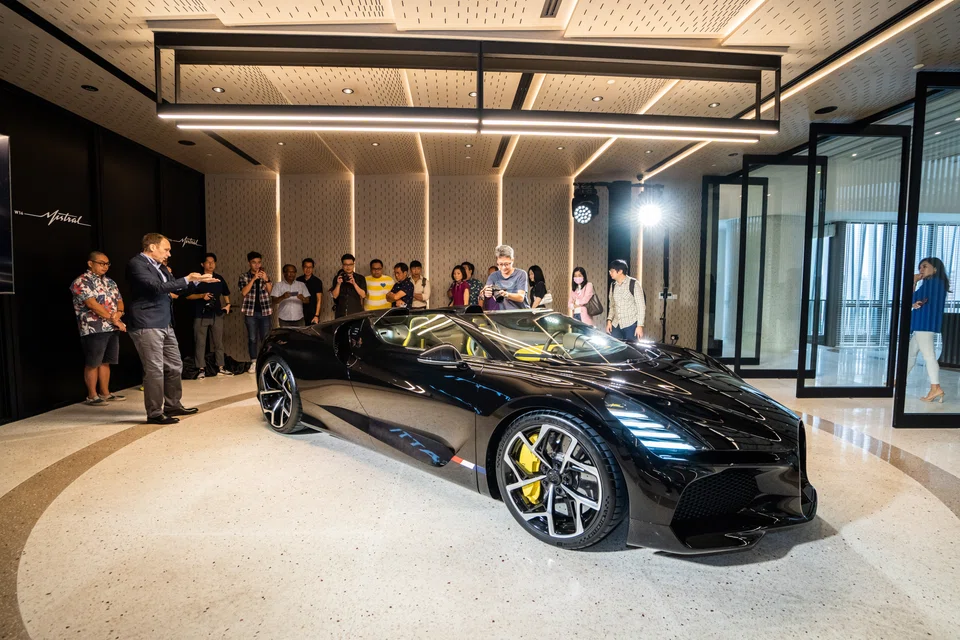
LOVELY as it is to gaze at the sculptural lines of Bugatti’s Mistral, it would be lovelier still to own one. Not merely because the 16-cylinder powerhouse is one of the fastest and rarest cars in the world, but because exclusive Bugattis have a habit of turning into handsomely rewarding investments.
“Many of our customers, when they invest an amount of money, they expect to at least get the money back if they ever sell the car,” Kostas Psarris, regional director, Middle East and Asia at Bugatti, told The Business Times (BT), during a media showcase for the Mistral at Wearnes Automotive, the brand’s Asia-Pacific dealer.
Bugattis aren’t intended to be flipped for quick profit, but the French marque’s ultra-wealthy customers often see them as a store of wealth. “They don’t buy a Bugatti with the mindset to sell it at some point. It’s something you pass on to your children, or to the next generations,” Psarris said.
Rarity certainly helps preserve these cars’ value. There are an estimated 2,000 Bugattis in existence; for comparison, Ferrari builds six times as many cars every year.
Transaction numbers are hard to come by, but Bugattis do show up in the used market regularly. Qatar car dealer Aj Wajba Motors currently lists a Chiron, the brand’s staple supercar, for 3.4 million euros (S$4.85 million). The price when new: 2.4 million euros.
Things get more heady with limited-edition cars. The Divo, a racetrack-oriented model that Bugatti decided to build just 40 examples of, sold for five million euros when new. One example in Dubai went on sale for nearly twice that amount in September last year.
That bodes well for the Mistral as an investment. Limited to 99 units, the roadster is Bugatti’s opulent farewell to the pure combustion era. “We wanted to celebrate the outgoing W16, a marvel of an engine,” Frank Heyl, deputy design director at Bugatti, told BT.
With its cylinder banks arranged in an unusual W configuration, Bugatti’s signature 8.0-litre engine packs 1600 horsepower, enough to make even other supercars look humdrum; it’s roughly twice as powerful as a V12 Lamborghini.
The Mistral is also Bugatti’s first open-top car in a decade, a layout that adds rarity points but also makes the driving experience more visceral. “If you step on the throttle, you have a certain growl, a certain bass. You feel it in your lungs actually,” Heyl said. “We thought, how can you magnify, how can you emphasise that?” Apparently, you place the engine’s air intakes just above the seats.
“By having that air intake right over your head like this, you hear the induction noise of the turbo sucking in air,” Heyl said. That must be quite a sound, because when roused to full power, the Mistral’s mighty W16 gulps down more than 1,000 litres of air per second.
“That acoustic sensation enhances your driving experience,” Heyl added. “It’s even more than if you drive a Chiron with the windows down. It’s times 10 in this car.”
If that’s an experience you want to sign up for, you’ll need not just five million euros, but a time machine. Every Mistral was snapped up even before the car made its public debut at the Pebble Beach Concours d’Elegance, a prestigious exhibition, in August last year.
In fact, 20 people each paid a refundable one million euro deposit just to join a queue and hang around, in case any of the first 99 buyers changes their mind.
Even getting to join that line takes some doing. Bugatti ranks its customers, and only offers limited-run models like the Mistral to those at the top. The main criteria: how many Bugattis you already own. Each of the five people who booked a Mistral from Wearnes already has at least two cars from the brand, the company said.
But Bugatti’s gatekeeping starts with a buyer’s first car, regional head Psarris told BT. “It’s part of our sales process that when someone enquires about our cars, we do a background check on them,” Psarris said. “Then we decide whether we keep talking to them or not.”
The factory also has a clause in its sales contracts that gives it the first right of refusal if a customer wants to sell his Bugatti within two years of taking delivery. That discourages quick flipping, and helps to keep the cars in the family, so to speak. “For us, it’s very important who drives the cars. An owner is very much seen as an ambassador of the brand,” Psarris said.
Those bitten by the Bugatti bug apparently welcome the intrusion. “The real buyers are more than happy because part of why they’re buying a Bugatti is to be part of that very limited, elite group. With any members club, you’re required to provide your credentials, let’s say, before you’re admitted into the club,” Psarris said.
Those credentials are ultimately backed by numbers. Bugatti’s research suggests that the average customer is worth more than US$100 million. Estimates for the typical Mistral buyer: half a billion and higher, according to Psarris, who added: “Even within the Bugatti world, you’re talking about the very top.”
Decoding Asia newsletter: your guide to navigating Asia in a new global order. Sign up here to get Decoding Asia newsletter. Delivered to your inbox. Free.
Share with us your feedback on BT's products and services