What if you could juice up an electric vehicle in seconds?
Taiwanese company Gogoro has more than a million electric scooters in circulation, but will they make sense for businesses here?
 Add BT as a preferred source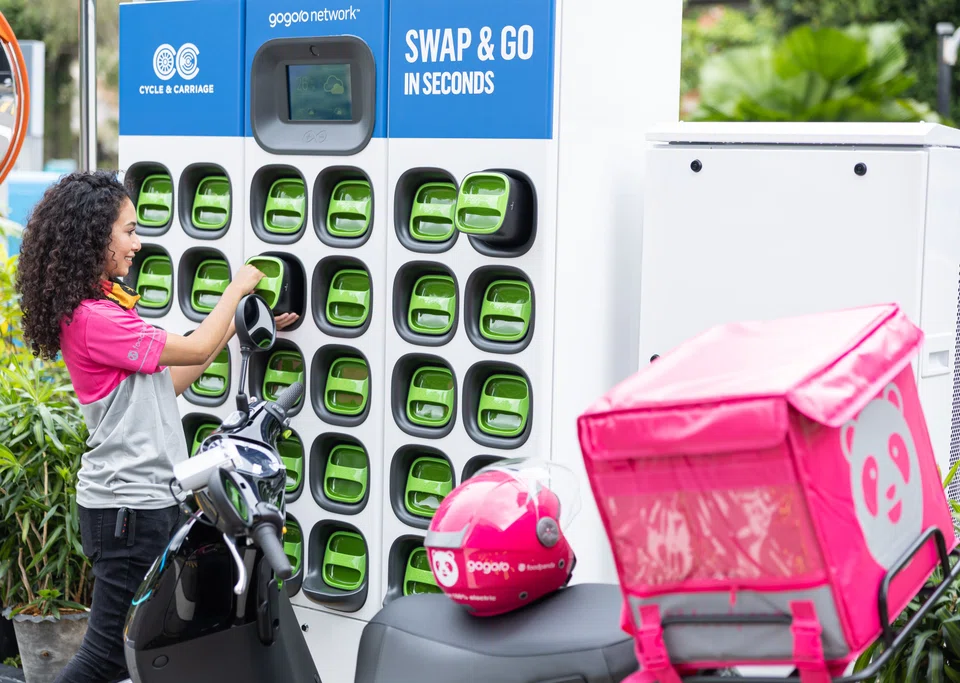
DeeperDive is a beta AI feature. Refer to full articles for the facts.
ELECTRIC car sales are growing rapidly in Singapore, but battery-powered two-wheelers are still nowhere to be found. Nearly 800 pure electric cars joined the vehicle population in the first three months of this year, compared to just six electric bikes during the same period.
Could a scooter with hot-swappable batteries change all that? Taiwanese company Gogoro is operating a sandbox pilot with Cycle & Carriage, its distributor here, to find out.
In March, the two companies kicked off a partnership with Foodpanda that will have the food delivery provider’s riders renting Gogoro’s electric bikes from Cycle & Carriage, which will also service them and make battery-swapping available.
Electric propulsion is a challenge for two-wheelers. Unlike cars, motorcycles have little room to carry hefty batteries. Gogoro’s solution is to dispense energy from battery vending machines.
Before a quick test ride of the Gogoro 2 scooter, I pulled up to one of the two GoStations that Cycle & Carriage is trialling, removed two battery packs from under the two-wheeler’s seat, and slid them into empty slots on the machine. It dispensed two freshly-charged batteries, which I simply heaved into the scooter.
The whole process takes seconds, and adds about 100 km of range. That beats the long hours it can sometimes take to charge an electric car. It also removes any worry about long-term battery degradation, since Gogoro riders don’t have any particular battery pack tied to their vehicle.
Navigate Asia in
a new global order
Get the insights delivered to your inbox.
And while I might have the physical build of a bamboo stalk, I found the GoStation’s 10 kg battery packs easy to manage. You wouldn’t want to drop one on your toes, but guiding them into the GoStation or scooter is an easy process because they have a sturdy handle and can be slotted home in any orientation.
The scooter itself is a pleasure to ride. Like other electric vehicles, the Gogoro 2 accelerates smoothly, quietly and responsively. In performance terms, it feels roughly equivalent to a motorcycle with a 125 cc engine. Gogoro says its top speed is just 90 km/h, but the one I rode could be persuaded to creep past that.
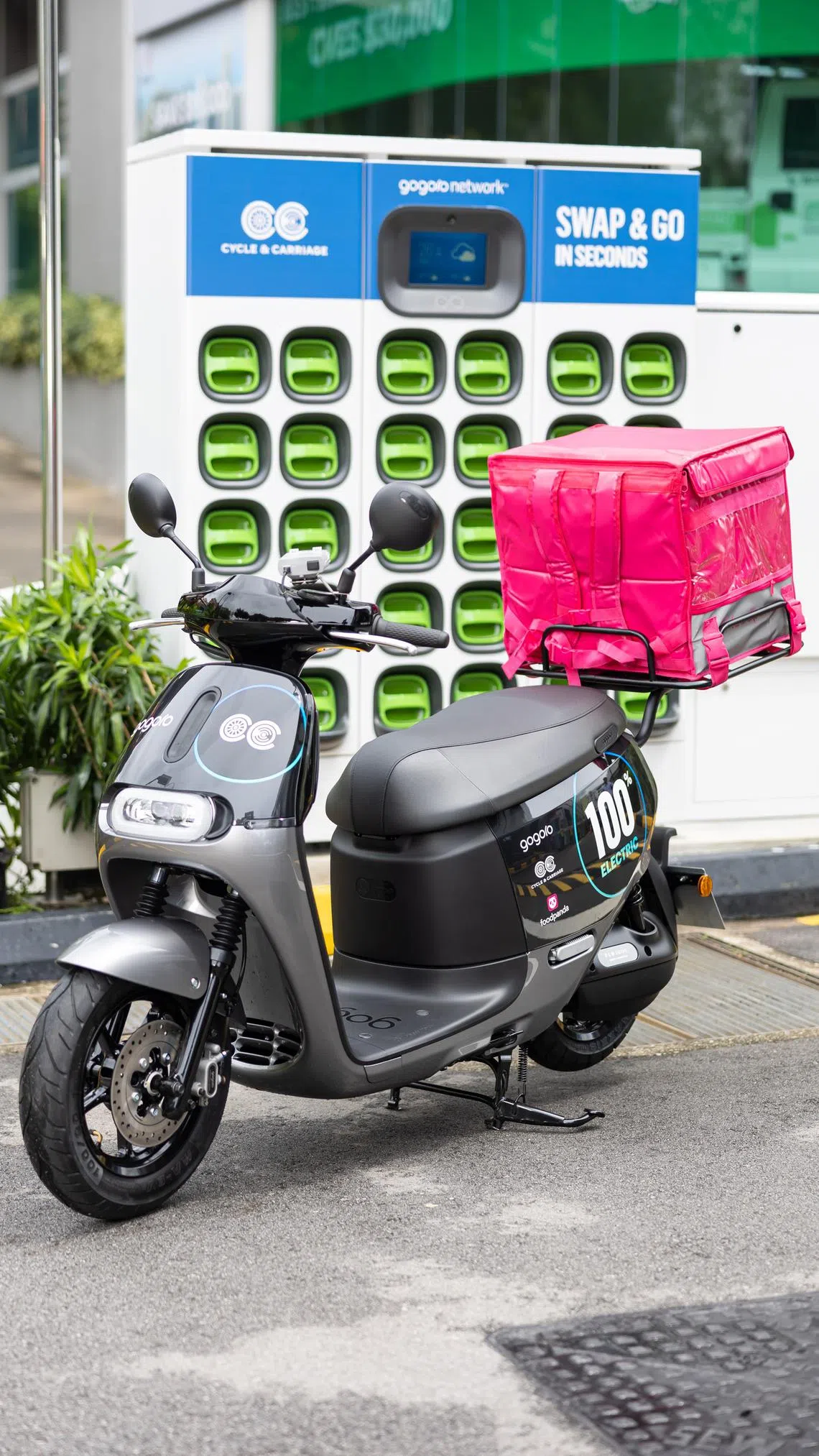
The Gogoro 2 can even crawl in reverse, in case the rider has to back up an incline. Overall, it’s so easy to handle that it feels like a child could ride one. If this is what electric scooters are like, it’s hard to see anyone clinging to petrol power.
Indeed, the Gogoro system seems well-established. The company was founded a dozen years ago, and its battery-swapping concept has become something of an industry standard. Other motorcycle manufacturers, such as the Japanese giant Yamaha, have agreed to adopt it for their electric models.
Gogoro says more than 250,000 battery swaps are carried out at GoStations in various countries every day. It says it uses artificial intelligence to work out where the best places to set up the battery vending machines are.
In a February report, the company claimed to have more than 1.3 million users, and said its bikes have collectively prevented 603 million kg of carbon dioxide emissions.
Yet the sandbox with Cycle & Carriage is less about Gogoro’s technology, and more about the dollars and cents of running a fleet of its electric scooters here. The dealership group already provides turnkey electric mobility services to companies, and is hoping to do the same with Gogoro’s scooters.
“We believe in Gogoro’s vehicles and battery-swapping technology, and they are complementary to our product portfolio,” Wilfrid Foo, the managing director of Cycle & Carriage Singapore, told The Business Times.
He said the trial with Foodpanda is about “ascertaining operational viability”, both for food delivery and in the wider logistics space. The company declined to say how much Foodpanda riders have to pay to rent the scooters, but a spokesperson said it was a “highly-subsidised” amount that includes battery swaps.
The costs of maintaining and servicing the scooters is also something that has to be worked out over the long term. The lower running costs of electric vehicles could be especially meaningful to delivery riders because they typically cover six times the distance that normal motorcyclists do.
Meanwhile, Cycle & Carriage is hoping other companies will sign up for Gogoro trials. Doing so would help speed up the commercialisation of battery swapping, and could address the fact that two-wheelers have plenty of catching up to do with other electric vehicles.
Decoding Asia newsletter: your guide to navigating Asia in a new global order. Sign up here to get Decoding Asia newsletter. Delivered to your inbox. Free.
Copyright SPH Media. All rights reserved.