People-related issues just as ‘financially material’ for businesses as climate: panel
Panellists say businesses should engage more stakeholders to address inequality
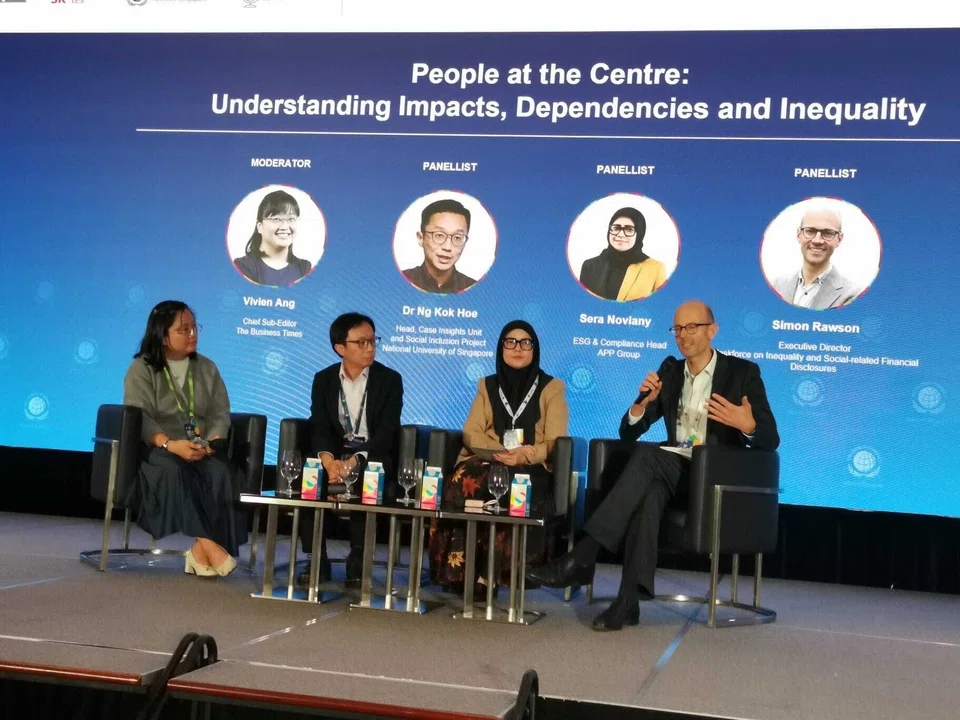
[SINGAPORE] For businesses, people-related issues are just as “financially material” as climate and nature-related issues, panellists said on Wednesday (Sep 2) at the United Nations Global Compact Network Singapore (UNGCNS) Summit 2026.
Dr Ng Kok Hoe, head of the case insights unit and social inclusion project at the National University of Singapore, said businesses can do more to reduce inequality in society and support people – not just communities on the ground, but people in the organisation and its supply chain.
“The ‘S’ in ESG is all about people,” added Simon Rawson, executive director of the Taskforce on Inequality and Social-related Financial Disclosures (TISFD), and another panellist.
They were speaking at a session called “People at the Centre: Understanding Impacts, Dependencies and Inequality”, moderated by The Business Times’ chief sub-editor Vivien Ang.
“I’m new to Singapore. I’ve been here for a few days, and I am overwhelmed by the level of thought and sophistication on climate change and addressing environmental sustainability… I’m also surprised at how little discussion there is of people-related issues,” he noted.
TISFD is a market-led initiative that aims to make the case for how such issues are financially material; lay out an evidence base; and create a standardised framework for companies and financial institutions to report people-related impact, dependencies, risks and opportunities.
Looking beyond wages
Dr Ng said household income inequality originates from wage inequality. While capital income – such as dividends or investment returns – makes a difference at the top end of the income distribution, most people’s main source of income is their wages.
He highlighted that based on his research, a living wage of around S$3,000 is “reasonable” in Singapore. This is based on a household budget for a working couple with two children. However, around one-third of working households earn below this benchmark.
“Wages do not just affect households’ economic security. Low wages affect people’s lives in so many other ways: access to health, education, prospects for participating fully in society.

“Good work – quality work – involves not just decent and fair income, but also social protection for dependents, chances for personal development and to participate in decision-making in the workplace and more broadly.”
Meanwhile, fellow panellist Sera Noviany, ESG and compliance head at APP Group, said that besides tracking data on people-related issues, it is important to understand people’s lived experiences and build trust.
APP Group is a holding company for pulp and paper industries in Indonesia, as well as some forestry companies. It is guided by three pillars: production, forests and people. The company has thousands of workers and contractors across Sumatra and Kalimantan in its supply chain.
“Income security depends on more than just wages – it’s shaped by market access, seasonal conditions, productivity and household resilience,” she said. “At APP, we address this through a social compliance programme, human rights due diligence, stakeholder engagement, an accessibility-driven mechanism and a community empowerment programme.”
Dr Ng agreed that hearing about people’s lived experiences – particularly on how inequality and poverty affect their lives – would “significantly enrich our understanding of inequality in any society”.
Inequality as financial risk
Meanwhile, Rawson said it is easy for companies to detach social issues from the business case; social issues and wages are often seen purely as costs. However, TISFD aims to change this mindset.
“Part of what the task force is doing – driven largely by financial institutions, investors, large asset owners – is showing that the cost that we minimise at an individual business level is borne somewhere else. It’s what we call an externality.”
In developed economies, he noted that extreme inequality has driven polarisation in societies, leading to political instability. This affects business and productivity.
“Impacts on people are starting to become financially material, and it may be hidden in the short term because the cost is externalised,” Rawson said. “But it’s there… and investors and financial institutions are seeking information from businesses about things like living wages.”
Other people-related issues include specific products’ impact on people, human rights risks in a supply chain and dependency on migrant labour. These all present material risks to a business.
And while measuring the “S” in ESG has been difficult, it is not impossible, Rawson said. TISFD is currently developing a framework, and is seeking feedback from businesses.
The panellists added that businesses should engage more stakeholders besides the government to address inequality.
Addressing businesses, Dr Ng said: “Your natural allies are communities – advocates who care for the long-term well-being of the places and societies where you are. It is in the interest of your business to engage actively with the community, which ultimately produces your consumers and your workers.”
At the 18th edition of the UNGCNS Summit, other key topics discussed were artificial intelligence and sustainability, nature dependencies and climate adaptation.
Over the years, David Fogarty, CEO of UNGCNS, said sustainability has become embedded into core business operations instead of treated as a separate function.
UNGCNS on Wednesday also announced the launch of Working Groups and Peer Learning Groups, enabling businesses to collaborate and tackle shared sector challenges and learn from each other.
“These initiatives reflect what our members are telling us what they need on the ground, right now,” he said.
UNGCNS, a registered charity, helps companies embed sustainability into their operations through advocacy, capacity building, partnerships and collective action platforms.
Decoding Asia newsletter: your guide to navigating Asia in a new global order. Sign up here to get Decoding Asia newsletter. Delivered to your inbox. Free.
Copyright SPH Media. All rights reserved.