

RWS partners Kranji Countryside Association to support local farmers
The resort operator provides a platform for Singapore-based farms to raise awareness about produce grown here
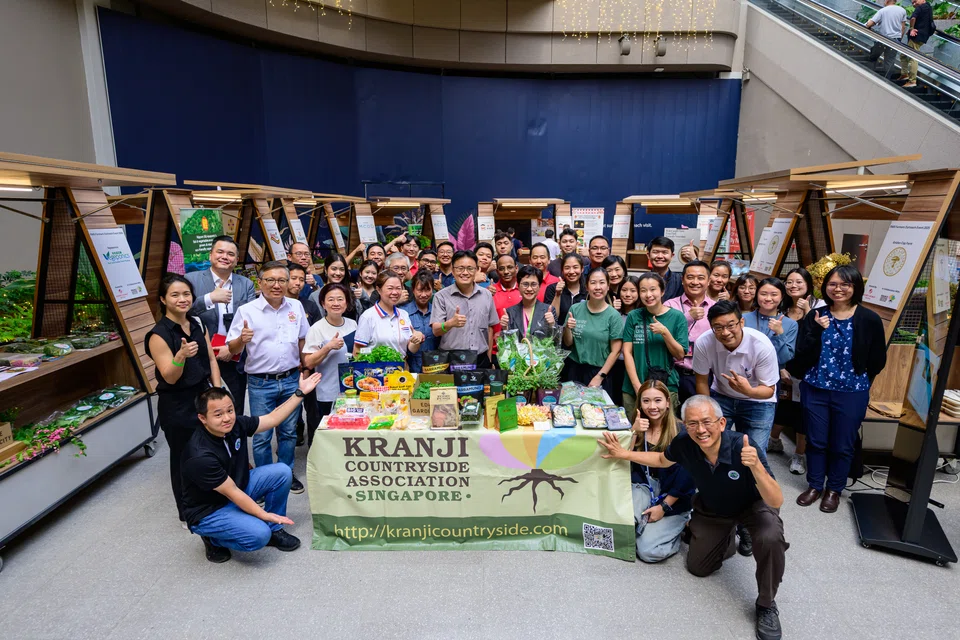
[SINGAPORE] More than 10 local farms and agriculture companies set up booths at Weave at Resorts World Sentosa (RWS) on Wednesday (Nov 19) and Thursday, hoping to build relationships with potential business partners.
In a business-to-business setting, these farms, which are part of Kranji Countryside Association (KCA), promoted their produce – including vegetables, eggs and fish – to restaurants and brands.
RWS chief executive Lee Shi Ruh said the event, jointly organised by the resort operator and KCA, “reflects RWS’ long-term ambition to help build a stronger, more connected, and more sustainable food ecosystem”.
The launch of the event was inspired by The Laurus Table, RWS’ newest restaurant, which focuses on sustainable seafood.
When the RWS team was developing the restaurant’s supply chain, they discovered that many of its farmers and producers were part of KCA’s network.
“This presented a natural opportunity to deepen collaboration and create a platform where farmers, chefs and procurement teams can come together to strengthen relationships, share insights and explore ways to collectively shape a more resilient food future,” Lee said.
'%3e%3cpath%20d='M12.1475%2025.5262C13.7713%2025.4295%2014.94%2023.913%2014.94%2021.8832C14.94%2019.5359%2013.474%2018.093%2011.5917%2018.093C11.3745%2018.093%2010.9582%2018.093%2010.8393%2018.1413V25.2086L11.8891%2025.5745C11.8891%2025.5745%2012.207%2025.5262%2012.1475%2025.5262ZM11.4934%2017.6281C13.2567%2017.6281%2014.3843%2016.4292%2014.3843%2014.4501C14.3843%2012.372%2013.275%2011.2973%2011.4339%2011.2973H10.8393V17.6305H11.4934V17.6281ZM6.66078%2025.6482L7.39265%2025.5492C8.02617%2025.4502%208.26403%2025.3053%208.26403%2025.1097V11.6149C8.26403%2011.4193%208.1451%2011.3709%207.23484%2011.249L6.68137%2011.173L6.6219%2010.7588H11.9508C15.7153%2010.7588%2017.0624%2012.0797%2017.0624%2014.1578C17.0624%2015.9666%2015.7748%2017.1909%2013.4969%2017.6305V17.7041C16.111%2017.948%2017.6571%2019.5382%2017.6571%2021.7636C17.6571%2024.3318%2015.8937%2026.0417%2012.1109%2026.0417H6.60132L6.66078%2025.6482Z'%20fill='%232B2B2B'/%3e%3cpath%20d='M20.6287%2025.6505L21.5596%2025.5515C22.1725%2025.4779%2022.4104%2025.3076%2022.4104%2025.112V11.249H21.9346C20.073%2011.3479%2018.982%2013.0095%2018.408%2014.6227L18.1907%2015.5018H17.6555L18.1701%2010.7588H29.3837L29.6421%2015.4787H29.1664L28.9491%2014.6227C28.3728%2012.8645%2027.3047%2011.2743%2025.5002%2011.249H24.9856V25.1856C24.9856%2025.3812%2025.1251%2025.4548%2025.9965%2025.5515L26.7695%2025.6505L26.829%2026.0417H20.5693L20.6287%2025.6505Z'%20fill='%232B2B2B'/%3e%3c/g%3e%3cdefs%3e%3cclipPath%20id='clip0_5242_21648'%3e%3crect%20width='24'%20height='16.8'%20fill='white'%20transform='translate(6%2010)'/%3e%3c/clipPath%3e%3c/defs%3e%3c/svg%3e)
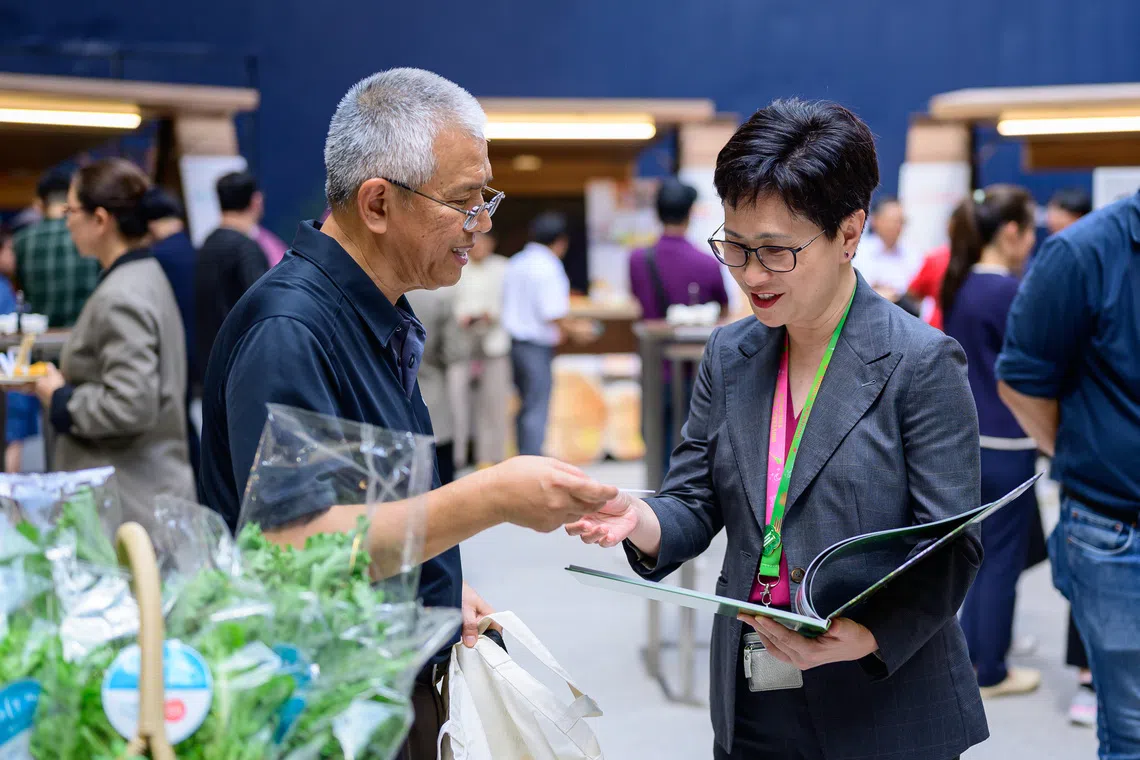
Malcolm Ong, CEO and founder of The Fish Farmer, one of the participating farms, said local farms do not get many opportunities to tie up with corporates in the food and beverage (F&B) industry.
Such outreach events are therefore important for them, said Ong, who is also president of KCA.
This also comes as Singapore recently dropped its 30 by 30 farming goal, which was to locally produce 30 per cent of the country’s nutritional needs by 2030. A new strategy focusing on strengthening food security has since been adopted.

Based on a 2024 Singapore Food Statistics report, local food production comprised less than 10 per cent of total demand in the Republic.
Ong said more can be done for local farms to contribute to Singapore’s food industry. “There is actually a lot of potential, but because historically we have brought in so much food, hotels and all are used to buying certain produce.”
Lee said RWS has a “longstanding commitment to uplifting local communities and businesses”, and noted that sourcing locally is aligned with this. “The resort aims to amplify the importance of sustainable sourcing, encourage wider industry adoption, and strengthen collaboration with local producers.”
Another participating farm in the two-day event, Sustenir, noted that such outreach events raise awareness about local produce, especially when there are other local farms in the same space leveraging the same platform.
Sean Aw, head of brand and marketing at Sustenir, said: “The more people are aware about the quality, as well as the affordability and variety that’s available, I think more people will support buying local produce.”
Reducing carbon footprint
Sourcing locally supports Singapore’s decarbonisation efforts, as food no longer has to cross borders.
“Choosing home-grown produce not only reduces reliance on international freight and logistics – significantly lowering transport-related carbon emissions – but also enhances supply-chain resilience in the face of global disruptions,” Lee said.
Ong pointed out that local produce is also fresher, since it does not need to be transported and stored, allowing it to retain nutrients.
RWS already implements local produce in its Mice event menus and across its signature restaurants.
Chef Faust Uwe, vice-president of F&B general management at RWS, said: “Our starting point is always the same: Can we get this from a local farm? If the answer is yes, we do it. Right now, that includes lettuce, mushrooms, eggs, fish and several others.”
And with Singapore reassessing its goal to focus on food resilience, Lee said sourcing decisions have become increasingly important as they have a “ripple effect on the wider community”.
She added that amid climate change and an “evolving global supply chain landscape”, RWS sees a responsibility and opportunity to “champion more sustainable practices across its operations, supporting the nation’s refreshed food security strategy”.
RWS is looking to organise more collaborative events. Lee said the resort hopes to “cultivate greater appreciation for home-grown produce and to strengthen the local ecosystem, ensuring the destination remains future-ready, resilient and reflective of Singapore’s unique identity”.
Decoding Asia newsletter: your guide to navigating Asia in a new global order. Sign up here to get Decoding Asia newsletter. Delivered to your inbox. Free.
Copyright SPH Media. All rights reserved.
TRENDING NOW

Singapore identifies 7 firms responsible for haze fires, notices issued urging action: Grace Fu

Philippine power giant First Gen rebuffs foreign offers, plans up to US$2.6 billion in expansion

DBS remains analysts’ pick ahead of Q3 earnings after Singapore banks’ share slump

Indonesia imposes US$116 million in fines over manipulation of Sinar Mas, Prajogo-linked stocks

