Singtel hackathon spotlights inclusive carnival games for children with disabilities
It is in collaboration with LionsForge and Cerebral Palsy Alliance Singapore
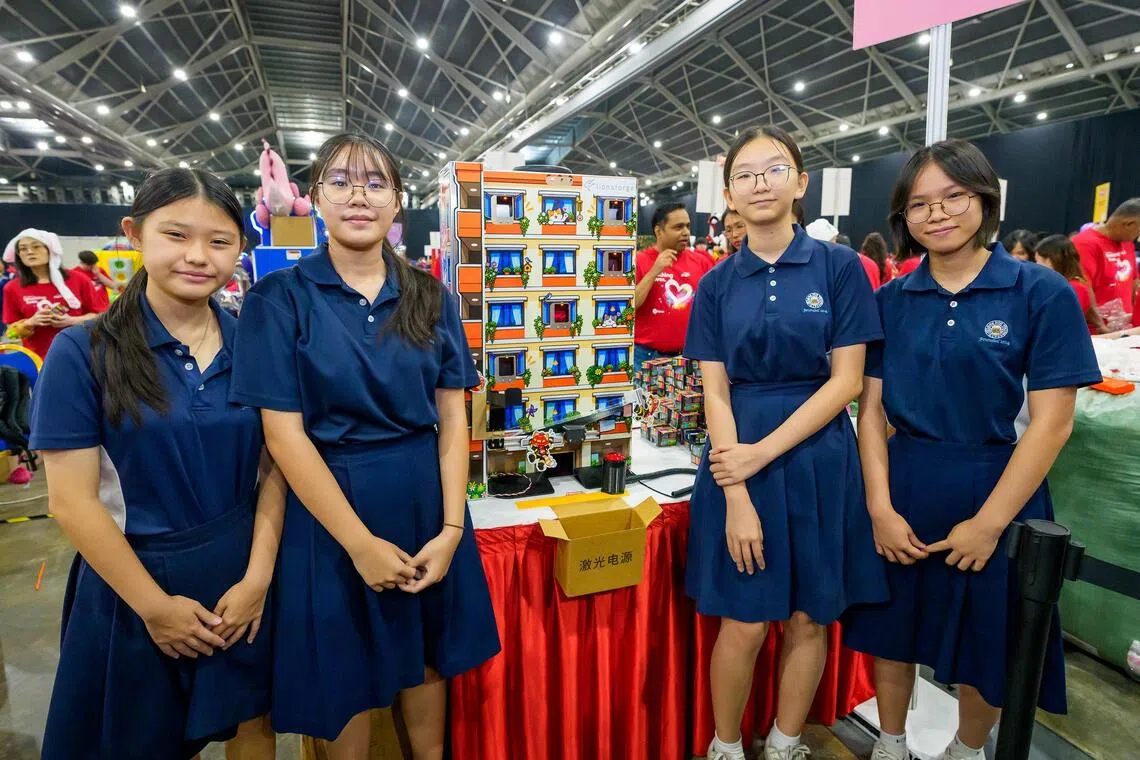
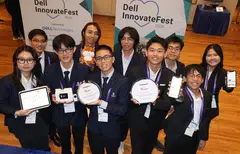
[SINGAPORE] Inspired by Singapore’s high-rise urban landscape, four students from Kuo Chuan Presbyterian Secondary School developed a firefighting game that helps children with disabilities train their hand-eye coordination.
Using a makeshift building resembling a Housing & Development Board block, players use accessible button controls to raise, lower and tilt a motorised gondola, guiding a ping-pong ball up and down. Windows with LED lights representing fire will be lit up, and players have to move the ball into the windows within a certain time frame to win the game.
Ng Thong Yi from the team said that in order to make the game inclusive, they made the controls easy to operate with instructions that are “clear and easy to understand”.
They were one of 111 teams participating in Singtel’s inclusive hackathon this year, in collaboration with tech company LionsForge and Cerebral Palsy Alliance Singapore (CPAS).
The hackathon challenged students to use tech to create inclusive carnival games for children with disabilities. Many teams showcased their innovations at Singtel Carnival 2026, which took place on Oct 7 at Singapore Expo.
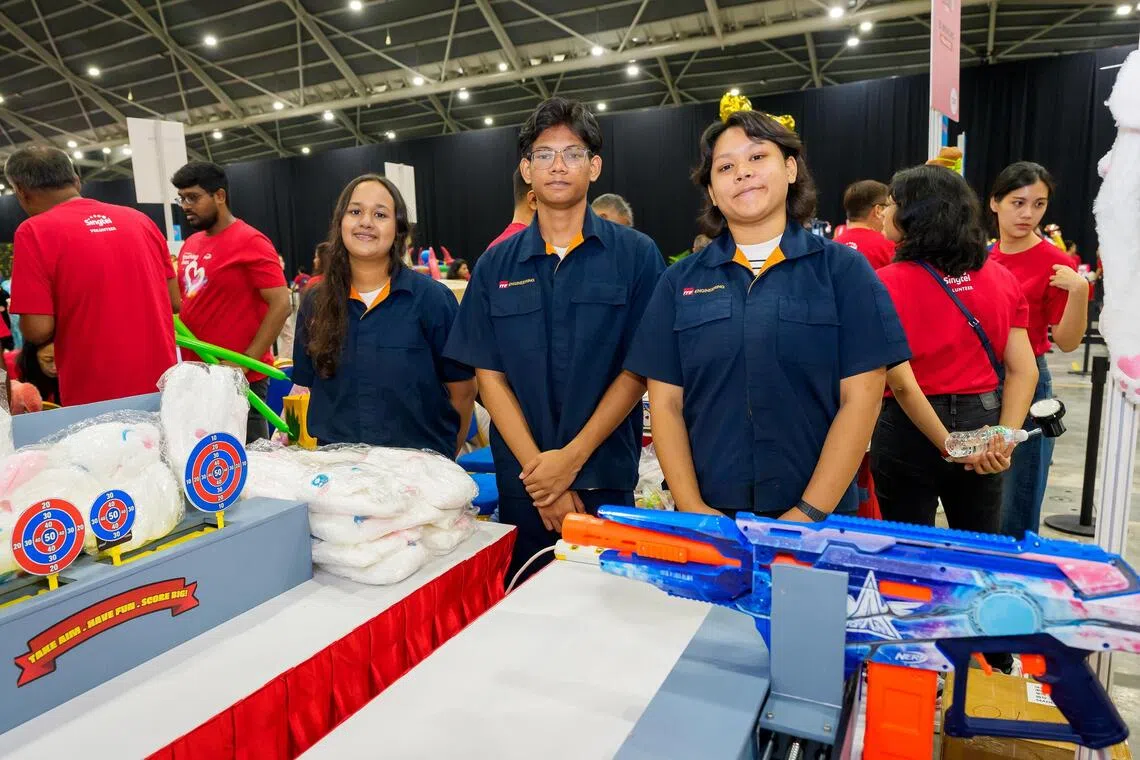
Four students from the Institute of Technical Education College East made a carnival shooting game using a modified Nerf gun that allows automation via push buttons. Controls include buttons to move the launcher from left to right and a firing mechanism. Players aim at an electronic target system with targets of varying sizes.
Team member Nur Serianni Muhammad Rossuandi said they selected large push buttons that only require a light touch to be activated, to be inclusive.
“Inclusive design is about understanding the needs of users and adapting the experience around them,” she added.
Another team comprising four students from assistive tech makerspace SalvageGarden developed a game based on the odd-one-out concept, where players identify the odd one out in a series of shapes, sounds or textures.

When setting up the game, the game master can determine the senses that the options are presented using sight, hearing and tactile feeling.
Team member John Ong said: “These dimensions enable inclusion by allowing those with different sensory abilities to play, such as turning on the sound and tactile dimensions for a blind player.”
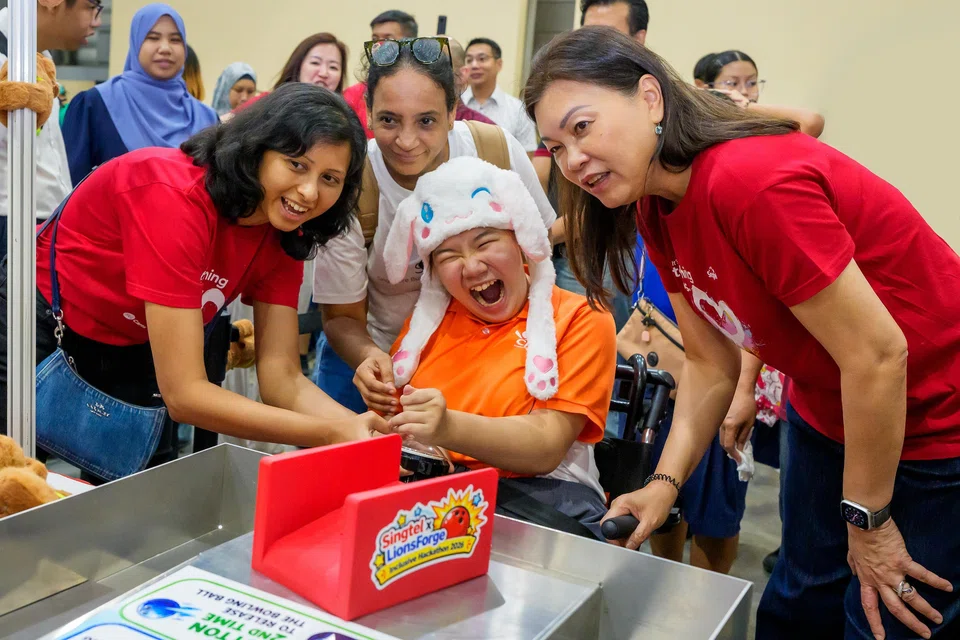
A team of three students from Pathlight School (Ang Mo Kio) – an autism-focused school – developed a bowling game, where a ramp automatically sweeps left and right and players use a button to release the ball. The aim is to knock down as many pins as possible.
“We made it inclusive by introducing bigger buttons and a ramp for the ball to roll down,” said team member Yu Jun Bo. “We hope that children will have fun while learning skills such as following simple instructions, taking turns and aiming.”
Developing inclusive games
In an interview with The Business Times, Aileen Tan, group chief people and sustainability officer of Singtel, said: “Many games and activities are not designed with children with special needs in mind, which can limit their opportunities to participate. Small design changes can make a big difference in making these experiences more accessible.”
Last year, CPAS School East, Singtel and LionsForge teamed up to launch an inclusive hackathon. This year marks the second year of collaboration, and the number of teams rose from 34 to 111.
For the first time, special education schools were part of the mix of schools participating.
Boo Hian Kok, principal of CPAS School East, said: “Beyond developing games, (the hackathon) fosters empathy, understanding and social responsibility among young people, encouraging them to design with inclusion in mind.”
The teams worked with the school to develop their games. They visited the school to interact with students and teachers, observe the learning environment, and learn from assistive tech specialists about accessibility considerations and adaptive equipment.
“Inclusive games do not have to be high-tech or complex,” Boo said. “This initiative promotes a more inclusive mindset by encouraging young innovators to consider the needs of diverse users when designing solutions.”
He noted that in recent years, there has been a growing recognition of games and digital experiences designed with users of diverse abilities in mind. These include features such as simplified interfaces, customised controls, and visual and audio support.
Tan said: “With more than 2,500 children from 22 special education schools attending this year’s carnival, which is the largest in Singapore for children with special needs, it provides a unique opportunity for the hackathon participants to see how inclusive design can make a difference at scale.”
Singtel will continue working with partners to come up with solutions to push for inclusive play, she added.
Decoding Asia newsletter: your guide to navigating Asia in a new global order. Sign up here to get Decoding Asia newsletter. Delivered to your inbox. Free.
Copyright SPH Media. All rights reserved.