

Stronger partnerships among social enterprises, corporations, SSAs can scale social impact: panel
Panellists highlight the importance of trust when it comes to building partnerships
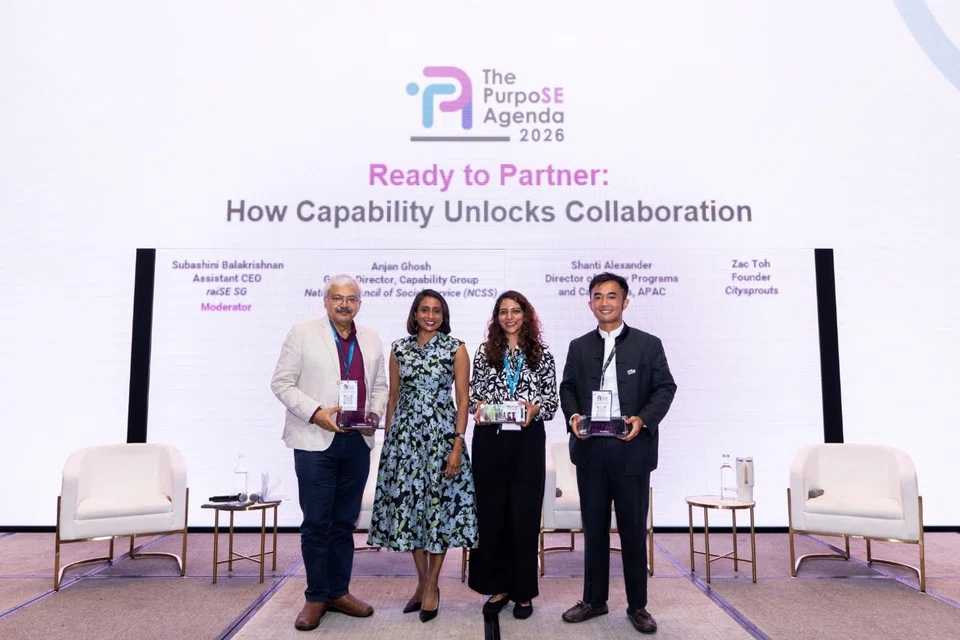
[SINGAPORE] Stronger and longer-term partnerships between social enterprises, corporations and social service agencies (SSAs) can scale social impact, said panellists at The PurpoSE Agenda 2026, the flagship conference by the Singapore Centre for Social Enterprise (raiSE).
The panel, “Ready to Partner – How Capability Unlocks Collaboration”, featured executives from Meta, the National Council of Social Service (NCSS) and social enterprise Citysprouts, and was moderated by raiSE.
While there is no lack of goodwill from corporates and SSAs in collaborating, more can be done to advance the social enterprise ecosystem, the panellists noted.
In an interview with The Business Times, Subashini Balakrishnan, assistant CEO of raiSE, said: “I think collaboration is still happening quite transactionally. For example, I want to do a project and test something out, so I will go and look for a social enterprise to do it.
“But where we would like to see it go is long-term social procurement, so there’s a real business relationship. (This is) where the social enterprise is the one providing the product or service, and then the corporate commits to buying it over a longer period of time.”
The panellists added that corporations can work with social enterprises by helping to drive awareness and visibility of social enterprises’ products and services, and by building capacity for entrepreneurs.

Social enterprises can also work closely with SSAs, since many of them target similar beneficiary groups and social causes. This would reduce costs and resources.
Through Sessame, the social enterprise social service agency multiplier effect, SSAs, impact ventures and social enterprises can co-create, pilot and scale beneficiary-centred solutions within a sandbox supported by raiSE, NCSS and the Singapore University of Social Sciences.
“Social enterprises have the products and services, and they know how to roll it out. But the SSAs hold all the knowledge about the beneficiaries, the people who are going to use the products, and have loads of data,” said Balakrishnan. “There is a lot of potential to explore.”

By working together, entrepreneurs can obtain feedback and tweak their products and services accordingly to best meet beneficiaries’ needs.
“There’s resilience behind how social entrepreneurs want to solve the problem, using a sustainable model. (They) are a different creature altogether – they have a lot of grit,” she added.
Trust, data and impact measurement
The panellists highlighted the importance of trust when it comes to building partnerships. Before partnering, the corporate and social enterprise can identify the strengths they can bring to the table and see how they complement each other.
They also said that acknowledging failure is a display of honesty, and improves transparency within the collaboration.
During the panel discussion, the panellists noted that frameworks help to bring a level of “confidence” to the sector.
For example, raiSE’s verified leading social enterprise (VLSE) is the highest membership category for those that have passed raiSE’s social impact verification.
Balakrishnan said: “We want our social enterprises to go beyond saying ‘I’m impactful’. How are you impactful? What are you measuring? Minimally, we need to measure output.
“The next step is to measure outcomes. In the longer term, did this person’s quality of life improve? Was there any social mobility?”
She added that funders will be “appreciative” of tangible data and impact measurement, as it provides a level of confidence and credibility to the partnership.
Yeoh Wan Qing, co-founder and CEO of Hatch, which is a VLSE, said that running pilot programmes with corporates helps to build trust.
The social enterprise runs a train-and-place programme for beneficiaries – mainly youths from disadvantaged backgrounds and persons with disabilities – to secure apprenticeships, internships or full-time roles in small and medium-sized enterprises (SMEs).
Its workshops and programmes focus on technical skills and workplace readiness. Hatch frequently works with SMEs on inclusive hiring.
“With a lot of the corporates we work with, we understand the hesitation and reservations about working with different groups, so we usually propose a pilot,” Yeoh said. “This helps them manage risk. We also share candidly with the companies the profiles of the students.”
The best partnerships are with corporates who are honest and have an open mind, she added.
raiSE’s long-term goal is to come up with a trust mark, which would help to facilitate collaboration.
Balakrishnan said: “There is no lack of (partners) coming forward. The problem we identified was that they needed trust, because corporates often call us to ask for a list of trusted social enterprises.
“Funders for sure are going to be more comfortable with the social enterprises whose impact is validated.”
Decoding Asia newsletter: your guide to navigating Asia in a new global order. Sign up here to get Decoding Asia newsletter. Delivered to your inbox. Free.
Copyright SPH Media. All rights reserved.
TRENDING NOW

What shattered Crystal Jade? How the culinary empire shrank from 120 to just 9 outlets

Demand, tech capabilities position Apac and AI as Skyscanner’s next growth frontiers: CEO Bryan Batista

Could Jensen Huang work for Elon Musk? It would be ‘a titanic ego death match’, says biographer

South-east Asia has lost Nvidia’s best salesman

