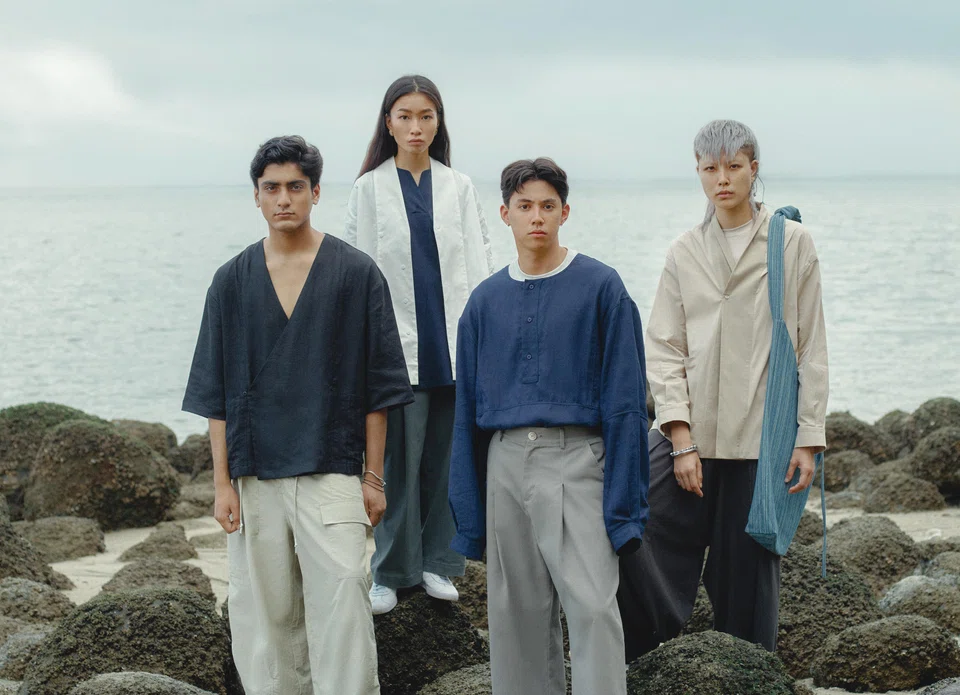
Like it or not, gender-neutral clothes are coming for you
It’s good for gender equality, diversity goals and the environment, say advocates

PING Tay and her long-term boyfriend Kevin Chan have been sharing clothes for years. Their favourite pieces are from home-grown label Graye, which has straight cuts, minimal patterns, discreet embellishments and neutral colours such as beige and grey that appeal to both men and women.
“It says a lot about society today that Kevin and I can share clothes daily, and almost no one realises it,” says Tay. “The concepts of what a woman or man can do, according to their gender, are diminishing… and Kevin and I have always believed in gender equality.”
Chan is a businessman and Tay is retired from her job in hospitality. They’re both in their 50s. They met about 20 years ago at nightclub Zouk and have been together since. They’re not married and have no plans to do so. They share clothes because it’s “just better for the environment… It means fewer wardrobe pieces and less laundry”.
They’re not alone. Graye’s founder Xie Qian Qian says that many other couples share clothes from her label because they’re more relaxed-fitting than gender-specific pieces, yet still chic and contemporary-looking for both genders.
“When I started the brand in 2016, Graye was a menswear brand,” says Xie. “But we soon realised that women were buying our pieces, too. So we pivoted our marketing strategy to include female models in our lookbook, and our revenue rose significantly.”
Today, Graye is one of Singapore’s most enduring home-grown brands. Though she declines to disclose numbers, Xie says it has been profitable from the start, allowing it to expand to two stores in Wheelock Place and Tiong Bahru. This is no small feat, considering how many local brands go bust in the face of intense competition from international labels.
“We believe we’re going in the right direction (with our gender-neutral silhouettes),” Xie says.
“We’re now looking at producing more experimental pieces. Recently, we launched tops that could turn into skirts on our online store. Every single piece got sold – and we had more buyers who were men than women.”
Graye’s evolution is reflective of larger world trends. Top designers such as Issey Miyake, Yohji Yamamoto, Jil Sander, Christophe Lemaire and Margaret Howell have long espoused silhouettes that are gender-neutral. With other designers such as Alessandro Michele and Haider Ackermann designing gender-fluid styles for top celebrities such as Harry Styles and Timothee Chalamet, gender style distinctions have never been more blurred.
The trend has only accelerated, with Generation Z (those born between 1995 and 2012) widely embracing the concept of gender fluidity. A 2022 survey of Gen Z consumers by fintech company Klarna and data platform Dynata found that about half of online shoppers have bought fashion items that are not traditionally associated with their gender. Similarly, a 2023 report by McKinsey predicted that fluid fashion is a key theme for consumers in 2024.
An inclusive festival
At the upcoming Fashion For All festival at Design Orchard, gender-fluid fashion is taking centre stage – a first for Singapore. Organised by Pink Fest in partnership with Singapore Fashion Council, it features brands with more inclusive perspectives on clothing design. These include IKV, Ther Yang, Voiddeck and Boheme.
One of the participating brands is Marilyn Tan Jewellery. An industry veteran, Tan says she has always created gender-neutral jewellery that can be worn by both men and women. “I design bold, strong, simple pieces that speak to the individuality of the wearer – rather than emphasising their gender. I don’t do pretty butterflies.”
Tan says her husband, whom she describes as “a straight-up Chinese businessman”, frequently wears her jewellery. “He might wear a floral brooch on his lapel or even a pearl necklace to an event.”
Tan’s pearls are unconventional because she uses keshi pearls, which have irregular shapes. These kinks, she believes, set them apart from conventional women’s pearls, allowing men to also indulge in them. In recent times, pearl-wearing has also become a popular trend among young men who typically don a string of pearls with T-shirts, denims and sneakers.
Tan says: “A lot of the rules (for) what men and women can or cannot wear are very much rooted in social conditioning and not much else. Did you know, for instance, that pink was once a colour for men – not women?”
She explains that pink was associated with masculinity and strength, while blue was seen as delicate and dainty, and more suitable for girls. These perceptions shifted in the mid-20th century when advertising and marketing for toys and fashion associated pink with girls and blue with boys.
“As a designer, I think pink looks even better on men than it does on women. It’s an incredibly masculine colour,” she says.
The right to be stylish
Another Fashion For All festival participant is Voiddeck, a Singapore-China brand co-founded by Griffith Lim and Tasya Ye. Its best-selling items are gender-neutral bags and jewellery, which are especially popular with the non-conforming fashion crowd.
Lim says: “We choose to be gender-inclusive because we believe a statement piece can belong to anyone of any gender identity without discrimination. Everyone has an equal right to be stylish and beautiful.”
Lim and Ye are inspired not just by the gender-fluid designs of highly respected designers such as Sander, Yamamoto and Rick Owens – but also the subcultures of China, which include punks and skinheads. Lim says: “Our pieces are minimal and versatile, with a focus on good design and quality material – instead of gender specification.
“Our bags are purchased by both men and women, with no regard for who they’re ‘supposed’ to be made for. We believe that customers have become more sophisticated in their taste and outlook, and are no longer chained to certain stereotypes.”
Voiddeck has manufacturing facilities in China, and helps produce and assemble parts for other fashion brands such as Alexander Wang and Michael Kors. Lim admits that gender-fluid fashion may not be as profitable now as gender-specific fashion – but thinks that, with the global movement towards inclusivity and greater sensitivity towards gender-non-conforming individuals, the market for gender-fluid fashion can only increase.
Irene Kusuma of IKV agrees. She says: “The clothing industry is something of a traditional business, so this differentiation of menswear and womenswear – be it on the runway, or in stores with their gendered sections – is a relic of older practices.”
These days, designers are putting both male and female models “on the same runway for the same show wearing the same styles”, she points out. “Increasingly, you see women shoppers going into the men’s section of the department store to look at the suits and pants, while more fashionable men are checking out women’s accessories.
“Gender-inclusivity is a trend society is visibly moving towards.”
Fashion For All, a gender-inclusive fashion festival, runs at Design Orchard throughout the month of June.
Decoding Asia newsletter: your guide to navigating Asia in a new global order. Sign up here to get Decoding Asia newsletter. Delivered to your inbox. Free.
Copyright SPH Media. All rights reserved.