

Survey to shed light on financial literacy in children
Singapore
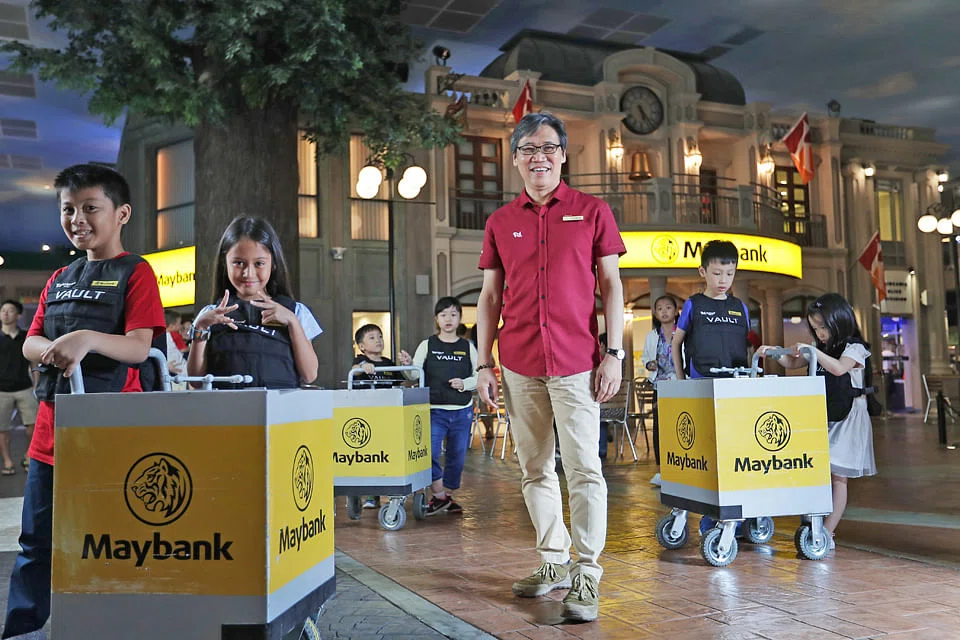
TO find out about the level of financial literacy among children here, family edutainment park KidZania Singapore is commissioning a survey on financial literacy among children in the later part of 2017.
The survey, which is still in the works, will cover areas such as spending and savings, and will poll kids at KidZania in Singapore and Kuala Lumpur.
KidZania is a kid-sized city where children can learn by role-playing various careers to earn KidZos - the park's official currency - which they can spend on things they want, mimicking a real economy. Founded in 1996 by Mexican entrepreneur Xavier Lopez Ancona, the company now has 24 facilities in 19 countries.
If we were to get a glimpse of how financially literate children here are when it comes to money management, how they handled their KidZos earned perhaps could give us a clue.
At KidZania Singapore, a total of 5.2 million Kidzos were earned over a year since the park started operating in April 2016. About two-thirds of the children who visited the park during the period were Singaporeans.

A total of 4.4 million Kidzos were notched up in their savings account while three million KidZos were spent. The numbers, however, do not tally as there are foreign factors, such as Japanese kids spending their KidZos earned in Japan over here.
Said Leong Yue Weng, general manager of KidZania Singapore: "I spoke to a few facilities, for example, in Japan, the kids save a lot. They hardly spend. They hardly redeem anything.
"(But) we have a lot of Japanese KidZos in Singapore because when they come, they spend here."
He attributed it to the desire to spend overseas, just like a tourist. He said: "You can actually shop in Singapore, but why do you go overseas to buy something that Singapore has?"
Mr Leong feels that financial literacy is still lacking in kids here and more can be done, such as inculcating financial literacy early in life.
"Kids don't have much of an idea about earning, saving and spending. KidZania gives them a very good platform to feel what it is like to be earning, saving and spending.
"If they fail, it is fine. If they become bankrupt - losing all their money by spending on one particular item, it is also fine. They can start all over again. There is a reset opportunity."
National Institute of Education (NIE) senior lecturer Koh Noi Keng said the interactive park presents wonderful play scenario combining inspiration, fun and learning. She said: "It has been proven that learning through play and having authentic experiences can create a positive impact on children."
The chair of Citi-NIE Financial Literacy Hub for Teachers said financial literacy is about making decisions, being disciplined and about values such as delayed gratification and working hard for money.
She recalled an experiment she did with 87P3 schoolchildren in Singapore to test their ability to practise delayed gratification. The students were each given a marshmallow. They can opt to eat it or wait two hours and claim another one, if they still have it. Only 20 of them managed to double their marshmallow - a finding that could be a concern.
Dr Koh also quoted a longitudinal study in New Zealand called Dunedin Study, which tracked a cohort of 1,000 New Zealand children from their birth in 1972 to age 38 in 2011.
The study found that children with poor self-control were earning less money than their more self-controlled peers; children with less self-control are also poorer money managers - less oriented towards saving and had accrued fewer assets - when they reached adulthood.
Dr Koh said: "So you see, we must really instil financial literacy values from young. This is part of our value-based financial literacy education in schools now. We do it as part of daily lessons - as part of Mathematics, English and Social Studies. Financial literacy education is infused into their textbooks and classroom lessons in schools."
An example is Food and Consumer Education, which is a compulsory subject for all secondary one and two students in Singapore schools. Said Dr Koh: "For this syllabus, we teach them financial literacy like budgeting, different methods of cooking and assessing the healthier food option, cost savings and consumer rights. These are very good life skills."
Share with us your feedback on BT's products and services
TRENDING NOW

Peter Kwee’s Ridley Park bungalow on the market with S$100 million asking price
Motoring tycoon Peter Kwee is back in court: Here are his previous legal battles

Demand, tech capabilities position Apac and AI as Skyscanner’s next growth frontiers: CEO Bryan Batista

South-east Asia has lost Nvidia’s best salesman

