Travelling out of my Covid-consumed bubble
It takes being on the ground to truly see how privileged 'living with Covid-19' has been for some of us

"THE last 2 years have really reminded us of exactly how good we had it."
These words from Power 98's Mister Young greeted me on my morning run last Friday (Apr 1). It was a "momentous" day, as Mister Young and fellow DJ Jacqui called it on their show, as those vaccinated for Covid-19 could now travel quarantine-free to Singapore.
The land borders connecting Singapore and Malaysia had also reopened for the first time in 2 years at midnight that day. Tens of thousands of people had crossed the Causeway and the Second Link by the afternoon, and we have since read and seen many stories of tearful reunions.
Earlier this week, Singapore authorities announced that the hard-hit nightlife sector can reopen from Apr 19, after 2 years of curbs. A fellow journalist described this as one of the most certain signs of the country's return to normalcy.
As a country, we have had to contend with a rather inconsistent, start-stop approach towards "living with Covid-19". And like many states around the world, the pandemic has dealt an unprecedented economic blow. Still, there is a sense that things, overall, are moving forward - even if sometimes we take one step forward and two steps back.
Not every nation is able to contemplate "living with Covid-19" in the same way. Many are battling still bigger demons - some brought on by Covid-19, others seized it to rear their heads - and it was the return of travel that helped me understand this intimately.
While preparing for a trip to Sri Lanka last month, I was surprised to find that it was one of the few countries that required inbound travellers to take just an ART (antigen rapid test), instead of a PCR (polymerase chain reaction) test - which is the more accurate of the two.
And then a few days before the trip, Sri Lanka dropped testing requirements altogether, for vaccinated travellers. Hurray!
It was only after spending over a week there that I saw how this move, which had me rejoice for easier travel, was really a desperate measure for a country in the throes of a financial crisis.
As a journalist, I can never be too removed from the headlines and have read about how the country is battling its worst economic crisis in history. Decades of economic mismanagement at the top have made life hard, and the pandemic further sunk vital revenue from tourism and remittances.
But it really takes being on the ground to see how fuel shortages, power cuts and inflation have hit communities hard.
It doesn't help that the pandemic has left many of us isolated for extended periods of time and out of touch from the rest of the world.
In our short time in Sri Lanka, the rupee devalued over 15 per cent against the US dollar and we experienced several electricity outages lasting over an hour - although I'm told 10-hour cuts are fairly normal these days. We walked into street protests as well as gas stations lined with people and jerrycans jostling for diesel in dwindling supply.
We have been back in Singapore for a few weeks now, and the crisis in Sri Lanka has only deepened. The country has been gripped by waves of anti-government protests, its president Gotabaya Rajapaksa declared a state of emergency a week ago, and the entire Cabinet on Monday walked out on Rajapaksa. More lawmakers have since followed suit.
As I read about how the crisis is escalating, I cannot help thinking about Mister Young's words last Friday morning.
Recently, I also reconnected with a Burmese friend who was fleeing her home country. It has become a challenge for her to stay because of her involvement with the People's Defence Force, the armed wing of the National Unity Government formed in May last year, in response to the military coup. She left for Thailand, armed with a 2-month tourist visa, some money, contact numbers of a few people my friend and I managed to connect her with, and a whole lot of desperation.
She told us in the past week that she has found a job in Thailand, but we still don't know if she can successfully apply for a work permit. If that doesn't work out, she may have to return to her home country and risk getting arrested by the junta. But this is the tinge of hope she holds on to.
I know the pandemic has affected everyone differently, and not all among us have it as good as others. I'm also cognisant of the myth of comparative suffering. I don't believe in denying or permitting ourselves to feel pain based on how our problems measure up to others.
But I share these encounters because they have helped me put "living with Covid-19" in perspective.
Many of us have had it so good. Many of us still do.
I, too, see that there are many things to applaud about the return of fuss-free travel, one of which is to remind us, who are among the privileged population able to afford this luxury, to look beyond ourselves.
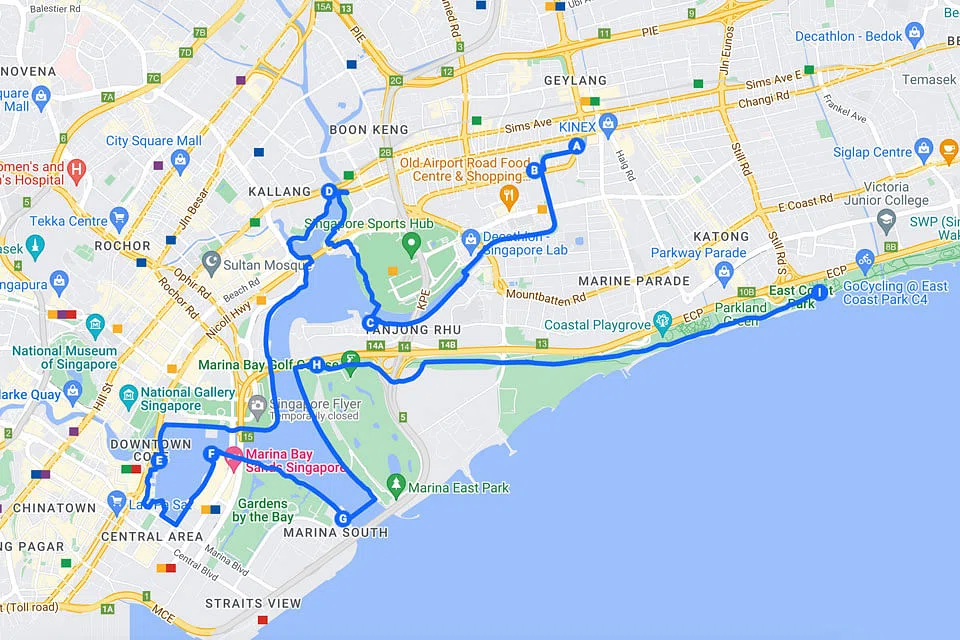
City + Coast
There's something therapeutic about watching the sun hover over the skyline along this route, which stretches slightly over half a marathon.
Distance: About 22 km
Route markers:
(A)/(B) Grandlink Square/ Kong Hwa School
(C) Tanjong Rhu Suspension Bridge
(D) Kallang Riverside Park
(E) One Fullerton
(F) ArtScience Museum
(G) Marina Barrage
(H) Bay East Garden
(I) McDonald's Marine Cove
Decoding Asia newsletter: your guide to navigating Asia in a new global order. Sign up here to get Decoding Asia newsletter. Delivered to your inbox. Free.
Copyright SPH Media. All rights reserved.
TRENDING NOW
UOB found ‘grossly negligent’ over Stamford Land rights issue advice, to pay S$1.9 million
MAS allocates S$1.45 billion to five asset managers in third EQDP batch: Chee Hong Tat
He built the Vingroup empire. Now South-east Asia’s richest man is handing some key roles to his sons
NoMad Singapore marks brand’s arrival in Asia