

Why migrants keep risking all on 'the deadliest route'
Desperate to escape poverty and poor prospects, thousands of African migrants will brave harsh desert only to face an unforgiving sea.
AMADOU Anne, the oldest son, tried first. "If you have a way to get there, maybe you should try it," his father told him.
The journey required crossing thousands of miles of ruthless desert and sea to reach Europe. Months passed with no news. And then the phone call.
Friends in France spotted a list of drowned migrants. Amadou's name was on it.
"I was standing right there, and I cried," his mother, Salmata Boullo Diallo, said near the family compound in a vast expanse of fallow peanut fields in Tongo, a remote part of Senegal.
The loss did not end there. Amadou's younger brother Gibbe also tried to reach Italy. He, too, died at sea.
Their fates, sealed in journeys nearly two years ago, matched those of so many in this region, where young men often fall into three unforgiving categories: the ones who have made it to Europe, the ones who were blocked or deported along the way, and the ones who died trying.

"If they would have made it, it really would have changed things for us," their mother said.
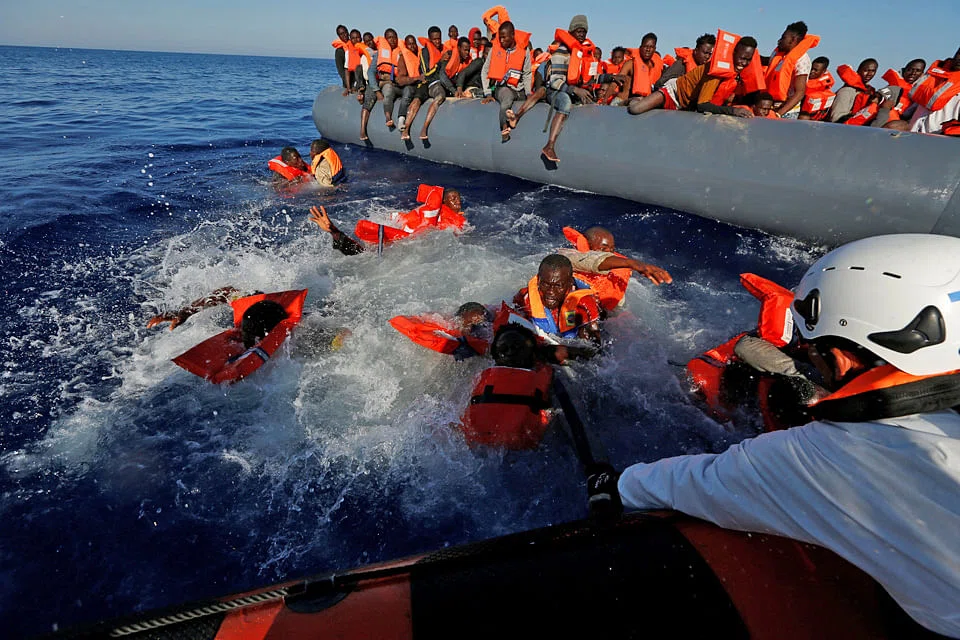
The same sea that swallowed the brothers in separate journeys on the Mediterranean has already claimed the lives of more than 2,100 migrants and refugees this year.
Ninety-five per cent of those deaths have occurred on the central route between Libya and Italy, a passage used chiefly by sub-Saharan Africans that the International Organization for Migration calls "the deadliest route migrants ply anywhere on Earth".
Yet more people keep trying. As of June 21, nearly 72,000 migrants had made it to the shores of Italy this year - a 28 per cent increase compared with the same period in 2016, according to the migration organisation.
The stream of migrants from this region - from Nigeria, Guinea, Gambia, Ivory Coast and Mali - is growing. In 2016, the number of Senegalese making the journey nearly doubled from the year before.
Senegal is one of the more developed countries in West Africa. In its capital, Dakar, tall buildings rise downtown and seaside restaurants charge New York prices for plates of the local catch. Recent offshore oil and gas discoveries offer hopes for transforming the economy, luring international companies like Total to sign exploration agreements.
Yet almost 47 per cent of the Senegalese population lives in poverty, according to the World Bank. In rural areas, almost two out of every three residents are considered poor.
The Anne brothers' sparsely populated region is among the poorest in Senegal. At least 110 people from here have died along the migrant route since 2015, local officials said. This area lost 17 of its men in a single episode, a shipwreck in April 2015 that killed more than 800 people.
"We have no machinery to cultivate the land, no rain and now no young people," said Alassane Diallo, mayor of the nearby village of Koussan.
In this sandy landscape, with its blistering heat and fat baobab trees, the chief means of survival is farming. The kind of life it provides is on full display in the small compounds of one-room mud homes: a mini-flock of two or three sheep, a piece of foam to soften a bed of sticks, a few changes of clothing, plastic flip-flops.
But some of the compounds strung along the bumpy dirt roads here serve as siren calls to Europe. Concrete homes instead of mud. A vehicle parked outside. A satellite television dish poking from the ground. An iPhone.
All of it comes from money sent home from Europe - from the migrants who made it. They are local heroes, the envy of everyone.
"A young Senegalese is always covered with shame and guilt when he sees his own mother trying to make ends meet without being able to support and relieve his parents," said Ousmane Sene, director of the West African Research Center in Dakar.
In the Anne family's tiny compound, the side-by-side huts of Amadou and his brother Gibbe are still empty, a broken bicycle resting against the mud wall in one.
No one realised the journey would be so dangerous, said the men's mother.
"We'd only heard success stories," she said, shaking her head.
Before he left, Amadou, 36, told his brother to wait. But Gibbe, 28, working in Dakar as a brick-maker, thought he could earn more in Europe. Anxious to follow his brother, he took off on his own, even before he heard of Amadou's fate.
"We had no idea where he was," their mother said.
Gibbe's name showed up on a list of dead migrants a few weeks after his brother's did.
The Anne family relied on other sons to help financially. One of them had been living in Gabon, where he had found work. A few months ago, he came to the village. He suddenly fell ill and died, of natural causes, the family said.
Another son, Adama, had planned to leave for Europe or somewhere promising, his family said.
But he, too, fell ill. A few weeks ago, while The New York Times was interviewing the family in the village, Adama began coughing violently. His father tried to help him walk back to his hut, but the man collapsed in his father's arms and went cold.
"He's gone," his father howled. "He's finally gone."
Now, it is up to Arouna, the last male in the family, to make a better life for his parents and the children his dead brothers left behind.
He is just 14 years old.
Arouna knows well the dangers of the trip to Europe. One of his friends from home also tried the trip not long ago and died in Libya.
Eventually, Arouna says, he will go to Gabon or Congo, to work in the mines.
"It's not risky there like Libya." NYTIMES
Share with us your feedback on BT's products and services
TRENDING NOW
Peter Kwee’s Ridley Park bungalow on the market with S$100 million asking price

Motoring tycoon Peter Kwee is back in court: Here are his previous legal battles

Demand, tech capabilities position Apac and AI as Skyscanner’s next growth frontiers: CEO Bryan Batista

South-east Asia has lost Nvidia’s best salesman

