Young money and domestic pride: The forces reshaping Asia’s art market
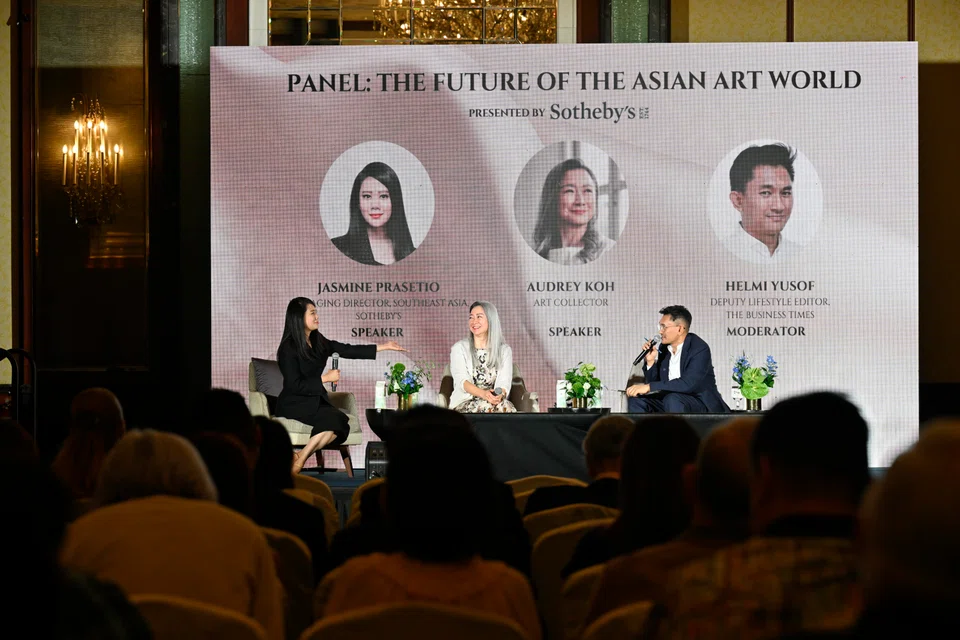
Panellists at The BTLuxe Edit – Future:Legacy symposium discuss the future of art in the region

[SINGAPORE] When discussing the future of Asian art, the conversation is often dominated by record-breaking auction prices – works fetching US$10 million, US$50 million, or even US$100 million – and the rapid rise of art hubs such as Singapore, Hong Kong and Seoul.
But as more art is bought and sold across the region, a deeper question emerges: Will Asia’s growing financial weight translate into a stronger cultural influence, dictating which artists truly matter on the global stage?
These questions, posed by moderator Helmi Yusof, deputy lifestyle editor at The Business Times, anchored a panel on the future of art in Asia at The BTLuxe Edit – Future:Legacy symposium, an event presented in collaboration with Schroders Wealth Management.
The answer to whether Asia can shape global artistic reputations lies partly in a formidable demographic shift.
Wealthy collectors in their 20s spent an average of more than US$300,000 on fine art in 2025 – more than twice what any older age group spent, the latest Art Basel and UBS survey found. Furthermore, Sotheby’s reported that one in three bidders in 2025 was new to the auction house.
“There is an increasing number of young collectors buying serious art,” said Jasmine Prasetio, Sotheby’s managing director for South-east Asia. “One case in point is earlier in May of this year, when an Asian collector under 40 bought a Degas for about US$6.5 million.

“We are seeing a generational shift, but we’re also looking at how these new, young, interested art enthusiasts engage.”
Among the shifts in engagement is a growing international demand for the next generation and long-overlooked female artists, such as Kim Lim, Pacita Abad and Christine Ay Tjoe. Calling it a “trailblazing path”, Prasetio affirmed that this market correction is “absolutely here to stay”.
Yet, for the Asian art market to sustain this momentum, corporate investment must be matched by fierce domestic patronage.

Art collector Audrey Koh exemplified this cultural stewardship when she shared her unusual collecting journey.
It began when she purchased 5 Kingsmead Road, the former residence of pioneer Singaporean artist Chen Wen Hsi. The property featured two of his original murals painted on a brick wall. To preserve the works, she had the eight-tonne wall extracted and installed in her new home, which now hosts public exhibitions and art tours.
For Koh, local backing is a non-negotiable prerequisite for global relevance.
“If we Singaporeans don’t support our own artists, past or present, then who else will?” she said.
Prasetio agreed, noting that a strong domestic ecosystem is precisely where international market confidence originates.
“I think there has to be a great ecosystem domestically, then regionally, and that is when the confidence of an international audience will come,” she said.
“What we have seen now is a really great exchange between the National Gallery and other institutions,” she added, citing the latest collaboration with the Boston Museum of Fine Arts for the “Into the Modern: Impressionism” exhibition.
This confidence also justifies Sotheby’s deepening regional investments, which include its permanent Maison flagship space in Hong Kong and the introduction of a luxury week in Singapore.
“Asia is the future,” Prasetio said.
Decoding Asia newsletter: your guide to navigating Asia in a new global order. Sign up here to get Decoding Asia newsletter. Delivered to your inbox. Free.
Copyright SPH Media. All rights reserved.