

Issue 105: Sustainable marine fuel’s safety risks; Asia’s protein inertia is a governance problem

In this issue: Singapore needs to address the dangers posed by ammonia and methanol bunkering, while a lack of governance pulls down regional companies’ performance on sustainable protein procurement.
Singapore
Green but not-so-safe marine fuel
The 400-tonne spill of marine fuel off Singapore’s southern coastline has cast a spotlight on the danger of bunkering in a busy port.
This danger is especially critical as the nation contemplates a future as a multi-fuel bunkering hub that can cater to different kinds of fossil fuel alternatives, including highly toxic ammonia and methanol. Without addressing the safety of those fuels, it is unlikely they can be viable replacements for diesel.
On Jun 14, the Netherlands-flagged dredger Vox Maxima and Singapore-flagged bunker vessel Marine Honour collided at Singapore’s Pasir Panjang Terminal. The hit punctured a holding tank on Marine Honour, releasing the low-sulphur fuel into the waters.
Oil from the spill was visible across Singapore’s southern and eastern coastlines and as far as some of its southern islands. As terrible as that was, it raised another question: What if the fuel was not diesel but ammonia or methane?
The global shipping industry has set itself a target to achieve net-zero emissions by or around 2050. Hydrogen, ammonia and methane are among the leading candidates to replace the diesel that typically propels ships.
Of those three alternatives, hydrogen is potentially the cleanest because it is a relatively harmless chemical that produces water as a by-product of combustion. However, green hydrogen – which is hydrogen produced using sustainable or renewable energy – is also furthest from feasibility. It has yet to achieve scale and overcome major challenges in terms of storage and transportation.
Ammonia and methane, however, are already being used on ships. In 2023, Maersk launched the world’s first methanol container ship. The first ammonia-fuelled ship set sail this year from Singapore.
In the meantime, existing ships are also being retrofitted to work with either fuel.
It is still too early for one alternative fuel to emerge as the global standard because the availability and carbon footprint of each fuel is dependent on location. Methanol might be more easily available in a market with abundant biofuels, for example, whereas ammonia might be easier to obtain in a market with a surplus of solar or wind energy.
What might happen is that certain fuels will dominate certain shipping routes will be dominated by certain fuels. For Singapore, being able to cater to all those fuels offers a way to ensure it can remain a global shipping hub.
Addressing the dangers associated with ammonia and methanol need to be priorities, though. An ammonia leak or a methanol spill would negatively impact ecosystems, although the extent of the environmental damage is still being studied.
In terms of toxicity, however, there’s little doubt that both ammonia and methanol are more dangerous to humans. Methanol is also highly flammable. These raise the risks for people operating near the chemicals.
At least one industry player has become more cautious about ammonia. Shell was reported in 2023 to have placed ammonia bunkering on the backburner in favour of liquefied natural gas and methanol over concerns about ammonia’s dangers.
Nevertheless, optimists believe the dangers can be overcome. After all, millions of tonnes of ammonia are already transported by ship each year.
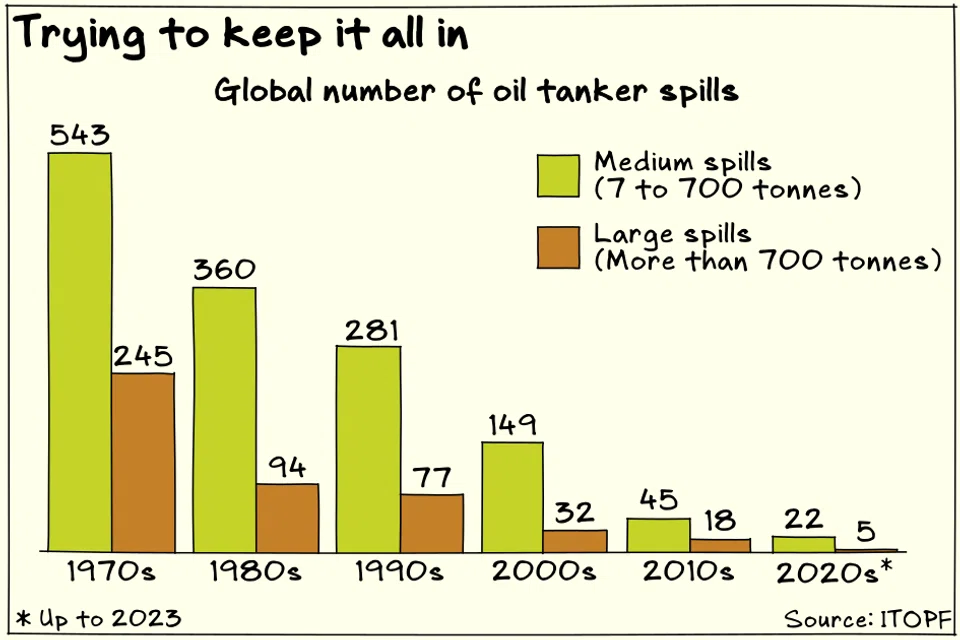
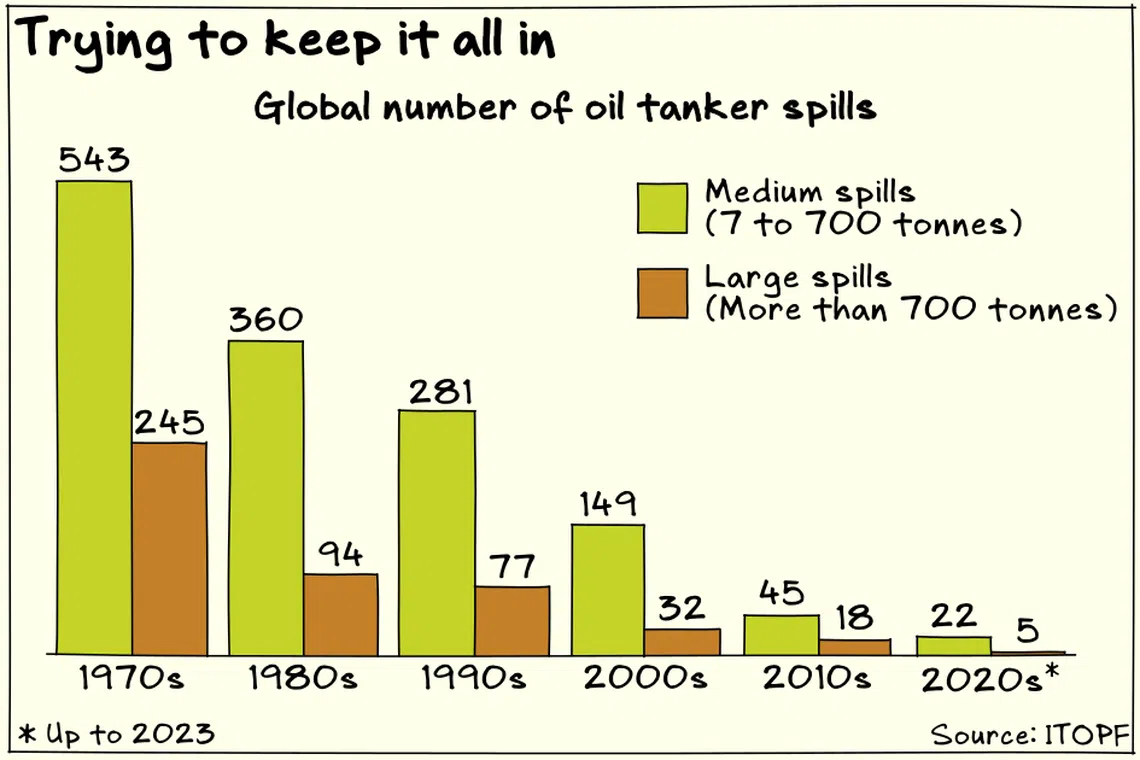
The number of tanker oil spills has also been falling over the years. Statistics provided by the shipping industry’s clean-up organisation, ITOPF, show that in the 2010s there were 45 medium spills (defined as seven to 700 tonnes of oil) and 18 large spills (more than 700 tonnes) around the world.
That was significantly fewer than the 149 medium spills and 32 large spills in the 2000s. In the first three years of the 2020s, there were 22 medium spills and five large ones.
Accidents are inevitable, however, and it only takes a handful of serious incidents to turn public opinion. Even though major nuclear accidents are rare, the names Three Mile Island, Chernobyl and Fukushima have become shorthand for the dangers of nuclear fission power. A similar scenario could play out for sustainable marine fuel alternatives if regulators and industry are careless.
Other Singapore reads
- Tougher policy could help Singapore achieve better energy efficiency
- JTC commits S$4 million to support Jurong Innovation District tenants’ carbon-saving solutions
South-east Asia
Sustainable protein lacks muscle at the top
A new study has found that Asia’s largest food buyers all fail a test of sustainable protein procurement, and a key reason could come from the very top.
Sustainability consultancy Asia Research and Engagement (ARE) analysed 100 listed food buyers in Asia for their efforts to transition to responsible and sustainable proteins – and found that all of them met less than half of the assessment criteria. The median score for all companies was 6 per cent, while the highest individual score was 46 per cent.
Across 10 sustainability themes, the companies scored best on water and waste – with an average score of 20 per cent. The worst theme was governance, with an average score of 2 per cent.
The dismal governance scores probably have a lot to do with why the region’s performance is so underwhelming. On governance, ARE asked four questions:
- Has the board approved a strategy for a just and humane protein transition?
- Does the board have relevant training and accountability for protein responsibility and sustainability?
- Does the board report on discussions related to the execution of a responsible and sustainable protein-sourcing policy?
- Does the board disclose decision making around capital expenditure or allocation to supply chains in relation to the climate or protein strategy?
At the risk of oversimplification, ARE asked if boards understood sustainable protein, if they discussed the topic, and whether they had a plan for it.
Given that answers to these questions were almost always “no”, it’s little wonder that the companies also did poorly in every other category.
There isn’t enough emphasis on governance in the discourse about businesses’ sustainability transition. On climate transitions, for example, emissions numbers and progress tend to hog the headlines. Whether a company sets credible goals, formulates a transition strategy and executes that strategy, however, comes down to the extent to which leadership cares.
Other South-east Asia reads
- Sabana Reit prices S$100 million in sustainability-linked bonds due 2029 at 4.15%
- Temasek to divest entire stake in Pavilion Energy to Shell






