

Issue 114: Mainstreaming ESG-linked pay; climate policy is better together

This week in ESG: Policymakers and investors increasingly demand executive accountability on ESG; policy combinations drive big emissions cuts, researchers find
ESG-linked remuneration
The greening payslip
While companies around the world are increasingly incorporating environmental, social and governance (ESG) factors into executive pay, in Singapore the practice remains atypical.
But Singapore’s listed companies may soon have little choice in the matter. Policymakers and investors are ramping up the pressure on businesses to hold executives accountable on ESG matters, making it harder and harder to avoid linking compensation to ESG outcomes.
The proportion of large Asia-Pacific companies that have ESG factors in executive incentive plans grew to 77 per cent in 2023 from 63 per cent in 2022, WTW reported in January in a study that looked at the leading listed companies in countries around the region.
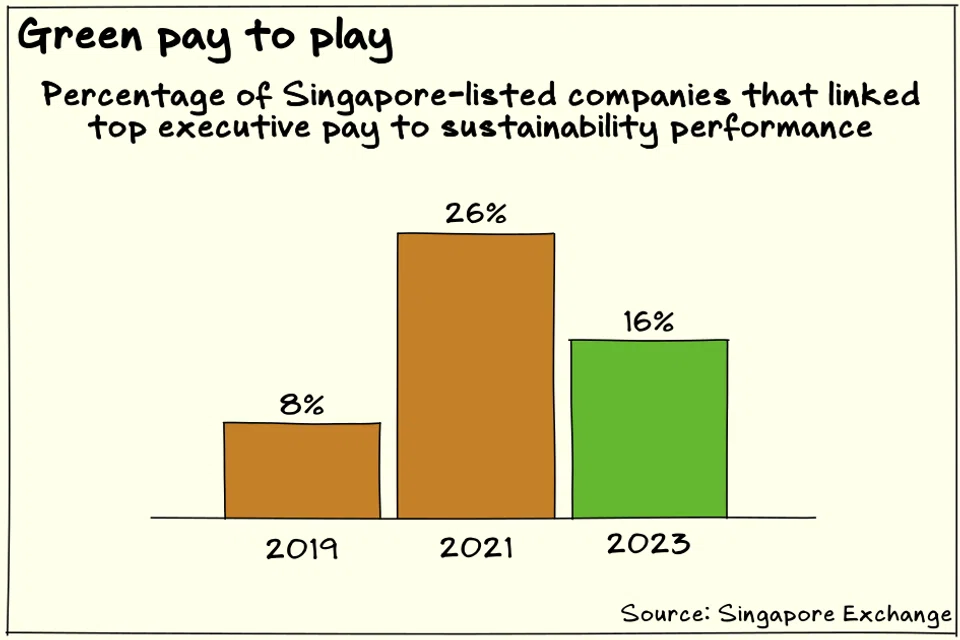
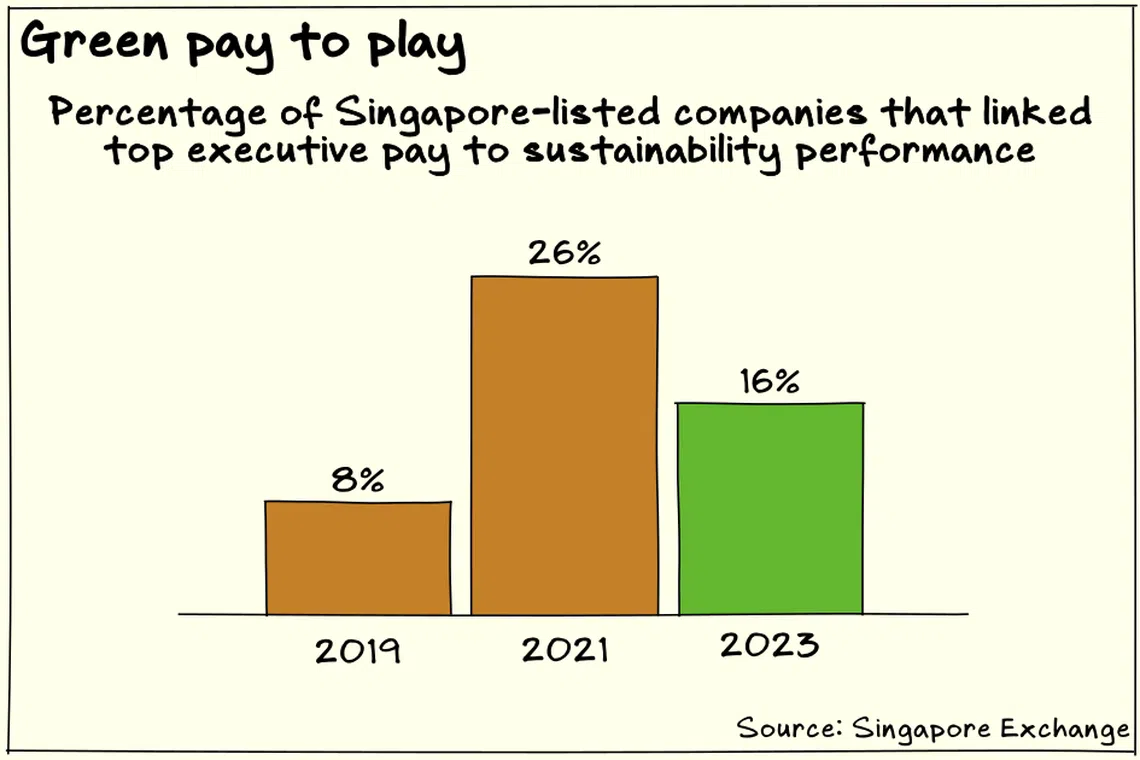
In Singapore, a sustainability reporting review by the Singapore Exchange (SGX) found that the use of sustainability performance in top-executive remuneration declined to 16 per cent in 2023 from 26 per cent in 2021.
The SGX study looked at all the listed companies on the local stock market, so it’s not the same dataset as that used in the WTW study, which only assessed 30 Singapore companies. ESG performance and processes at larger companies are generally better than at smaller companies, which explains the difference in the occurrence rates.
However, the direction of change in both reports is telling. At a time when the region’s use of ESG compensation factors is going up, in Singapore the trend is reversing.
Still, there’s a good chance that the next SGX report – which is carried out every two years – will show an improvement. The reason? Key stakeholders are increasingly demanding that executives’ compensation be tied to ESG performance.
For example, beginning this financial year, European companies have to disclose information about sustainability-linked board remuneration under the Corporate Sustainability Reporting Directive (CSRD) and the European Sustainability Reporting Standards.
Large investors are similarly scrutinising ESG-based compensation.
In its 2024 governance and voting policy, BNP Paribas Asset Management said it now applies environmental and social considerations to remuneration-related voting matters. The asset manager will “require companies in all sectors to link executive variable compensation plans to relevant environmental and social performance criteria”.
Hong Kong-based insurer Prudential is requiring sustainability-linked key performance indicators (KPIs) for all its managers by 2026 and will include questions about climate-related pay in engagements with investee companies.
Whether it is to operate in a market or obtain capital, the price to play increasingly includes ESG-related pay.
ESG-related compensation isn’t simply a nice-to-have when it comes to sustainability. Holding directors and top executives accountable for ESG performance is a critical aspect of a credible ESG strategy. Of course, this assumes that the ESG KPIs themselves are credible as well.
Integrating ESG into remuneration is still a work in progress within remuneration circles.
Professor Mak Yuen Teen, a corporate governance expert from the National University of Singapore, has highlighted the importance of a “robust materiality assessment” as a starting point for figuring out which ESG factors should be included in KPIs. For instance, worker safety is critical in many construction and manufacturing businesses.
Companies also need to work out the appropriate time periods to assess performance. This can be complicated by environment-related factors, which can operate on long time scales. KPMG noted that many longer-term ESG milestones lie beyond the performance period of the longest long-term incentive plans. The suggested solution is to identify short-term milestones along the long-term pathways.
The mechanism by which the KPIs affect remuneration is also a key decision that remuneration committees and functions will have to grapple with. Most companies use metrics, whether on a scale or as a binary underpin. Remuneration committees might prefer open-ended discretionary mechanisms where they have the flexibility to adjust payouts if targets are missed.
Last but not least, the KPIs must be reasonably ambitious. Targets that are too easy to achieve can be abused as ways to beef up executive pay under the guise of a performance bonus.
Discussions about ESG-related compensation can also be too narrowly focused on targets and quantums, and neglect the question of operational readiness. It’s great to concoct exquisite goals on emissions and diversity, but they might not be very impactful if organisations and their people don’t know how to reach those goals.
Hewlett Packard Enterprise (HPE) offers an interesting case study. HPE has decided to link executive compensation to Scope 3 emissions, which are greenhouse gases indirectly produced along the company’s supply chain. The indirect nature of Scope 3 emissions makes them extremely challenging to accurately calculate, which is why most companies stick to the more easily measurable Scope 1 and Scope 2 emissions, which come from direct operations and energy consumption.
However, HPE recognised that most of its emissions are Scope 3 – most of the emissions it creates are produced after its products are sold to customers.
In order to work Scope 3 into KPIs, HPE undertook a three-year plan to build a knowledge base and to train and prepare its executives so that they could figure out how to strategise and operationalise Scope 3 reduction plans.
The lesson here is that creating a proper ESG strategy that includes remuneration KPIs takes time and effort. Companies in Singapore might consider starting the process before policymakers and large investors come calling.
Climate policy
One is the loneliest number
A one-dimensional standalone policy isn’t good enough to meaningfully cut emissions, European researchers have found. Instead, it takes a combination of climate policies addressing different facets of the issue to be able to slash emissions.
The study looked at 1,500 policies implemented over 25 years in 41 countries across six continents.
Ban coal-fired power plants only or internal combustion engine cars only, and those measures are unlikely to make any major dent in greenhouse gas output, said the researchers from the Potsdam Institute for Climate Impact Research and the Mercator Research Institute on Global Commons and Climate Change.
But combine those policies with tax or price incentives, and effectiveness significantly improves.
For example, in Indonesia, energy efficiency mandates in 2012 and 2014, combined with fossil fuel subsidy reforms in 2013, led to a 30.9 per cent reduction in emissions compared to the pre-policy trajectory.
The research is a good reminder that climate change is a massive and massively complex issue that requires many parts of societies and economies all pull together to solve. Standalone policies are often ineffective in the face of such problems because policy leakage is high.
For instance, a country might plan to phase out internal combustion engine vehicles. But if electric and hybrid vehicles remain significantly more expensive to buy and insure, charging infrastructure remains underdeveloped, petrol and diesel remain cheap and public transport remains inadequate, consumers will remain reluctant to switch to greener options.
While the paper looked only at policies within countries, the same principle can apply when looking across borders. Climate policies are probably more effective when they are harmonised between countries and regions.
It is therefore encouraging that regional bodies like the Association of South-east Asian Nations (Asean) have placed climate change on the agenda across many workstreams. For all the criticism that it draws, the annual United Nations Climate Change Conference (COP) is also an important platform for coordinating global decarbonisation efforts.
Other ESG reads
- Can Singapore balance its ambitious AI goals with sustainability?
- Indonesia’s incoming leader hopes to implement 50% palm-based biodiesel in 2025
- Big polluters urged to pay as key Pacific summit opens in Tonga
- South Asia air pollution fell in 2022, but remains major killer: report
- The new wave of climate claptrap
- US clean energy jobs growth rate double that of overall jobs, report says
TRENDING NOW

Once staunchly pro-China, Malaysian Chinese businesses are now distancing themselves from Beijing

Stocks to watch: HPL, Aims Apac Reit, Zico, Advanced Systems Automation, ComfortDelGro

‘How many will survive?’: Bubble fears arise as China’s humanoid robotics face reality check

Smaller board lots can’t fix a market run by three banks

