Issue 156: GIC stays the green course; bright spots in ESG debt slowdown

This week in ESG: GIC annual report discusses climate strategy; South-east Asia ESG debt issuance falls in Q1 2025
Sustainable investing
GIC navigates a choppy climate landscape
Investors must prepare for greater uncertainties and heightened physical risks due to climate change, says Singapore sovereign wealth fund GIC in its latest annual report.
Amid the uncertainties, GIC remains positive on green energy and supporting infrastructure as global energy demand continues to grow, and on climate adaptation solutions as global warming inevitably continues.
In his letter to stakeholders, GIC chief executive Lim Chow Kiat describes a world facing deep, long-term forces of change that make it more difficult to forecast future outcomes.
“In an increasingly more volatile and fragmented trade system, policy decisions can quickly reverse advantages, reminding us that today’s winners may not remain so tomorrow,” he writes. “Similar fragmentation is unfolding in capital markets. Financial systems are dividing along geopolitical fault lines, complicating cross-border investing.”
Those shifts are happening as the world confronts artificial intelligence and the climate transition, which have the potential to reshape economies, capital deployment and value creation, Lim says.
The firm views the climate investing landscape through three lenses:
Policy signals
Perhaps one of the more notable observations by GIC is that transition trajectories are diverging across the globe, with some markets pulling back from climate action while others remain committed. Investors must therefore pay heed to “how climate policy momentum and direction vary across regions”.
The GIC report explains that to better assess climate-related uncertainties, the firm considers four possible climate scenarios that characterise different levels of transition risk and physical risk. Transition risk refers to the impact of policy and disruptive technologies. Physical risk includes both acute impact, such as extreme weather events, and chronic impact, such as agricultural productivity affected by rising temperatures.
The most optimistic scenario is one in which the world achieves net-zero carbon emissions by 2050, while the most pessimistic is a “failed transition” in which no new climate policies are implemented beyond what’s currently in place. Both scenarios have low transition risk, but the net-zero outcome has low physical risk, whereas the failed transition has high physical risk.
Between those extremes are the “delayed disorderly transition” scenario, where the world is initially slow to address climate change but manages to keep global warming to below 2 deg C by 2100 through a late surge in aggressive policies; and the “too little too late” scenario, where policy change happens, but is slow and insufficient to keep warming below 2 deg C. Both these scenarios present high transition risk, but the delayed disorderly transition has lower physical risk, while the too little, too late scenario has a high physical risk.
GIC says the two high-transition-risk scenarios are becoming more probable than the low-transition-risk scenarios.
Technology economics
On the economic viability of technologies, GIC sees electrification, increased digitalisation and artificial intelligence powering global demand for energy. This will drive further investments into green energy and supportive infrastructure as renewables become more cost-competitive.
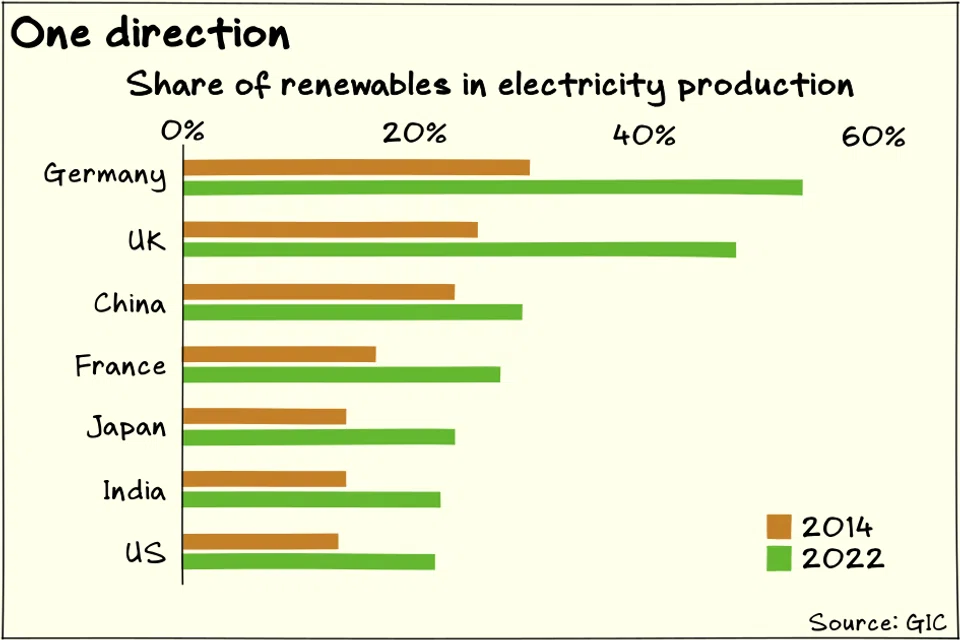
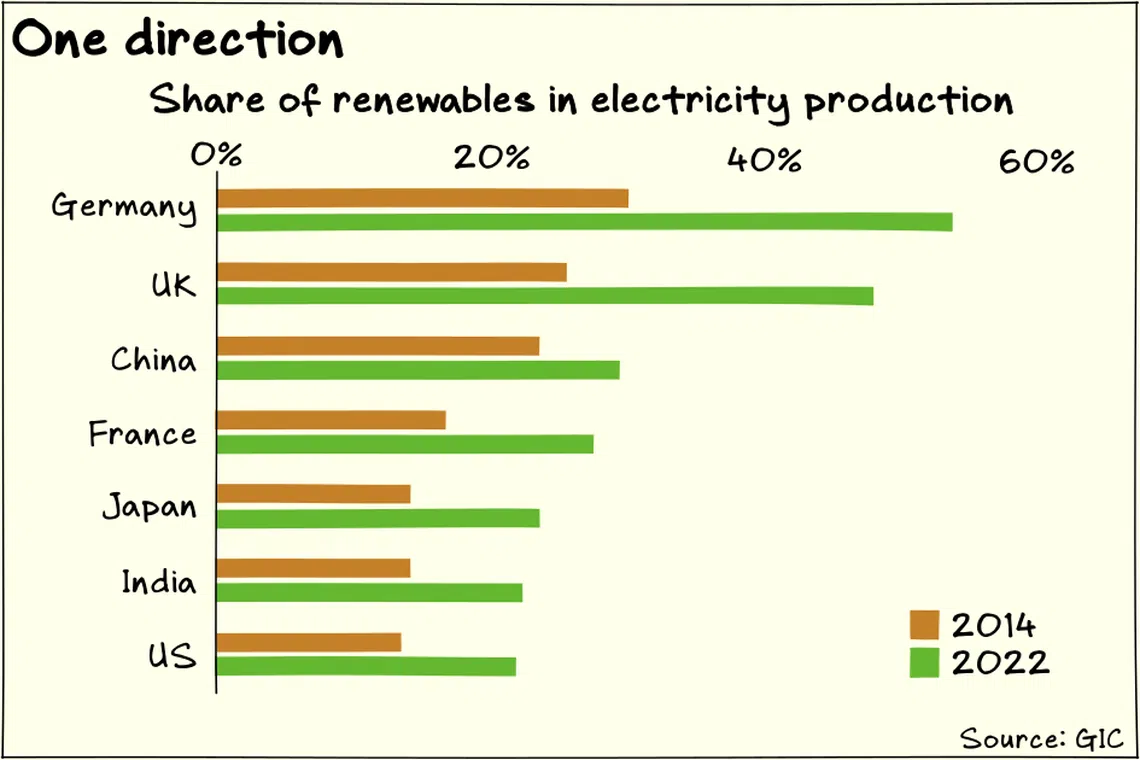
GIC notes that renewables have experienced improving economics – they cost less than they used to. This has helped to sustain demand even when government support has been dialled back, such as in the US.
But renewable power is more intermittent and distributed than traditional fossil fuel systems. As the supply mix of electrical grids evolves, there is a need to update grid infrastructure, power equipment and supply chains. GIC says it is positive on regulated electric networks and utilities, because improvements to their assets will lead to additional earnings growth opportunities. Dispatchable baseload generation and battery storage are also essential for unclogging grid congestion.
However, GIC is wary of political risk in regulated assets.
“We especially favour assets benefiting from stable and transparent jurisdictions, with regulatory frameworks that support high cashflow predictability by providing inflation and volume protection,” the firm says.
Pace of climate change
GIC expects global warming to “inevitably” continue, which will increase demand for climate adaptation and resilience solutions.
The firm analysed 14 adaptation solution groups, and it expects investment opportunities in those groups to increase from US$2 trillion today to US$9 trillion by 2050, of which US$3 trillion of the increase is attributed to global warming. These solution groups include water treatment, weather intelligence, indoor cooling, weather-resilient building materials and components and weather-related insurance.
Examples of GIC’s adaptation-related investments include a data analytics and risk assessment provider, as well as a water and hygiene solutions provider.
GIC’s commitment to addressing climate change in its portfolio in terms of both risks and opportunities reflects its position as an institutional long-term investor. When your primary performance metric is the 20-year real rate of return of a global portfolio, you can’t ignore long-term global problems like climate change.
Sustainable finance
Slow start to 2025
The sustainable finance market slowed down considerably in the first quarter of 2025, but there’s no need to panic.
The amount of environmental, social and governance (ESG)-labelled bonds issued in South-east Asia fell 15 per cent year-on-year during the quarter to US$4.6 billion. ESG-labelled loan volumes slid 23.4 per cent to US$10.2 billion over the same period.
The slowdown is a symptom of several factors, chief among them being uncertain markets and policy shifts that deprioritise sustainability in a number of markets. With ESG-related business activity slowing overall, it’s not so surprising that supply has declined.
But it’s worth noting that issuance volumes can change a fair bit from one quarter to another because the market is still relatively small, and large deals – which are sporadic – can significantly affect numbers for each quarter.
The ESG bond market, which has always benefited from sovereign issuances in South-east Asia, could get a slight bump in September when the Singapore government reopens its 50-year green bond. The 50-year bond currently yields about 22 basis points (bps) more than the 10-year bond and about 62 bps more than the five-year bond, which is a historically wide spread. That could entice investors looking for Singdollar-denominated yields.
Social and sustainability bonds also represent growth areas in the market, even as green and sustainability-linked labels see a pullback. Deals focused on social impact have been gaining in popularity, partly because social impact tends to use more mature business models, technologies and metrics – which offer some insulation against greenwashing risks. The way that risks and impact of a small-business loan programme for women are measured – default rates, income generated and so on – are much more established than green yardsticks like emissions and glide paths.
There’s no getting around the fact that ESG activity has slowed down overall, but it’s not hard to find the bright spots.
Other ESG reads
- With IPO in the bag, Sheffield Green plots training and listing spinoff for wind energy sector
- China shuns low-grade coal from Indonesia as imports collapse
- ABN Amro analysts see ESG bond issuance dropping ‘considerably’
- Energy and climate cooperation still key for China-EU ties
- Inside Asia’s impact investment boom
- British business slows climate action, sees government net zero agenda as unrealistic