Issue 164: Hong Kong eyes South-east Asia sustainable finance prize; Singapore buys first Article 6 carbon credits
This week in ESG: Report finds growing activity in green Asean; Singapore awards contracts to four nature-based projects

Sustainable finance
South-east Asia heats up
The Asia-Pacific is growing as a climate finance hotspot as investors look for new frontiers of green growth amid a US pullback.
Fund managers are attracted to the region’s “growing pipeline of clean-energy and infrastructure projects, favourable demographics and strengthening policy support for green development,” says a new report authored by MSCI Sustainability Institute, the Hong Kong Financial Research Institute of Bank of China and the University of Hong Kong Business School’s Jockey Club Enterprise Sustainability Global Research Institute.
Greening business
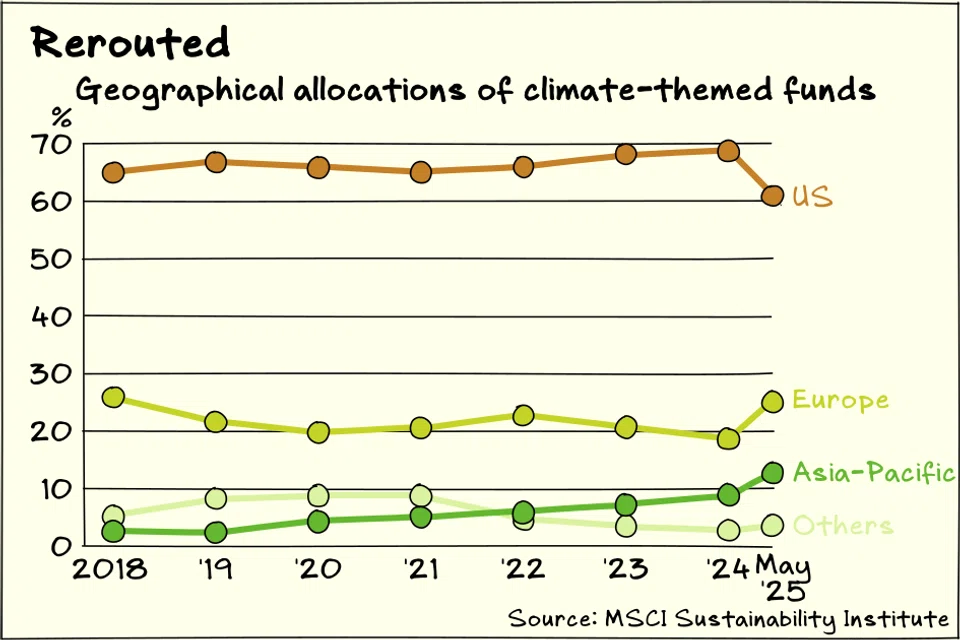
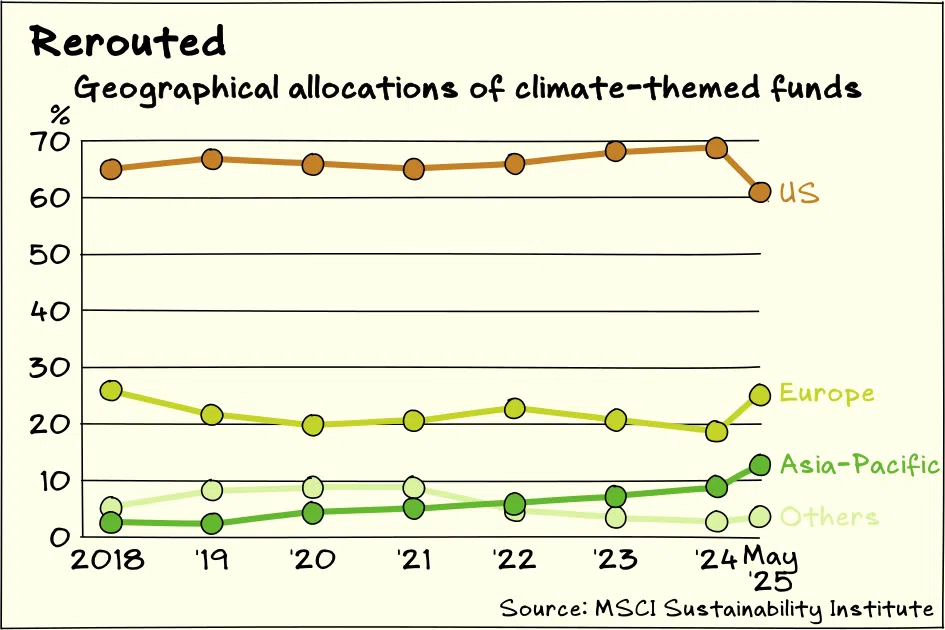
A key data point is that global climate fund allocations shifted by about 6 percentage points to the Asia-Pacific region in the first half of 2025.
That figure comes from an MSCI analysis in June of the asset-weighted exposures of climate funds. The US remains the largest allocation of climate funds, with more than 60 per cent of assets deployed to the world’s largest economy, the June analysis finds.
“One reason that climate funds have tilted toward the US in recent years is that it’s the place to be for returns,” MSCI says. The analysis states that average annual net returns of US equities was just over 12 per cent in the decade to end-May, 2025, about twice the rate of the US’ global peers.
However, US equities’ share of climate fund portfolios fell by about 10 percentage points from January to May. The weight of US stocks in the MSCI All County World Index (MSCI) slipped 3.1 percentage points in the same period.
Those redirected allocations in the climate funds have mostly been sent to Europe and the Asia-Pacific. Climate fund allocations to Europe are roughly double that for the Asia-Pacific.
MSCI suggests that the Asia-Pacific may be drawing investors with the growth of green business in the region. From 2019 to 2024, the average annual revenue growth of pure-play green-tech companies in the Asia-Pacific – from energy storage, green mobility and low-carbon power sectors – has significantly outpaced the rate in the US and Europe.
South-east opportunity
The Hong Kong report identifies South-east Asia as a “high-growth subregion with opportunities in energy, mobility, water and urban resilience” within the Asia-Pacific.
South-east Asia presents investment opportunities in climate adaptation and resilience, which are severely underfunded areas of climate action that receive less than 5 per cent of total flows. The region’s attractiveness is further boosted by positive structural conditions that support scaling up, such as growing urban populations, infrastructure demand and rising consumption.
Investors are also assured by a generally consistent policy stance towards climate action, although the pace of progress is uneven.
An April article by MSCI identified three South-east Asian companies as examples of climate adaptation investment plays. Those companies are:
PTT Global Chemical, a Thailand-based petrochemical and chemical products manufacturer that makes materials for insulation and heat-resistant clothing.
SP Group, the Singapore state-owned energy company
Keppel, a Singapore-listed asset manager with businesses in infrastructure and real estate, among others.
Not missing out
Those opportunities perhaps help to explain why Hong Kong has South-east Asia in its sights.
The Hong Kong report was commissioned partly to examine how Hong Kong can strengthen its role as a regional hub for sustainable finance. That interest doesn’t stem purely from the private sector – the Hong Kong Monetary Authority’s Sustainable Finance Action Agenda includes an ambition for Hong Kong to become a regional sustainable finance player.
Hong Kong could be a formidable rival to Singapore in South-east Asia, which would benefit from the attention of two regional financial hubs.
The value of sustainable bond issuance in South-east Asia and the Greater Bay Area – comprising Hong Kong, Guangdong and Macau – between 2020 and 2024 has been comparable, based on data compiled by MSCI. In the first half of 2025, sustainable bond issuance in South-east Asia is slightly more than in the Greater Bay Area.
As it stands, South-east Asia and the Greater Bay Area are collectively emerging as an Asia-Pacific sustainable finance centre of gravity.
In a statement, Rumi Mahmood, research director at the MSCI Sustainability Institute, says: “The coming decade will define whether Asia’s fast-growing economies can transition in a way that is both sustainable and inclusive. Across South-east Asia and the Greater Bay Area, the twin forces of rapid economic growth and escalating climate risk are reshaping the sustainable finance agenda. Mobilising capital toward credible transition pathways is no longer optional – it is essential to securing the region’s long-term resilience and prosperity.”
Carbon markets
Singapore’s Article 6 market in sight
Singapore has agreed to pay four overseas nature-based solutions projects about S$76.4 million for carbon credits representing a total of 2.175 million tonnes of carbon dioxide equivalent (MtCO2e) for use from 2026 to 2030, says the National Climate Change Secretariat (NCCS).
The four projects that clinched the contracts are the Kowen Antami REDD+ and Together for Forests REDD+ projects in Peru, the Boomitra Grassland Restoration Project in Paraguay, and the Kwahu Landscape Restoration Project in Ghana. REDD+ refers to a framework on reducing emissions from deforestation and forest degradation.
The credits may be used by companies subject to Singapore’s carbon tax to offset up to 5 per cent of their emissions. They are Singapore’s first purchased credits that comply with Article 6 of the Paris Agreement, which imposes safeguards against double-counting for cross-border carbon offsets and ensures an overall mitigation of global emissions.
The purchase price works out to about S$35.13 per credit. Singapore has not yet provided details about how taxed companies may obtain the credits to offset their emissions. For instance, it’s not clear whether companies can buy the credits at cost, or – more likely – there will be a market process to facilitate price discovery.
In any case, the carbon tax rate will probably set a ceiling for how much companies are willing to pay; if a carbon credit costs more than the tax rate, companies are better off paying the tax. Singapore’s carbon tax is currently set at S$25 per tonne of emissions, but will step up to S$45 for 2026 and 2027. The official guidance is to raise the tax rate to S$50 to S$80 per tonne by 2030. Singapore has granted carbon tax allowances to some trade-exposed emitters, which lowers some emitters’ carbon cost.
Singapore has committed to share 5 per cent of proceeds from selling the credits towards climate adaptation measures of respective host countries. At the moment, Singapore has nine such Article 6 implementation agreements, with Bhutan, Chile, Ghana, Papua New Guinea, Peru, Paraguay, Rwanda, Thailand and Vietnam.
Singapore’s most updated emissions profile is from 2022, when the country produced 58.6 MtCO2e of emissions. The national target is to achieve peak emissions before 2030, then reduce emissions to about 60 MtCO2e by 2030 and eventually reach net zero by 2050.
The 2.175 MtCO2e of credits purchased this round represents about 3.7 per cent of Singapore’s emissions in 2022. It is likely that Singapore needs at least about six times the amount just procured in order to offset 5 per cent of its annual emissions from 2026 to 2030.
NCCS says it will launch a second request for proposal for carbon credits this year.
Other ESG reads
- APP Group pledges US$30 million a year to restore 1 million hectares of Indonesia’s rainforests
- Benefits of forcing banks to adopt taxonomies outweigh costs: former PBOC chief economist
- Shining a much-needed light on Singapore’s healthcare carbon emissions
- Singapore inks carbon credit transfer agreement with Vietnam, second deal with Asean country
- Malaysia’s largest state aims to be region’s ‘green battery’
- OCBC aims to provide social loans to 10,000 women entrepreneurs by 2030, up from 2,000 now