Issue 168: S-E Asia’s attainable smart grid; new GRESB rankings show progress
This week in ESG: US$11 billion can deliver Asean smart grid, says think tank; average scores improve in real estate sustainability benchmark

Energy transition
Smart grid within reach for Asean
Variable renewable energy (VRE) may offer South-east Asia one of the most optimal ways to feed its fast-growing hunger for electricity, but the region will have to upgrade its grid to capture that potential.
Fortunately, recent reports suggest that the cost of doing so is not prohibitive.
Ember, an energy think tank, estimates that it might take US$4 billion to US$10.7 billion to turn South-east Asia’s power grid into a smart grid. That would be less than 5 per cent of Indonesia’s fiscal spending Budget of US$231.5 billion for 2026. A smart grid uses digital and other advanced technologies to monitor and manage electricity transmission.
Ember’s estimate is a rather rough projection based on global averages of per-capita smart grid investment costs. Five European countries – France, Germany, Denmark, the Netherlands and Norway – invested between US$6 per person and US$17 per capita, the firm says. For China and India, the investment quantum ranges from US$6 per person to US$10 per person.
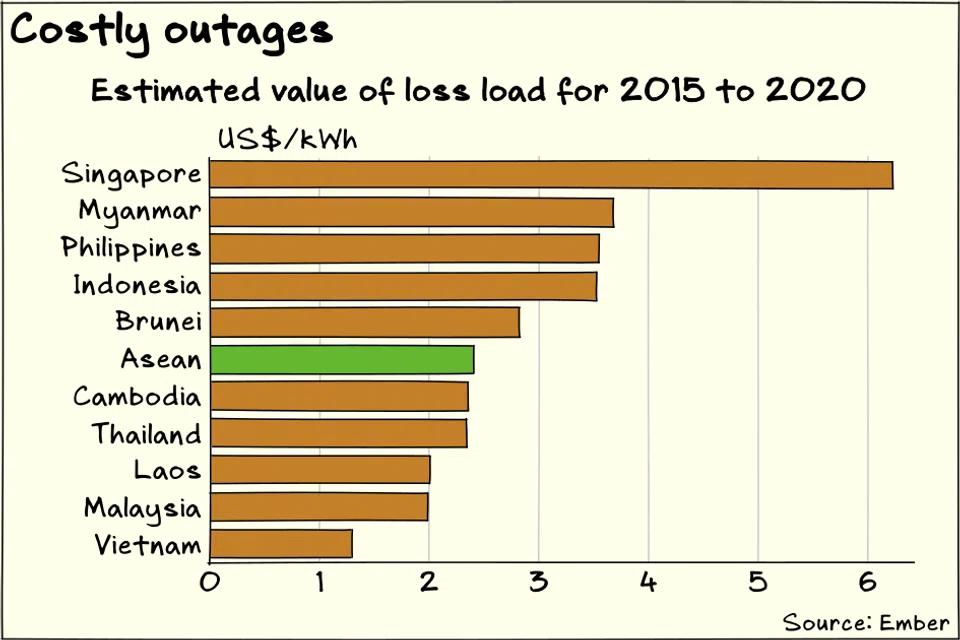
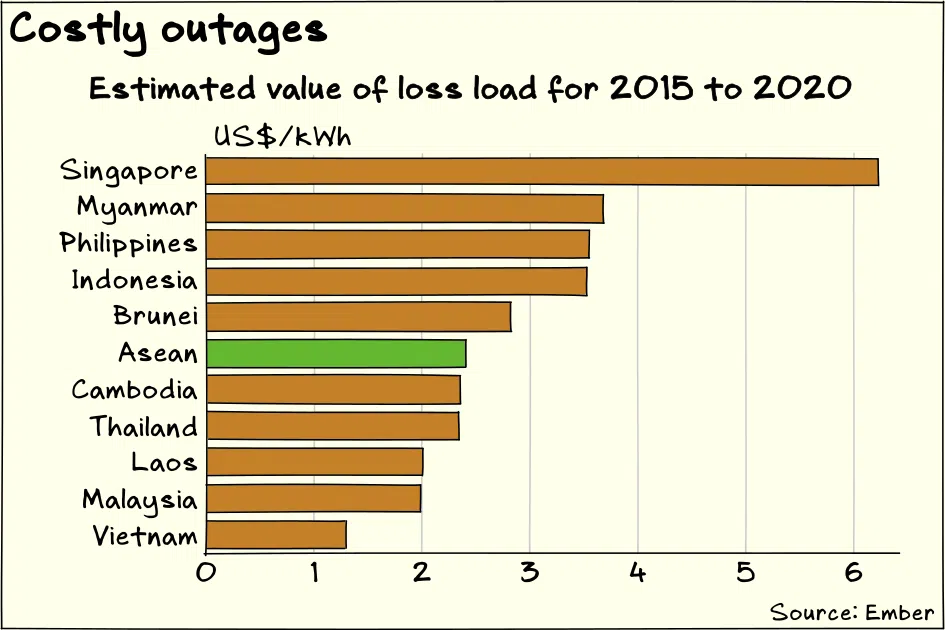
Is it worth spending that amount? Ember calculates that unaddressed power outages in the region could cost US$2.3 billion in annual GDP losses by 2040. That’s based on estimates about the frequency and severity of outages, scaled to the gross value added of the energy industry. One metric used is the value of loss load, which measures the monetary value of each unit of unserved energy. In a more affluent country like Singapore, each minute of outage is more costly.
The bottom line is that the cost of building a smart grid for South-east Asia makes sense. Even without factoring potential benefits of having a renewable electricity source, the value of avoided outages alone is worth the price of a smart grid.
A separate report by the International Energy Agency (IEA) finds that the near-term challenges of integrating VRE into South-east Asia’s electricity grid are “manageable with proven, low-cost measures”.
IEA defines six phases of VRE integration:
- Phase 1: VRE deployment is still nascent, so its impact at a system level is insignificant.
- Phase 2: VRE deployment steps up, and upgrades to operating practices are usually enough.
- Phase 3: VRE usage has grown to the point wherel it now determines the operation pattern of the power system, necessitating a systemic increase in flexible operation that goes beyond what is readily supplied by existing assets.
- Phase 4: VRE sometimes meets almost all electricity demand, and advanced operational solutions and regulatory changes may be necessary.
- Phase 5: There are significant volumes of surplus VRE across the year, and may require additional measures such as energy storage.
- Phase 6: VRE accounts for almost all secure electricity supply, and long-duration energy storage or extensive cross-border electricity trading might be required.
The agency says all South-east Asian countries except Vietnam, which is the furthest along in deploying solar and wind assets, are still in Phase 1 or 2 where VRE has “minor to moderate” impact on the power system. Most of them are expected to remain in these phases until 2030.
“At these low phases, integration challenges are manageable,” IEA explains. “Key integration measures include unlocking flexibility of existing conventional power plants, improving forecasting systems, making dispatch decisions closer to real time and at higher granularity, updating grid codes for renewable connections and modernising grid monitoring and control capability.
“Critically, these measures do not require significant investment or restructuring of power systems or markets. Countries can implement them progressively, adapting to specific challenges as VRE shares increase.”
These reports should be welcome for South-east Asia’s regional cooperation body, which launched its latest five-year Asean Plan of Action for Energy Cooperation (APAEC) this month.
The APAEC 2026-2030 plan updates the regional ambition on renewable energy adoption and energy conservation with three 2030 targets:
- Reduce energy intensity by 40 per cent from 2005 levels. As at 2023, the reduction stood at 25.5 per cent.
- Raise renewable energy’s share of total primary energy supply to 30 per cent. As at 2023, the share was 14 per cent.
- Raise renewable energy’s share of installed power capacity to 45 per cent. As at 2023, the share was 33.5 per cent.
The previous five-year plan aimed to reduce energy intensity by 32 per cent by 2025; to achieve 23 per cent share of renewable energy in total primary energy supply by 2025; and to achieve 35 per cent share of renewable energy in installed power capacity by 2025.
The strategy to achieve those targets includes growing the Asean Power Grid, which is envisioned as an interconnected regional grid across the Asean member states. One part of the action plan for the Asean Power Grid is to “advance grid modernisation and digitalisation”, but concrete details are scant.
Individual member states have more detailed plans. For example, Singapore’s Energy Market Authority and SP Group this year launched a national Future Grid Capabilities Roadmap to prepare the country’s electrical grid for a more diverse supply mix.
Grid modernisation and smart grid development in South-east Asia are areas where policies and economics seem aligned – a rare combination for many aspects of the energy transition. Amid a global retreat from climate action, these are important signals that can help the region to attract businesses and investors looking for long-term resilience against climate change.
ESG Ratings
Steady as she greens for real estate
The latest Global Real Estate Sustainability Benchmark (GRESB) assessment results suggest that the real estate industry continues to improve its green credentials despite headwinds and uncertainty in the sustainability agenda.
The GRESB ranking is a widely followed industry gauge for a real estate company’s sustainability performance.
This year, the average score for development companies increased 2.1 points to 87.9 from the 2024 ranking, while the average for standing-investments companies increased 3.1 points to 79. The maximum possible score is 100. A new category for residential assets saw an inaugural average score of 80.1.
The improvements reflect the resilience of sustainability goals in the real estate industry despite widespread challenges around the world. GRESB chief innovation officer Chris Pyke observes that capital flows fell sharply in calendar year 2024, which is the dominant reporting year in the 2025 rankings.
Pyke highlights a GlobeScan survey that shows a majority of respondents around the world – especially in North America – experiencing a backlash towards sustainability. The notable exception to this is Asia, where only 38 per cent of respondents observed a backlash.
The Asia-Pacific remains a thriving market for sustainability, Pyke says. Amid a backdrop of broad sustainability goals applied at large scales like industrial zones and cities, real estate companies in this region face strong market competition to differentiate themselves from their rivals. There is also greater preference here for third-party validation of sustainability performance.
Indeed, the GRESB rankings serve two purposes for some real estate companies in Asia. The first is a form of conspicuous participation, where a good performance in the assessment is flaunted and goes towards strengthening the sustainability aspects of the brand. The second purpose is more operational, where sustainability-linked loans or bonds are tied to performance on independent benchmarks.
Doing better on GRESB can mean paying lower interest on a sustainability-linked loan. These sustainability-linked structures not only ensure that the companies stick to their decarbonisation plans, but also give investors greater confidence that the companies are doing so.
Other ESG reads
- Malaysia says multilateral power deal delayed by Thai politics, renewal expected next month
- Asian philanthropies should reframe clean energy as driver of social outcomes, says philanthropy platform
- Japan warns Vietnam of job losses as Hanoi petrol-powered motorbikes ban hits Honda
- UN shipping agency delays decision on carbon price for one year amid splits
- China’s power paradox: Record renewables, continued coal
- Carbon’s ‘hidden passport’: Financing sustainable supply chains
TRENDING NOW
Green fuels, autonomous ships: How Singapore is future-proofing its shipping industry
US trade chief to consider trade deal tariff caps in excess capacity probe
Grab CEO’s wife Chloe Tong on life with Anthony Tan and finding her purpose
Deal between tycoon friends sparks scrutiny of Philippine power sector