

Issue 181: Singtel acquires greener data centres; carbon tax in focus for Singapore Budget 2026
This week in ESG: ST Telemedia Global Data Centres may improve Singtel’s emissions profile; businesses call for relief from carbon tariff

Sustainable investing
Singtel buys a greening portfolio of data centres
Singtel’s acquisition of a significant stake in data centre group ST Telemedia Global Data Centres (STT GDC) could be positive for the Singapore telco’s near-term greenhouse gas emissions targets, although the impact in the longer term may be more complicated.
KKR, a private equity firm, and Singtel announced on Wednesday (Feb 4) that they will buy the remaining 82 per cent stake in STT GDC they do not own for S$6.6 billion, or an implied S$13.8 billion of enterprise value when debt and committed capital expenditure are included. The acquirers first bought their 18 per cent stake in STT GDC in 2024 for about S$1.75 billion.
The acquisition will raise Singtel’s stake in STT GDC from about 4 per cent to 25 per cent.
The deal will turn Singtel into a major data centre player. Across 12 markets in Asia and Europe, STT GDC has about 673 megawatts of total operational capacity, more than four times Singtel’s own Nxera data centre platform, according to information disclosed by Singtel. STT GDC also has a development pipeline of about 1.7 gigawatts of capacity.
In a statement, Singtel chief financial officer Arthur Lang says: “When added to our portfolio of data centre assets that includes Nxera in which KKR is also a capital partner, it meaningfully changes the business complexion of the group while creating new opportunities for capital optimisation and growth.”
An enlarged stake in STT GDC could also have a positive impact on Singtel’s greenhouse gas emissions profile.
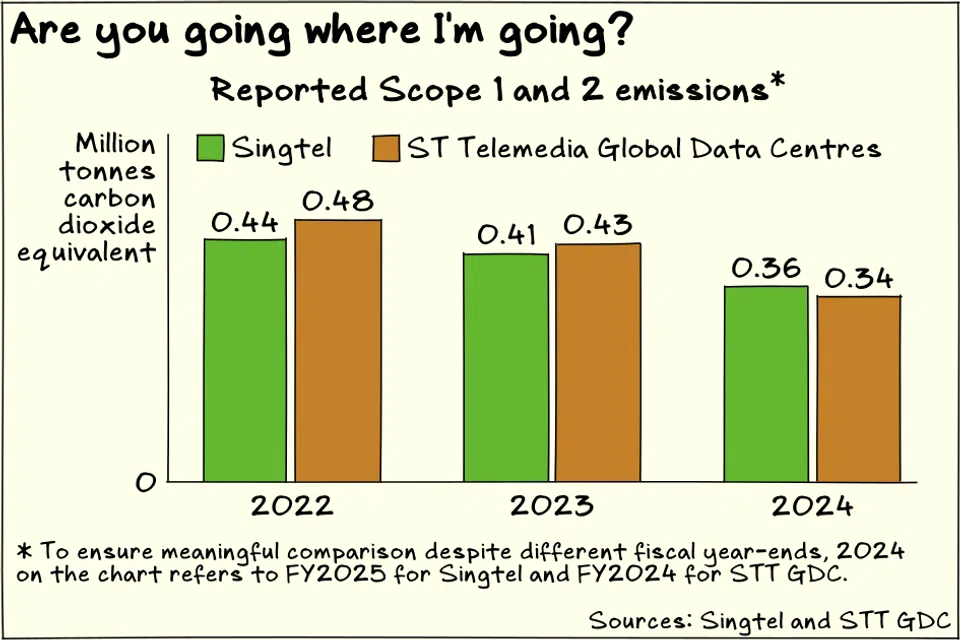
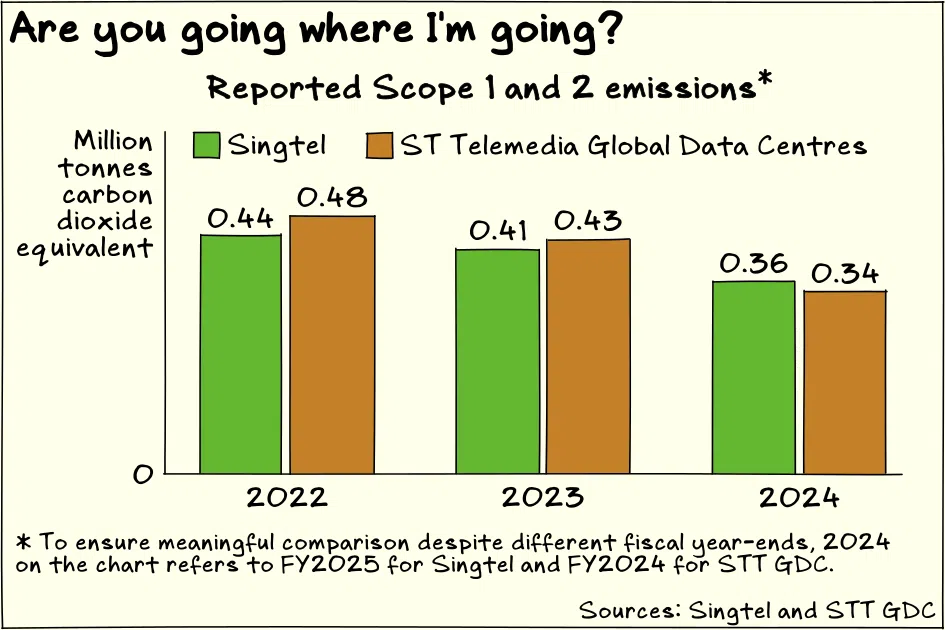
Singtel’s climate targets include a 2030 goal to reduce Scope 1 and 2 emissions by 55 per cent from 2023 levels. Scope 1 emissions are directly generated by the company in its operations, and Scope 2 emissions are generated from purchased electricity. For the year ended March 2025, Singtel reported Scope 1 and 2 emissions of 355,768 tonnes of carbon dioxide equivalent (tCO2e), which was 19.3 per cent below the 2023 baseline.
STT GDC reported Scope 1 and 2 emissions of 336,629 tCO2e for the year ended Dec 31, 2024. That was 22.3 per cent below 2023 levels, which is a sharper reduction than what Singtel posted for the comparable period. Although Singtel’s 25 per cent stake means that it might only consolidate a quarter of STT GDC’s numbers, this addition to the Singtel portfolio would probably nudge Singtel closer to its 2030 target for absolute emissions.
Such a boost could come in handy for Singtel, which has obtained sustainability-linked debt with interest rates that vary with the company’s performance against its emissions targets.
However, sustaining that alignment may require a more holistic review of the two companies’ sustainability approaches.
One issue to address is the companies’ differing commitments to emissions reductions. Singtel is aiming for net zero emissions across its value chain by 2045, a comprehensive, science-based target that not only includes Scope 1 and 2 emissions, but also indirect Scope 3 emissions generated through Singtel’s supply chain.
On the other hand, STT GDC has a narrower goal to achieve carbon neutrality for its data centre operations by 2030. While STT GDC’s 2030 timeframe appears more ambitious than Singtel’s 2045 deadline, STT GDC does not appear to include Scope 3 emissions in its target, even though its Scope 3 emissions are substantial. Without better clarity and alignment, there is a risk that STT GDC could turn from a tailwind into a drag on Singtel’s decarbonisation journey in the coming years.
But improving alignment might be challenging because Singtel will hold only a minority 25 per cent stake in STT GDC, limiting its ability to influence STT’s direction. As the majority owner, KKR will ultimately be the one calling the shots.
Addressing the sustainability issues in the acquisition is economically important for Singtel, not only because it has sustainability-linked borrowings. The company’s hefty investments in improving its sustainability – including obtaining third-party verification that its climate goals are science-based – has earned Singtel inclusion on a number of important sustainability-related rankings and indices. These include the Corporate Knights ranking of the world’s 100 most sustainable corporations in 2025, and a spot in the FTSE4Good index. It pays to maintain access to investors that value sustainability.
Of course, no acquisition is without its risks. Despite potential complexities in aligning the sustainability approaches of Singtel and STT GDC, that STT GDC’s emissions profile is heading in roughly the right direction should give Singtel’s shareholders some comfort.
Carbon pricing
Businesses seek carbon tax relief in Singapore Budget 2026
The business community is looking for changes to the carbon tax as Singapore prepares for its annual fiscal budget.
Singapore Prime Minister and Finance Minister Lawrence Wong announces the government’s 2026 budget on Feb 12 amid an uncertain environment beset by turbulent global politics and trade. While the economy and social policies might take immediate priority, longer-term issues such as the national climate goals remain intact.
One area of uncertainty lies with Singapore’s carbon tax, which currently stands at S$45 per tonne of emissions for 2026 and 2027. Singapore has indicated that the rate will be increased to between S$50 and S$80 per tonne by 2030, but the landing point and the pathway from 2028 to 2030 – and beyond – have not been announced. This budget could be an opportunity to provide that visibility for businesses.
Businesses are asking to pay less.
The Singapore Business Federation (SBF), in a wish list produced with PwC, has called for the 2030 carbon tax rate to land closer to S$50 to reduce operating costs for businesses amid global uncertainties. The business group is also proposing carbon tax vouchers for small- and medium-sized enterprises (SMEs) to cushion the impact of higher electricity prices.
The Singapore Institute of Directors (SID) and KPMG in Singapore are proposing a more fundamental redesign of the carbon tax system to make it more progressive. Such a system would vary tax rates based on emissions volumes, emissions per unit of output and the potential for a sector to abate its emissions – which means that certain sectors that are needed, but for which abatement is not yet feasible, might enjoy lower tax rates. The directors are also suggesting permanent conditional tax rebates for energy-intensive, trade-exposed sectors to preserve competitiveness while incentivising decarbonisation. Such rebates might reward reductions in carbon intensity, investments in low-carbon technology and the implementation of decarbonisation roadmaps.
Related to the carbon tax are carbon credits, which may be used by facilities subject to Singapore’s carbon tax to offset up to 5 per cent of emissions.
SBF recommends raising that offset cap to 10 per cent of emissions to provide flexibility to large emitters and to support the development of Singapore’s carbon trading markets. The organisation further asks for changes to the Goods and Services Tax (GST) treatment and tax claims for carbon credits, to allow carbon credit sellers to recover input costs.
SID asks for renewable energy certificates (RECs) to be exempt from GST, which would make them cheaper to buy. However, SID and KPMG are suggesting that the tax authorities do so by expanding the definition of carbon credits – which are already exempt – to include RECs.
While that might solve one issue, it could create inadvertent confusion elsewhere because carbon credits and RECs have significantly different qualifying criteria and are therefore not interchangeable. For instance, one could not swap a carbon credit with an REC on a carbon exchange, or use an REC to offset emissions.
A reminder, perhaps, that budget wish lists aren’t always easy to fulfil, which is why Budget Day always has some surprises!
We’ll be live blogging the Budget on Feb 12. In the meantime, stay updated with all our Budget 2026 coverage here: bt.sg/budget26
Other ESG reads
- Keppel division bags S$600 million in green projects, raising long-term contracted revenue to S$7.1 billion
- Vicom sets up S$60 million integrated hub to adapt to EVs, complex industrial testing needs
- Malaysia’s Petronas set to sign LNG supply deal with QatarEnergy: sources
- Indonesia coal miners warn of layoffs, economic risks over proposed output cuts
- Less than 50% of companies looking to invest in climate risk management: survey
- Vietnam-Singapore partnership seen as catalyst for scaling sustainable innovation
TRENDING NOW

Cracks emerge in AI borrowing boom as CoreWeave, Oracle and SoftBank debt worries grow

Could stablecoins be the future of money?

‘How many will survive?’: Bubble fears arise as China’s humanoid robotics face reality check

Philippine power giant First Gen rebuffs foreign offers, plans up to US$2.6 billion in expansion

