

Issue 188: Singapore banks face slower growth in sustainable finance; Grab’s confusing dual-class shares
This week in ESG: DBS, OCBC, UOB release sustainability reports; Grab raises CEO’s voting rights

Sustainable finance
Singapore banks’ slower sustainable finance growth
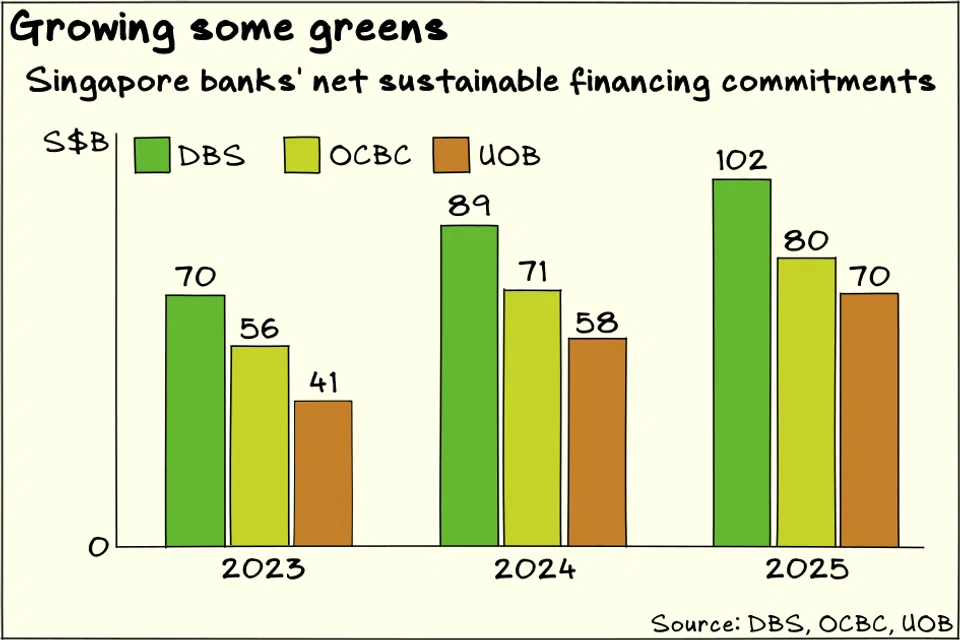
The three Singapore banks’ sustainable loan portfolios grew at a slower pace in 2025 amid a broader slump in the sustainable finance market.
The latest sustainability reports by DBS, OCBC and UOB reveal progress on greening the banks’ loans and growing sophistication in how they approach sustainability, but also some caution about the outlook for financed emissions.
All three banks’ sustainable financing commitments net of repayments grew in 2025. DBS leads the way with S$102 billion of sustainable financing commitments, up about S$13 billion from a year earlier. OCBC’s S$80 billion of commitments as at end-2025 was S$9 billion higher than in 2024. UOB’s S$70 billion portfolio at the end of 2025 grew S$12 billion year-on-year.
Although the sustainable loan portfolios grew, they did so at a slower rate than in 2024. DBS’ net commitments grew 15 per cent in 2025, down from about 27 per cent in 2024. OCBC’s 13 per cent increase in 2025 was less than half of 2024’s 27 per cent expansion. UOB’s portfolio, up 21 per cent in 2025, had a more robust 43 per cent jump in 2024.
The slower growth reflects a lacklustre 2025 for sustainable financing in South-east Asia. Proceeds from new sustainability-aligned loans in South-east Asia slipped 0.8 per cent to US$43 billion in 2025, based on LSEG data. The region’s new sustainability-aligned loan proceeds had grown 28 per cent in 2024.
While the banks’ portfolios seem aligned with the regional new-issue market, the comparison does have limitations. The reported sustainable financing commitments are net of repayments, so they do not fully reflect how much new sustainable financing the banks extended during the year.
In describing the general slowdown in new issuance of sustainable finance, OCBC head of global wholesale banking sustainability office Jeong Yoonmee previously cited a “wait-and-see” approach among corporates as they deal with geopolitical tensions and macroeconomic uncertainties.
Financed progress
The vast majority of greenhouse gas emissions that are impacted by banks are “financed emissions”, which are emissions attributable to the loans that the banks extend.
Each of the three banks has identified a number of priority sectors for which the bank has set decarbonisation targets. All of the banks are on pace or slightly ahead for most or all of their targets. OCBC is on track for all of its six sectors, and UOB for all of its five sectors. DBS is on track for five of seven sectors.
The oil and gas sector, tracked by DBS and OCBC, has seen especially good progress with both banks already ahead of their 2030 goals. DBS financed 20.4 million tonnes of carbon dioxide equivalent (MtCO2e) in the sector in 2025, less than the 22 MtCO2e target for 2030. In fact, DBS has been below its 2030 goal since 2023. OCBC financed 8.8 MtCO2e of emissions in the sector in 2024 to go below its 2030 target of 9.6 MtCO2e. OCBC’s latest financed emissions numbers are for 2024 due to the lag between its own reporting period and the reporting periods of its clients.
The speed with which DBS and OCBC have managed to lower the emissions of their oil and gas portfolio is commendable, but also raises the question of whether the two banks can afford to be more ambitious with their oil and gas goals.
Air, sea struggles
Performance is starkly different in the air and sea transport sectors, where global challenges in securing low-carbon fuel alternatives have stymied decarbonisation at scale.
DBS and OCBC, both of which have aviation as a priority sector, continue to see only modest progress in lowering emissions intensity for air transportation. DBS’ aviation emissions intensity increased slightly to 0.084 kilogrammes of carbon dioxide per passenger kilometre (kgCO2e/p-km) in 2025. OCBC’s aviation emissions improved to 0.09 kgCO2e/p-km from 0.097 kgCO2e/p-km, but that was partly due to a change in the data provider that the bank uses. OCBC says the new data provider offers “a more granular and accurate data source”.
The two banks have also set goals for shipping, where the aim is to have the sector portfolio be aligned or ahead of various decarbonisation pathways. A positive “alignment delta” means that the portfolio is lagging, while a negative delta means the portfolio is ahead. While both banks reported progress – the alignment delta improved for DBS to 24.1 per cent from 28 per cent, and for OCBC to 0.01 per cent from 4.6 per cent – their shipping portfolios remain behind schedule.
Evolving approaches
The banks continue to develop ways to assess sustainability-related risks and opportunities.
All three lenders engaged with the University of Cambridge in 2025 to produce a white paper to develop methodologies to assess nature risk in the food and agriculture sector in South-east Asia. OCBC and UOB also reported building in-house models to assess flood risk in the region.
Those initiatives reflect increasing sophistication about sustainability-related issues. Nature-related assessments in particular are a still-nascent field with complexities in measuring impacts and outcomes. While the banks may be starting by searching for solutions related to risk, as the tools become more developed, they will also enable assessments of nature-related opportunities.
Reporting changes
UOB has changed its sustainability-reporting cycle to more closely match its financed emissions numbers with its financial year, which ends on Dec 31. The bank’s financed emissions figures used to reflect the previous year’s performance – financed emissions numbers in the 2024 sustainability report are for 2023.
With the change, UOB’s reporting period for financed emissions will be June 30 of each year.
UOB also has the odd claim to be the only bank among the three to provide historical annual financed emissions for each of its priority sectors in its report. OCBC used to do it as well, but stopped providing that information in this year’s report.
Historical emissions data has the potential to be especially confusing for investors, because methodologies are constantly being refined, which can make it inappropriate to perform historical comparisons if old and new figures are not measured the same way or if there are restatements.
However, historical trends can also improve understanding by providing context. For example, the emissions intensity of OCBC’s steel portfolio reduced by 12 per cent to 1.7 tonnes of carbon dioxide per tonne of steel (tCO2/t-steel) in 2024, bringing the portfolio back on track after an underperformance in 2023. But a closer look at OCBC’s historical emissions data from previous years’ sustainability reports might temper expectations for the bank to maintain that pace. In 2022, OCBC also lowered emissions intensity in its steel portfolio by 9 per cent to 1.76 tCO2/t-steel, only for the metric to bounce back to 1.91 tCO2/t-steel in 2023.
The banks might find it worthwhile to also build up sophistication in how their sustainability information is communicated to investors.
Corporate governance
Grab’s confusing reasons for voting rights changes
The confusing information that Grab Holdings used to justify strengthening chief executive Anthony Tan’s hold on the business may be as big of an issue as his entrenchment.
Shareholders of Grab, a Singapore-based ride hailing and food delivery platform listed in New York, have approved a resolution to increase the vote-per-share of its Class B shares to 90 from 45. That raises the voting power of the Class B shares to about 74 per cent from 59 per cent. Anthony Tan owns almost four-fifths of the Class B shares, and former executives Tan Hooi Ling and Ming Maa own most of the remainder. Grab’s common Class A shares carry only one vote each.
The exercise appears to be prompted by a plan for Tan Hooi Ling and Maa to convert their Class B shares into Class A shares, which will be done at a 1-to-1 ratio. In a circular to shareholders, Grab explained that the increase in Class B’s voting power will help to ensure that Anthony Tan retains majority voting rights.
Independent observers have raised concerns that the move can entrench Anthony Tan’s grip over the company. To be clear, Tan was already well entrenched in Grab. Tan effectively controlled the entire Class B’s 59 per cent vote share because Tan Hooi Ling and Maa had signed proxy pledges that allow Tan to decide how their shares vote.
The impact of the doubled voting rights is where it gets confusing. Grab has said that, without the proxies, Anthony Tan will control only 46.6 per cent of Grab’s voting power, which is less than a majority. While that number is correct, it’s not as relevant as it might appear for a couple of reasons.
The first is that the proxy agreements exist. The 46.6 per cent figure is therefore meaningless since Anthony Tan will never have just 46.6 per cent of voting power as long as Tan Hooi Ling and Maa own Class B shares.
The second reason is that the whole point of this change is to prepare for Tan Hooi Ling and Maa converting their Class B shares into Class A shares. When that happens, the voting weight of Anthony Tan’s Class B shares will actually go up, and he will in fact continue to control a roughly 53 per cent majority of voting rights based solely on his own Class B shares.
It’s therefore not clear why the Class B shares’ voting rights need to be increased in the first place. Tan Hooi Ling and Maa can convert their stock to common Class A shares at any time, together, and Anthony Tan never loses his majority.
Furthermore, the way that the transactions are timed creates unnecessary risks and complexities. For example, it’s entirely feasible to negotiate with Tan Hooi Ling and Maa and contractually ensure that the conversions are done simultaneously to ensure that Tan’s majority is not jeopardised.
Grab should also have ensured that the Tan Hooi Ling and Maa conversions were carried out immediately once the resolution was passed. But because Grab has pushed to increase the Class B voting rights first, common Class A holders now have depressed voting rights of only about 26 per cent after the change from about 41 per cent before, and will have to wait until Tan Hooi Ling and Maa convert in order to see their collective voting share recover to about 31 per cent. There’s no good reason that Class A holders have to suffer this risk, because Grab should have secured the conversions and made them effective once the resolution passed.
Grab’s other justification for the change was to preserve Anthony Tan’s majority in order to fulfil Monetary Authority of Singapore’s requirements for Singapore ownership for GXS Bank, the digital banking joint venture between Grab and Singtel in which Grab holds a 60 per cent stake. That reason does not hold water, given that the Singapore regulator has pointed out that there are many other ways to meet the requirements.
The biggest beneficiary of the change could well be Anthony Tan, who will now control more than two-thirds of the voting rights of Grab even after the expected Tan Hooi Ling and Maa conversions. That will give him sole power to decide on certain key decisions and corporate actions that require a two-thirds majority, essentially disenfranchising common shareholders for such matters.
Minority shareholders shouldn’t have to navigate such important decisions on their rights with such confusing information. Grab and its independent directors can do better.
Other ESG reads
- Keppel CEO Loh Chin Hua bets on AI, energy transition to drive S$200 billion ambition
- Sembcorp picks banks for A$3 billion Alinta loan in Aussie push
- Sustainable aviation fuel levy deferred to flights departing from Jan 1, 2027, as Gulf conflict drags on: CAAS
- VPBank seeks US$1.2 billion in one of Vietnam’s largest ESG deals
- India delays coal flexibility plan as solar power curbs rise
- Asean energy cooperation ‘more crucial than before’ with global disruption: EMA chief
TRENDING NOW

Once staunchly pro-China, Malaysian Chinese businesses are now distancing themselves from Beijing

Looking beyond looming CEO succession, should UOB potentially pursue a transformative merger?

Could stablecoins be the future of money?

Grab CEO’s wife Chloe Tong on life with Anthony Tan and finding her purpose

